















Sumitomo Chemical to commercialize LFT-LCP grades for crash structure parts

Sumitomo Chemical Advanced Technologies has developed and will soon commercialize a new family of long-fiber thermoplastic (LFT) compounds with high-performance liquid crystal polymer (LCP) matrices reinforced with 13-mm chopped carbon fiber or fiberglass.
The new materials are currently undergoing customer evaluations in several industries and developmental quantities of two grades — SUMIKASUPER SCG-379 with 30-50% fiber-weight fraction (FWF) E-glass and SUMIKASUPER SCG-420 with 30-40% FWF high-modulus carbon fiber.
An LCP matrix and the option for carbon fiber reinforcement will significantly upgrade the thermal and mechanical performance available from LFT technology and the products are being targeted to replace alloys of aluminum and magnesium as well as steel.
Most commercial LCPs are aromatic polyesters characterized by high thermal and mechanical performance, good and inherent flame/smoke/toxicity (FST), good weatherability, good electrical insulation, high resistance to stress cracking, and chemical inertness.
Recently, Sumitomo Chemical introduced the industry’s first chemically soluble LCPs, which were specifically developed to produce films and coatings to protect flexible and rigid electronic components and speaker membranes.
And one especially promising area of research with the new compounds has been molding them into a variety of energy-management structures and then conducting crush tests to see how much energy they absorb before failure.
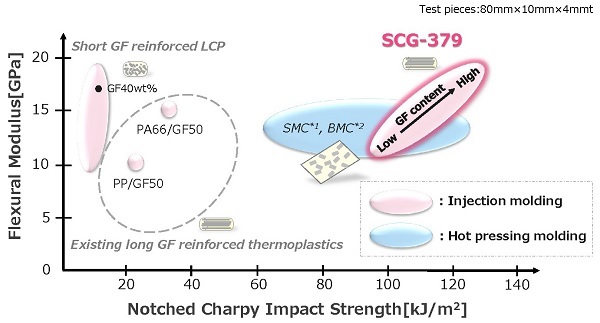
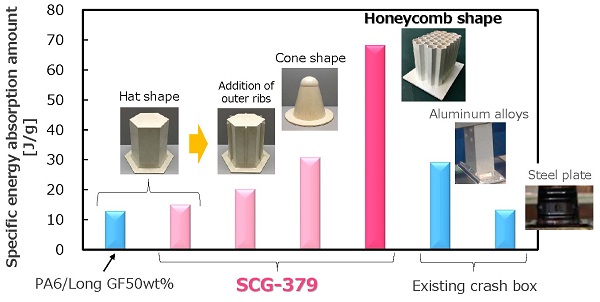
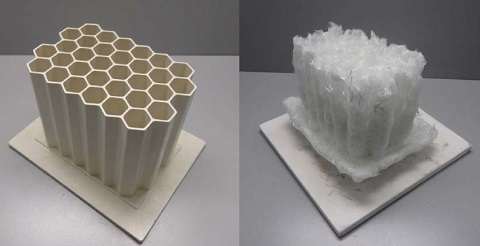
Test results on structures ranging from ribbed hat and cone designs to a variety of honeycombs show the LFT-LCP grades offer very good energy absorption.
Test results on structures ranging from ribbed hat and cone designs to a variety of honeycombs show the LFT-LCP grades offer very good energy absorption, exhibit very-controlled crush characteristics, and produce no sharp shards during ductile failure.
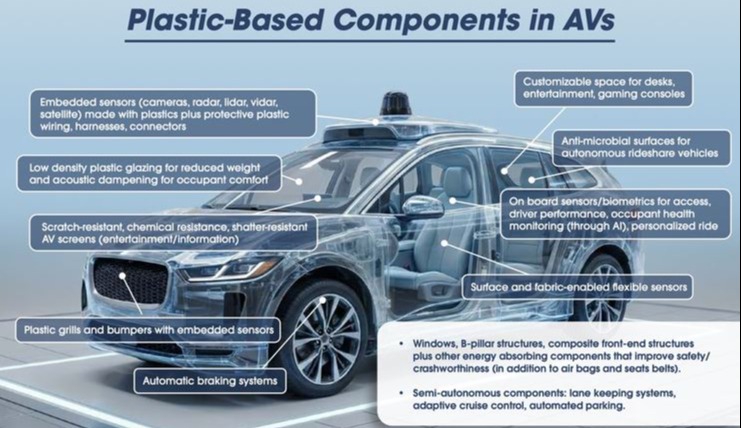
This suggests the materials may be good candidates for crash structures (e.g., bumper crash boxes and rocker and pillar reinforcements) on passenger vehicles.
Owing to their high thermal and broad chemical stability, LCP parts can be mounted to the body-in-white (BIW) during initial vehicle build and travel through the electrophoretic coating (e-coat) lines where rust-prevention coatings are applied to vehicle structures.
Although LCPs do not corrode, the ability to survive e-coat makes it easier to use such materials in chassis structures, since their use does not require changing the way vehicles are assembled.
Other automotive uses could include rails and support structures on sunroof systems and seating components. Outside the automotive industry, high-end sporting goods and industrial uses such as end of arm tooling for robots are also being explored.