









Search History
Clear History
{{item.search_key}}
Hot Searches
Change
{{item.name}}
{{item.english_name}}
Subscribe eNews
Once A Week Once Every Two Weeks
{{sum}}
Login Register

Applications

Beijing Transwest Automation as exclusive Chinese distribution partner of EyeC

No more waste! Turning spoiled milk into 3D printing material

Professtional smart extrusion laminating machine manufacturer

Products

BOLE Machinery introduces EPL injection molding machine for large plastic pallets

AIMPLAS to develop manufacture process for bioplastics from agricultural waste

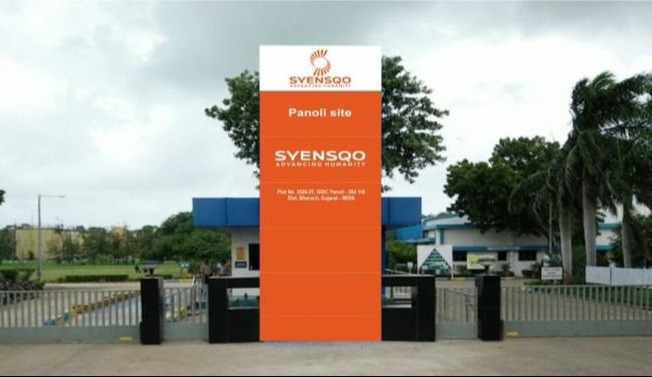
Molding Solutions to open new production facility in India

Activities

  • Fakuma to celebrate 30th anniversary edition in October 2026

  • Italy pavilion at Plast Eurasia proves its rising presence in Turkish market

  • CHINAPLAS 2026: Grand stage for new material, smart manufacturing and green solutions

Pictorial

Industry Topic

ASEAN: The Next Manufacturing Hub

Innovative and Sustainable Packaging

Green Plastics: News & Insights

CHINAPLAS

CHINAPLAS 2025 Focus

CHINAPLAS 2024 Focus

CHINAPLAS 2023 Focus

Exhibition Topic

CHINA INSIGHT

K 2025 FOCUS

Fakuma 2024 Highlights

News Videos

Haitian South China Headquarters opening

BEILIJIA Double Walled Corrugated Pipe Plant

Magnetic mold changing system developed in-house by Shanghai Qiaotian

Conference Videos

【Mandarin session: Webinar playback】SACMI: Your Digitalized Manufacturing, Your Future Today

[Live Replay] LK Group: Smart Manufacturing, New Chapters in Southeast Asia: High-Efficiency Solutions in PET Preform & Thin-Wall Packaging

[Live Replay] Fu Chun Shin (FCS): Data-Driven Digital Rebirth and Intelligent Future of Injection Molding

Corporate/Product Videos

DR-24T Cap Compression Molding Machine

leading solutions for large diameter pipe extrusion

GIENKEE High ConductionE nergy-saving Heater Band Application case for blow molding machine

Exhibition

Playback TECHHUB 2025@CPRJ Live Streaming for CHINAPLAS

Playback TECHHUB@CPRJ Live Streaming for CHINAPLAS

Events

Playback On April 14, the "6th Edition CHINAPLAS x CPRJ Plastics Recycling and Circular Economy Conference and Showcase" at the Crowne Plaza Shenzhen Nanshan is currently being livestreamed!

Playback 5th Edition CHINAPLAS x CPRJ Plastics Recycling and Circular Economy Conference and Showcase

Home > News > Automotive

Let’s talk: Reimaging the future of automotive interiors

Source:Adsale Plastics Network Date :2022-01-26 Editor :Victor Cheng

Have you ever imagined turning a car into a mobile office, an entertainment center or a place for relaxation? The automotive interior concept will be reshaped as the whole automotive industry is reinventing beyond the context of “traditional” vehicle.


With the development of autonomous driving creating a shift in car usage and ownership, the interiors will transform into mobile and multifunctional living space, making the driving experience more than simply getting to the end destination. As such, Covestro is pushing the boundaries of what is possible when traveling in future cars.


Adsale Plastics Network talked to Philipp Möller, Technical Marketing Manager Mobility for APAC region, Engineering Plastics, Covestro, to know more about the key trends identified and the company’s vision for future automotive interiors.
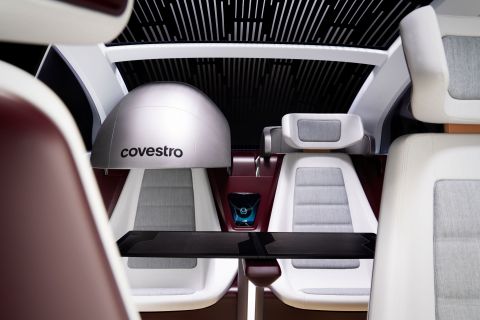

Car Interior Concept_web.jpg

Covestro believes that the future car will be a mobile and multifunctional living space to be integrated into daily life. 


24/7 mobility, seamless connectivity and designed ambience


It is expected that autonomous vehicles (AVs) will not be used by one single user, but instead shared by different people 24 hours a day and seven days a week, which brings higher requirements for design and sturdiness of AVs during constant usage.


In the era of digitalization, people expect a seamless transition in their mobile experience when they are on the road. “The vehicle itself will transform to a smart and connected device, connecting with other devices and vehicles via the internet to exchange data, allowing for work and entertainment as the driver will become a passenger,” said Philipp Möller.


To set the mood and deliver different experience, he expects future interiors to have seamless surfaces, large displays and improved haptics. “Ambient lighting and sensors will be integrated into all aspects of the vehicle, from seating to infotainment panels,” he said.


From the perspective of Covestro, high design freedom and high-quality functional surfaces are the new concepts for next-generation car interiors. They are also key factors for automotive OEMs to set themselves apart in many different ways.


“Let’s imagine for a second. We can daydream while gazing out a panoramic roof, or rotate our seats and turn on ambient lighting for a shared lounge experience with fellow passengers. We can also peer at large and richly animated screens to keep us connected with friends and family when we travel,” added Philipp Möller.
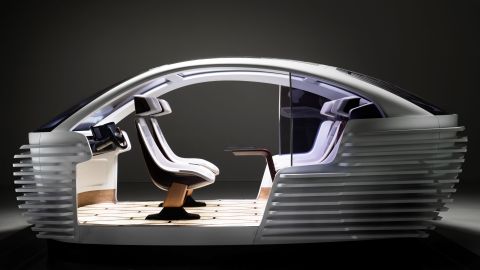

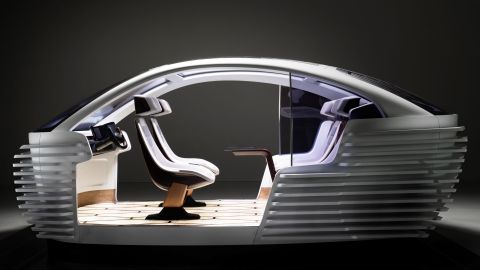
Covestro Concept Car Interior_web.jpg

Interior design of Covestro’s concept car.


Large curved displays and 5G compatible


When it comes to multifunctional displays and control panel for cockpit, Philipp Möller confirmed the trends of larger curved displays as well as greater personalization and privacy.


“As ridesharing becomes more common, we anticipate that personal privacy will increase in importance,” he explained.


Therefore, Covestro provides and works on new polycarbonate offerings for granules and specialty films, aiming to integrate larger displays with complex geometries into dashboards, center consoles and side windows.


The same materials also enable seamless curved displays to have personalized lighting and surfaces with special touch and feel.


The company also provides solutions for holographic films that enable head-up displays (HUDs) to show important information in the driver’s line of sight without blocking it.


While conventional HUDs use only the reflectivity of the windshield, next-generation HUDs that use optical films can include augmented reality (AR) features, showing larger images but reducing the size and energy demand of the projector in the dashboard.


Covestro is now expanding its collaboration with Ceres Holographics, Scotland, to make transparent displays with volume holographic optical elements fit for applications in the automotive industry.


Bayfol HX films from Covestro are the key to Ceres Holographics’ capability to provide high-volume transparent films with light-guiding optical functions for volume holographic display solutions.
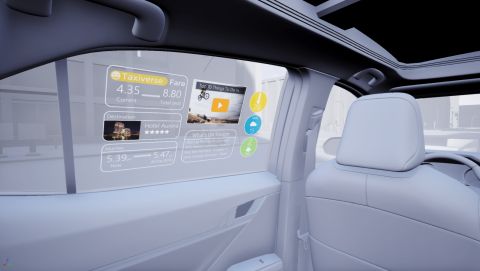
 

holographic-display-solutions-pic_web.jpg

Covestro and Ceres Holographics are expanding their collaboration on holographic transparent display technology. (Photo: Ceres Holographics)


Meanwhile, connected vehicles are expected to be built with 5G receivers and transmitters. Philipp Möller emphasized that in addition to meeting the high transmittance requirements, the materials for 5G applications in these vehicles have to fulfill automotive requirements including impact, weathering and aging tests.


At Covestro, polycarbonate (PC) is the material of choice. PC and PC blends show a superior level of transparency in the relevant electromagnetic range and offer a good homogeneously distribution of those values. Besides, they have no issues with water absorption or warpage, which makes them satisfy tough automotive requirements.


Sustainability has a way to go


Sustainability is another major driver behind the revolution of the automotive industry. “We see a rising demand for more sustainable materials across all industries, and the automotive industry is no exception,” said Philipp Möller.


While reducing emissions is certainly at the top of agenda, he said “fostering circularity is still an even more complex task for the automotive industry.” It is because materials and assembly of current vehicles are not appropriate for recycling.


A typical vehicle contains around 20,000 different parts in mixed materials from steel and aluminum to glass, plastic and rubber. Disassembling and sorting these materials is an enormous effort. Some applications are also not designed to be recycled.


“There is still a long way to go, but it is a way that we want to go together with the value chain, by providing ever more sustainable materials,” remarked Philipp Möller. 


Besides, future regulatory requirements to meet certain threshold of recycled materials will definitely help and push the OEMs to look further into recycled material solutions, he added.


Read more: 

Let’s talk: How advanced composites complement mobility of tomorrow?

 Like 丨  {{details_info.likes_count}}
Automotive
Covestro
 MOTAN TAICANG CO., LTD.      
 GUANGDONG HTASO NEW MATERIALS TECHNOLOGY CO.,LTD      
 CHUZHOU SEP MATERIAL CO,LTD.      

The content you're trying to view is for members only. If you are currently a member, Please login to access this content.   Login

Source:Adsale Plastics Network Date :2022-01-26 Editor :Victor Cheng

Have you ever imagined turning a car into a mobile office, an entertainment center or a place for relaxation? The automotive interior concept will be reshaped as the whole automotive industry is reinventing beyond the context of “traditional” vehicle.


With the development of autonomous driving creating a shift in car usage and ownership, the interiors will transform into mobile and multifunctional living space, making the driving experience more than simply getting to the end destination. As such, Covestro is pushing the boundaries of what is possible when traveling in future cars.


Adsale Plastics Network talked to Philipp Möller, Technical Marketing Manager Mobility for APAC region, Engineering Plastics, Covestro, to know more about the key trends identified and the company’s vision for future automotive interiors.


Car Interior Concept_web.jpg

Covestro believes that the future car will be a mobile and multifunctional living space to be integrated into daily life. 


24/7 mobility, seamless connectivity and designed ambience


It is expected that autonomous vehicles (AVs) will not be used by one single user, but instead shared by different people 24 hours a day and seven days a week, which brings higher requirements for design and sturdiness of AVs during constant usage.


In the era of digitalization, people expect a seamless transition in their mobile experience when they are on the road. “The vehicle itself will transform to a smart and connected device, connecting with other devices and vehicles via the internet to exchange data, allowing for work and entertainment as the driver will become a passenger,” said Philipp Möller.


To set the mood and deliver different experience, he expects future interiors to have seamless surfaces, large displays and improved haptics. “Ambient lighting and sensors will be integrated into all aspects of the vehicle, from seating to infotainment panels,” he said.


From the perspective of Covestro, high design freedom and high-quality functional surfaces are the new concepts for next-generation car interiors. They are also key factors for automotive OEMs to set themselves apart in many different ways.


“Let’s imagine for a second. We can daydream while gazing out a panoramic roof, or rotate our seats and turn on ambient lighting for a shared lounge experience with fellow passengers. We can also peer at large and richly animated screens to keep us connected with friends and family when we travel,” added Philipp Möller.


Covestro Concept Car Interior_web.jpg

Interior design of Covestro’s concept car.


Large curved displays and 5G compatible


When it comes to multifunctional displays and control panel for cockpit, Philipp Möller confirmed the trends of larger curved displays as well as greater personalization and privacy.


“As ridesharing becomes more common, we anticipate that personal privacy will increase in importance,” he explained.


Therefore, Covestro provides and works on new polycarbonate offerings for granules and specialty films, aiming to integrate larger displays with complex geometries into dashboards, center consoles and side windows.


The same materials also enable seamless curved displays to have personalized lighting and surfaces with special touch and feel.


The company also provides solutions for holographic films that enable head-up displays (HUDs) to show important information in the driver’s line of sight without blocking it.


While conventional HUDs use only the reflectivity of the windshield, next-generation HUDs that use optical films can include augmented reality (AR) features, showing larger images but reducing the size and energy demand of the projector in the dashboard.


Covestro is now expanding its collaboration with Ceres Holographics, Scotland, to make transparent displays with volume holographic optical elements fit for applications in the automotive industry.


Bayfol HX films from Covestro are the key to Ceres Holographics’ capability to provide high-volume transparent films with light-guiding optical functions for volume holographic display solutions.


holographic-display-solutions-pic_web.jpg

Covestro and Ceres Holographics are expanding their collaboration on holographic transparent display technology. (Photo: Ceres Holographics)


Meanwhile, connected vehicles are expected to be built with 5G receivers and transmitters. Philipp Möller emphasized that in addition to meeting the high transmittance requirements, the materials for 5G applications in these vehicles have to fulfill automotive requirements including impact, weathering and aging tests.


At Covestro, polycarbonate (PC) is the material of choice. PC and PC blends show a superior level of transparency in the relevant electromagnetic range and offer a good homogeneously distribution of those values. Besides, they have no issues with water absorption or warpage, which makes them satisfy tough automotive requirements.


Sustainability has a way to go


Sustainability is another major driver behind the revolution of the automotive industry. “We see a rising demand for more sustainable materials across all industries, and the automotive industry is no exception,” said Philipp Möller.


While reducing emissions is certainly at the top of agenda, he said “fostering circularity is still an even more complex task for the automotive industry.” It is because materials and assembly of current vehicles are not appropriate for recycling.


A typical vehicle contains around 20,000 different parts in mixed materials from steel and aluminum to glass, plastic and rubber. Disassembling and sorting these materials is an enormous effort. Some applications are also not designed to be recycled.


“There is still a long way to go, but it is a way that we want to go together with the value chain, by providing ever more sustainable materials,” remarked Philipp Möller. 


Besides, future regulatory requirements to meet certain threshold of recycled materials will definitely help and push the OEMs to look further into recycled material solutions, he added.


Read more: 

Let’s talk: How advanced composites complement mobility of tomorrow?

全文内容需要订阅后才能阅读哦~
立即订阅

Recommended Articles

Automotive
Mitsubishi Chemical's bio-based plastic adopted in automotive instrument panels
 2026-01-09
Automotive
India joins low-altitude economy race with world’s biggest sky factory
 2026-01-09
Automotive
Covestro accelerates automotive coatings innovation with Direct Coating
 2025-12-23
Automotive
Chongqing Wolf Chemical launches new PPS for vehicle capacitor
 2025-12-18
Automotive
KruassMaffei supports automotive components manufacturing at Yanfeng
 2025-12-15
Automotive
LG Chem and ZEISS jointly advance photopolymer film supply for HWDs
 2025-12-12

You May Be Interested In

Change

  • People
  • Company
loading... No Content
{{[item.truename,item.truename_english][lang]}} {{[item.company_name,item.company_name_english][lang]}} {{[item.job_name,item.name_english][lang]}}
{{[item.company_name,item.company_name_english][lang]}} Company Name    {{[item.display_name,item.display_name_english][lang]}}  

Polyurethane Investment Medical Carbon neutral Reduce cost and increase efficiency CHINAPLAS Financial reports rPET INEOS Styrolution Evonik Borouge Polystyrene (PS) mono-material Sustainability Circular economy BASF SABIC Multi-component injection molding machine All-electric injection molding machine Thermoforming machine

Let’s talk: Reimaging the future of automotive interiors

识别右侧二维码,进入阅读全文
下载
x 关闭
订阅
亲爱的用户,请填写一下信息
I have read and agree to the 《Terms of Use》 and 《Privacy Policy》
立即订阅
Top
Feedback
Chat
News
Market News
Applications
Products
Video
In Pictures
Specials
Activities
eBook
Front Line
Plastics Applications
Chemicals and Raw Material
Processing Technologies
Products
Injection
Extrusion
Auxiliary
Blow Molding
Mold
Hot Runner
Screw
Applications
Packaging
Automotive
Medical
Recycling
E&E
LED
Construction
Others
Events
Conference
Webinar
CHINAPLAS
CPS+ eMarketplace
Official Publications
CPS eNews
Media Kit
Social Media
Facebook
Linkedin