


















Search History
Clear History
{{item.search_key}}
Hot Searches
Change
{{item.name}}
{{item.english_name}}
Subscribe eNews
Once A Week Once Every Two Weeks
{{sum}}
Log in Register

Applications

COLINES recyclable pouch with ExxonMobil Signature Polymers

Dr. Boy machines to demonstrate high-precision medical components at CHINAPLAS 2026

Market report: Three key application areas boosting upgrades in plastic packaging

Products

Syensqo to show high-performance sustainable solutions at JEC World

Analysis: US-Israel strike on Iran creates uncertainty for China's chemical imports

WITTMANN vertical machine supports efficient automation for complex metal-plastic assemblies

Activities

  • Chinaplas2026 Preview Webinars | Smart Blow Moulding & AI Inspection (FREE)

  • CHINAPLAS 2026: Government blueprint for emerging industries driving new plastics innovation

  • Fakuma to celebrate 30th anniversary edition in October 2026

Pictorial

News Videos

Automatic 5L 120mm neck PET jar blowing machine

YZ-ECO2000-4 6000BPH full automatic 4cavity bottle blowing machine

Opening Ceremony of Bechton's New Factory

Conference Videos

【Mandarin session: Webinar playback】SACMI: Your Digitalized Manufacturing, Your Future Today

[Live Replay] LK Group: Smart Manufacturing, New Chapters in Southeast Asia: High-Efficiency Solutions in PET Preform & Thin-Wall Packaging

[Live Replay] Fu Chun Shin (FCS): Data-Driven Digital Rebirth and Intelligent Future of Injection Molding

Corporate/Product Videos

QINGDAO BOUNI introduction video

PVC-O160-400 Production Line Trial Run Video

PVC-O630 production line testing

Home > News > 3D printing

3D printing a heart: Stanford’s project to bioprint fully functioning human heart

Source:Adsale Plastics Network Date :2023-10-04 Editor :RC
Copyright: Original work. Please do not reprint.

Bioprinting, the 3D printing of living tissue, takes a giant leap forward when a multidisciplinary team from Stanford University received a federal contract to fabricate whole organs from scratch and implanting them in living beings.


Under a new US$26.3 million federal contract from the Advanced Research Projects Agency for Health (ARPA-H), the team aims to bioprint a fully functioning human heart and implant it in a living pig within five years.


What is bioprinting?


The project is pushed forward by the present advancement in stem cell science, the scale of cell production and 3D bioprinting.


Bioprinting is a 3D printing technology that, instead of using plastic or metal, prints living tissues using cell. The key development is that the team can now print cells and blood vessels into those tissues.
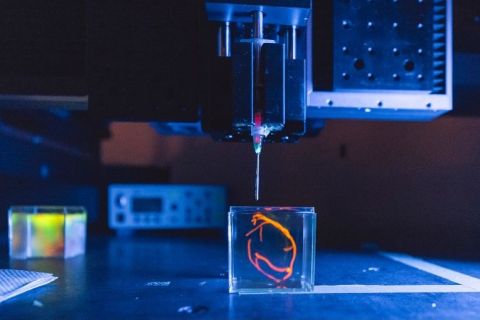

bioprint tissue_480.jpg


A 3D bioprinter prints a sample of heart tissue.


“With vasculature comes the ability to make large and thick tissues that can be implanted and survive,” said Skylar-Scott, assistant professor of bioengineering in the Schools of Engineering and Medicine and principal investigator on the project. “Thus begins the era of organ biofabrication.”


Closer look to the manmade heart


Skylar-Scott explained that the team would use an automated bank of bioreactors to produce different cell types of the heart.


This bank of bioreactors will turn out billions of ventricular and atrial cardiomyocytes, specialized conduction cells that form the Purkinje fibers, nodal cells that are the heart’s pace-making cells and smooth muscle cells, macrophages that support tissue development, and blood vessel endothelial cells to keep the tissue alive.


The principal investigator estimates that the team will be able to generate sufficient cells for a heart every two weeks.


Your own heart made out of your own cells


The team will practice and learn all the design rules of the heart and optimize viability and function at the whole-heart scale for the eventual implantation into a pig.


The bioprinted human heart will be transplanted into a pig with severe congenital immunodeficiency to prevent rejection.


In real person implantation, however, the team’s approach uses patient-specific stem cells, which may not require immunosuppression when transplanted into the same patient.



 Like 丨  {{details_info.likes_count}}
Medical
3D prinitng
 WUHAN CHANGXIN PLASTIC MACHINERY CO.,LTD.      
 DSP CHEMICAL CO.,LTD      
 SHANGHAI JANTON PLASTIC AND CHEMICAL CO.,LTD      
 MOTAN TAICANG CO., LTD.      
 SHANGHAI HUIDE SCIENCE AND TECHNOLOGY CO., LTD.      
 Taizhou Huangyan Zhengwei Mould Co.,Ltd      
 SUZHOU UNIKING NEW MATERIAL CO., LTD      
 Beijing Chemical Industry Group CO.,LTD      
 CHUZHOU SEP MATERIAL CO,LTD.      
 DMAC PRECISION TECHNOLOGY CO.,LTD      

The content you're trying to view is for members only. If you are currently a member, Please login to access this content.   Log in

Source:Adsale Plastics Network Date :2023-10-04 Editor :RC
Copyright: Original work. Please do not reprint.

Bioprinting, the 3D printing of living tissue, takes a giant leap forward when a multidisciplinary team from Stanford University received a federal contract to fabricate whole organs from scratch and implanting them in living beings.


Under a new US$26.3 million federal contract from the Advanced Research Projects Agency for Health (ARPA-H), the team aims to bioprint a fully functioning human heart and implant it in a living pig within five years.


What is bioprinting?


The project is pushed forward by the present advancement in stem cell science, the scale of cell production and 3D bioprinting.


Bioprinting is a 3D printing technology that, instead of using plastic or metal, prints living tissues using cell. The key development is that the team can now print cells and blood vessels into those tissues.


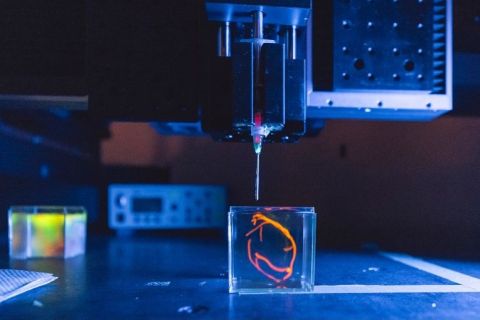
bioprint tissue_480.jpg


A 3D bioprinter prints a sample of heart tissue.


“With vasculature comes the ability to make large and thick tissues that can be implanted and survive,” said Skylar-Scott, assistant professor of bioengineering in the Schools of Engineering and Medicine and principal investigator on the project. “Thus begins the era of organ biofabrication.”


Closer look to the manmade heart


Skylar-Scott explained that the team would use an automated bank of bioreactors to produce different cell types of the heart.


This bank of bioreactors will turn out billions of ventricular and atrial cardiomyocytes, specialized conduction cells that form the Purkinje fibers, nodal cells that are the heart’s pace-making cells and smooth muscle cells, macrophages that support tissue development, and blood vessel endothelial cells to keep the tissue alive.


The principal investigator estimates that the team will be able to generate sufficient cells for a heart every two weeks.


Your own heart made out of your own cells


The team will practice and learn all the design rules of the heart and optimize viability and function at the whole-heart scale for the eventual implantation into a pig.


The bioprinted human heart will be transplanted into a pig with severe congenital immunodeficiency to prevent rejection.


In real person implantation, however, the team’s approach uses patient-specific stem cells, which may not require immunosuppression when transplanted into the same patient.



全文内容需要订阅后才能阅读哦~
立即订阅

Recommended Articles

3D printing
Toray Toraypearl spherical PA12 powder for 3D printing
 2026-03-02
3D printing
No more waste! Turning spoiled milk into 3D printing material
 2026-01-13
3D printing
3D-printed sculptural coffee table with bio-based transparent polyamide
 2025-11-28
3D printing
Formnext: Modular 3D printing solution for large-format components from KraussMaffei
 2025-11-11
3D printing
Arburg withdraws from 3D printing business
 2025-09-15
3D printing
Stratasys and Shin Etsu launch silicone material for industrial 3D printing
 2025-07-23

You May Be Interested In

Change

  • People
  • Company
loading... No Content
{{[item.truename,item.truename_english][lang]}} {{[item.company_name,item.company_name_english][lang]}} {{[item.job_name,item.name_english][lang]}}
{{[item.company_name,item.company_name_english][lang]}} Company Name    {{[item.display_name,item.display_name_english][lang]}}  

Polyurethane Investment Medical Carbon neutral Reduce cost and increase efficiency CHINAPLAS Financial reports rPET INEOS Styrolution Evonik Borouge Polystyrene (PS) mono-material Sustainability Circular economy BASF SABIC Multi-component injection molding machine All-electric injection molding machine Thermoforming machine

3D printing a heart: Stanford’s project to bioprint fully functioning human heart

识别右侧二维码,进入阅读全文
下载
x 关闭
订阅
亲爱的用户,请填写一下信息
I have read and agree to the 《Terms of Use》 and 《Privacy Policy》
立即订阅
Top
Feedback
Chat
News
Market News
Applications
Products
Video
In Pictures
Specials
Activities
eBook
Front Line
Plastics Applications
Chemicals and Raw Material
Processing Technologies
Products
Injection
Extrusion
Auxiliary
Blow Molding
Mold
Hot Runner
Screw
Applications
Packaging
Automotive
Medical
Recycling
E&E
LED
Construction
Others
Events
Conference
Webinar
CHINAPLAS
CPS+ eMarketplace
Official Publications
CPS eNews
Media Kit
Social Media
Facebook
Linkedin