

















Pioneering BOY injection molding machine with DC network at Fakuma 2023

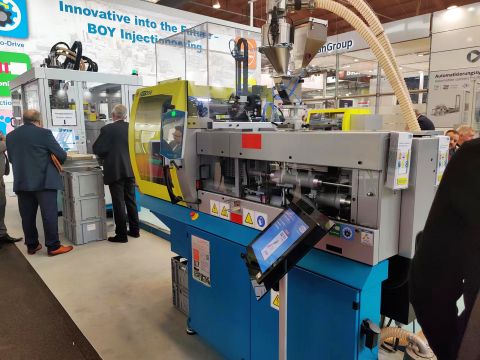
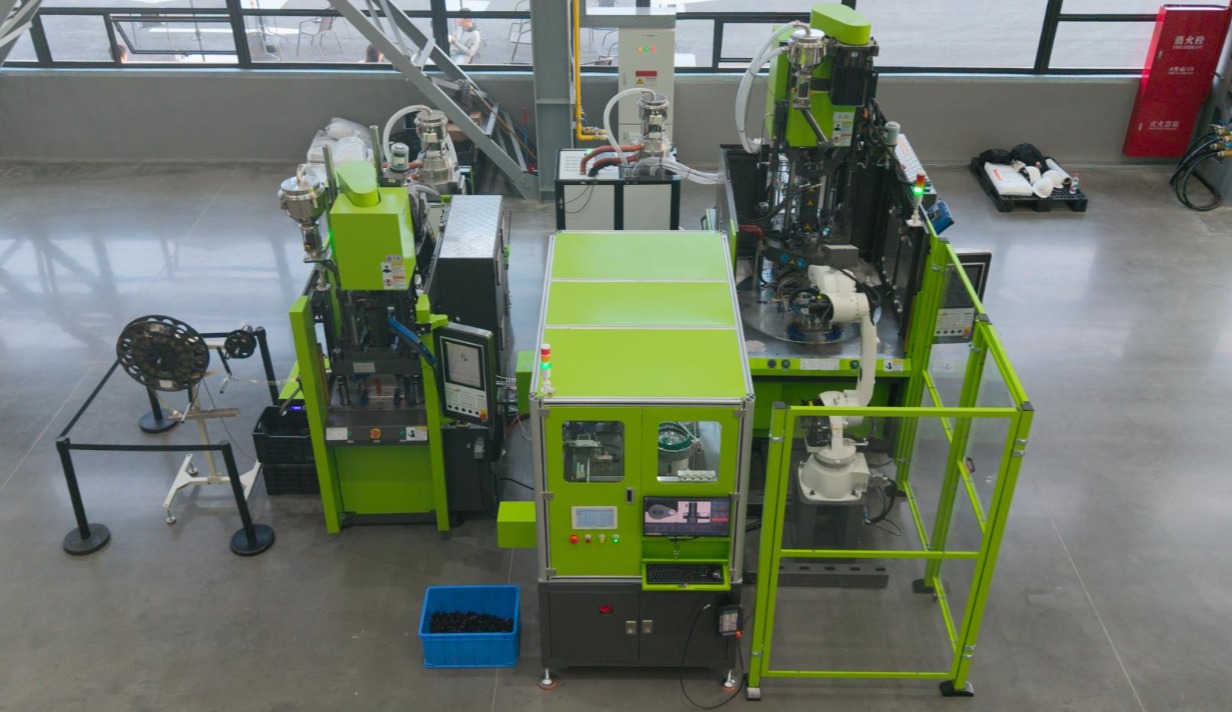
The injection molding machine manufacturer, Dr. Boy GmbH & Co. KG, presented many highlights at Fakuma 2023, including the BOY 35 E with electric removal handling operated by a 650V DC network.
The machine was one of the only two injection molding machines operated by pioneering DC technology at the fairgrounds.
Efficient utilization of renewable energy in the production process is becoming more important. One way of increasing efficiency is setting up a direct current (DC) network, which means machines are not using the usual alternating current (AC) but an independent DC system, in the production facility.

The stand of BOY at Fakuma 2023.
Energy loss reduced with no further conversion
The system is fed via an Active Front End (AFE), which is connected to the standard 3-phase 400V AC-network. After active input conversion with integrated stabilization, a DC network with a voltage of 560 to 840 VDC is available. The AFE automatically provides a feed-in and feed-back direction, both ways have the same high degree of efficiency.
An additional buffering can be created with battery systems. Photovoltaic (PV) systems or other energy generation systems can then be integrated directly into the system without energy loss resulting from the conversion of direct current (PV system) to alternating current to direct current (intermediate circuit).
In comparison with conventional production machines, conversions can be saved as the converters are powered directly with the intermediate circuit voltage. This saves energy and improves electromagnetic compatibility (EMC). Braking energy is also used to charge the battery instead of converting it into heat via a braking resistor.

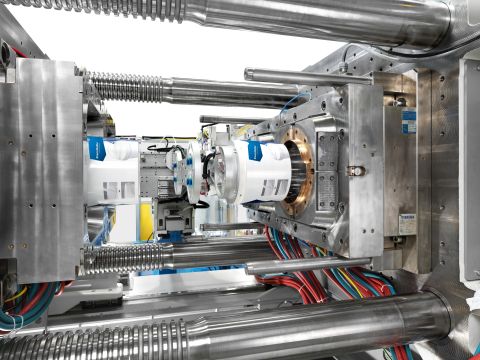
The BOY 35 E injection molding machine operated by a DC network at BOY’s stand.
Power peaks and downtimes minimized
Besides, DC network protects the supply network as no idle power is generated. Power peaks are also minimized. In areas with unstable power supply, network fluctuations and short-term breakdowns can be bypassed, preventing machine damage and production downtimes.
“Our servo-hydraulic range is well positioned to offer energy-efficient injection molding solutions. With DC-technology, we further can improve the high energy efficiency of our machines by another big step; the driving energy can be reduced by up to 15% in DC operation,” said Martin Kaiser, BOY's Technical Manager.
“This is an innovative way to make the company's energy supply more secure," added Thomas Kühr, Head of Electrical Design at BOY.