








Search History
Clear History
{{item.search_key}}
Hot Searches
Change
{{item.name}}
{{item.english_name}}
Subscribe eNews
Once A Week Once Every Two Weeks
{{sum}}
Login Register

Applications

Trinseo and RWDC jointly develop PHA dispersions for barrier coatings

US-ASEAN Business Council: Regional alignment is core to accelerate Southeast Asia’s circular economy

Franplast introduces biocompatible TPEs for medical sector

Products

WACKER opens technology center for specialty silanes in China

ENGEL opens clearmelt-Competence-Center for PUR projects

EuCIA launches Carbon Fiber Europe alliance

Activities

  • Fakuma to celebrate 30th anniversary edition in October 2026

  • Italy pavilion at Plast Eurasia proves its rising presence in Turkish market

  • CHINAPLAS 2026: Grand stage for new material, smart manufacturing and green solutions

Pictorial

Industry Topic

ASEAN: The Next Manufacturing Hub

Innovative and Sustainable Packaging

Green Plastics: News & Insights

CHINAPLAS

CHINAPLAS 2025 Focus

CHINAPLAS 2024 Focus

CHINAPLAS 2023 Focus

Exhibition Topic

K 2025 FOCUS

CHINA INSIGHT

Fakuma 2024 Highlights

News Videos

Magnetic mold changing system developed in-house by Shanghai Qiaotian

Xiamen LFT Composite's plastic solutions as alternative to steel

Ausell highlights car-to-car closed-loop recycling technology

Conference Videos

【Mandarin session:Webinar playback】HUSKY: Molding the Future of Drug Delivery: Solutions for the Evolving Autoinjector

[Live Replay] Star Plastics: A Global Solution Provider of Sustainable Material for Your Circular Economy.

[Live Replay] Wanhua Chemical: Green Horizons, Health Guardians - Advancing ESG and Low-Carbon Transition, Innovating Medical Material Solutions

Corporate/Product Videos

ARBURG new electric machine – ALLROUNDER TREND will start mass production in Pinghu, Zhejiang in 2026.

Jiangsu Liside New Material Co., Ltd.

Dow 45 years in China

Exhibition

Playback TECHHUB 2025@CPRJ Live Streaming for CHINAPLAS

Playback TECHHUB@CPRJ Live Streaming for CHINAPLAS

Events

Playback On April 14, the "6th Edition CHINAPLAS x CPRJ Plastics Recycling and Circular Economy Conference and Showcase" at the Crowne Plaza Shenzhen Nanshan is currently being livestreamed!

Playback 5th Edition CHINAPLAS x CPRJ Plastics Recycling and Circular Economy Conference and Showcase

Home > News > Focus

(Interview) CEO at Global Impact Coalition: Enabling net-zero transformation through collaboration

Source:Adsale Plastics Network Date :2024-02-19 Editor :VC
Copyright: This article was originally written/edited by Adsale Plastics Network (AdsaleCPRJ.com), republishing and excerpting are not allowed without permission. For any copyright infringement, we will pursue legal liability in accordance with the law.

With the focus on upscaling of low-carbon emissions technologies for the chemical industry on its path to net-zero emissions by 2050, seven global chemical companies found the Global Impact Coalition (GIC) in September last year.


The Low-Carbon Emitting Technologies (LCET) initiative was first incubated within World Economic Forum (WEF) in 2019, then was spun off and re-branded as the Global Impact Coalition in September 2023.


The CEO-led Coalition was officially launched in Switzerland as an independent entity by seven of the largest global chemical companies including BASF, SABIC, Covestro, Clariant, LyondellBasell, Mitsubishi Chemical, and Solvay (now Syensqo).


Notably, the members pay a yearly membership fee to the GIC, ensuring that all aspects of project ideation cycles and delivery can be well managed.


The Coalition is looking at other new ways that members can use the organization to deploy impact funding, such as through a venture creation and accelerator arm that can also serve to complement existing GIC project development.


In an interview, CPRJ talked with Charlie Tan, CEO, Global Impact Coalition, to know more about the big ambitions and impactful projects of the Coalition.


Charlie Tan_230.jpg

Charlie Tan, CEO, Global Impact Coalition.


Independence allows higher governance and efficiency


“The goal was always to become independent from the WEF. It was important that we developed our own governance structures, budget models, and operating frameworks to allow us to be as efficient and value focused as possible,” Charlie Tan told CPRJ about the reasons why an independent coalition was needed.


As the chemical industry strives for net-zero emissions, industry transformation be that in new business model creation, or new technological innovation, is “less of a path and more of a maze”, he said. “Some forms of collaboration will work, and some will not. We are here to figure out both.”


“In the early days, the WEF provided us with a trusted environment to build strong foundations for what collective action under the LCET initiative could look like. During the period, we were also able to demonstrate that the LCET (now GIC) concept was working through the development and launch of initial projects,” he added.


The rationale is understood, but why now. Tan continued, “True transformation takes time. There is no overnight success, and we do not want the chemical industry to fall behind the curve, in terms of collaborating.”


He underscored that trust, a crucial factor to build foundations for collective transformation, has been established, and it is the time to move from “context to action”. 


The mutual relationship between the GIC and WEF remains strong after the spin-off. “Even if we have ‘left the building’, we are still very much ‘neighbors’ with the WEF,” he said.


The two organizations are currently working on various other forms of partnership together. For example, the WEF is doing a lot in the space of industrial clusters on a global scale, and the GIC or its projects might serve as a model for how industrial clusters can form special partnerships and collaborations to make tangible impact.


Moving tangible projects in full swing


The GIC is already moving projects ahead. Two of the leading projects come from Coalition member companies: R&D Hub for Plastic Waste Processing, and another example of member company project is the Electrically Heated Steam Cracker Furnace.


The R&D Hub for Plastic Waste Processing focuses on developing new technologies for waste processing with a lower CO2 footprint and greater levels of plastic waste recycling.


The Electrically Heated Steam Cracker Furnace project is the collaboration to construct the world’s first demonstration plant for large-scale electrically heated steam cracker furnaces.


Cracker-furnace_updated_480.jpg

Building the world’s first demonstration plant for large-scale e-furnaces is a great example of a collaboration project by some of the GIC member companies.


On why recycling was identified as a field of interest, Tan explained that currently less than 10% of the 400 million tons of plastic produced annually is being recycled, so ensuring constant innovations in new technologies for waste processing is pivotal from GIC’s perspective. 


The R&D Hub was found and co-funded by seven Coalition member companies, which are BASF, SABIC, LyondellBasell, Mitsubishi Chemical, Syensqo, Covestro, and Dow. The project was one of the Coalition’s first successful spinoffs, and it is now hosted by TNO, a leading research institute based in Europe.


“We have some exciting projects coming out of the pipeline already, and this is a sustained and ongoing commitment by the founding companies,” Tan said when talking about the progress. “The projects are aimed at making significant strides towards more sustainable waste processing practices and targeted technologies to increase waste suitable for recycling.”


He also unveiled four specific technologies the projects are now focusing:

- sensing for sorting;

- polymer/inorganic separation at mm-scale;

- polymer/inorganic separation at um-scale;

- enhanced solvolysis for composite recycling.


Meanwhile, the project of building the demonstration plant for electrically heated steam cracker furnaces is an example of collaboration between Coalition member companies BASF and SABIC, and engineering firm Linde.


Using electricity from renewable sources instead of natural gas in one of the most energy-intensive production processes in the chemical industry can reduce significant amount of CO2 emissions.


“Construction of the demonstration plant is in full swing,” remarked Tan. According to him, the new technology has the potential to reduce CO2 emissions by at least 90% compared to technologies commonly used today.


“This is a great example of a project borne from GIC member companies. The GIC, through partnership with the Boston Consulting Group, works with members on a continuous basis to develop such groundbreaking projects as the e-furnace,” he said.


The Coalition has regular ideation sessions where industry pain points and respective areas of opportunity and collaboration to drive net zero objectives are assessed.
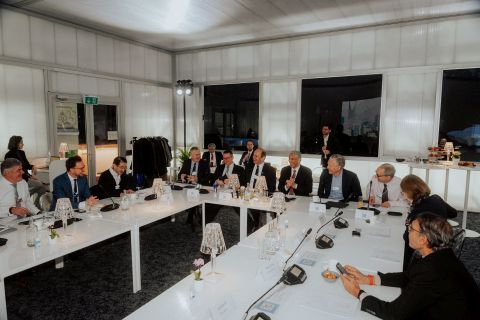

GIC meeting_480.jpg

The Coalition holds regular meetings to identify and solve industry pain points.


“Growth through collaboration” points the way


As importantly, is the chemical industry progressing well in achieving net-zero emissions?


“I do think that in general, chemical companies are moving to a new, multifunctional, more collaborative form of R&D, where growth depends on their capacity to engage with the outside world,” said Tan. “Innovation spend is also strong, with listed chemical companies spending around 2.4% of revenues on R&D, which is significant.”


From his point of view, “growth through collaboration” really needs to be the blueprint to follow while the industry is pushing forward with net-zero commitments for a successful sustainability journey.   


Tan also thinks that challenges of the green transition, if tackled, also create opportunities. “In this case, I would say that people enablement, innovation outside of the core business model, and reinforcing processes & structures to simplify external collaboration are all crucial to ensure the future of innovation as we drive towards net zero.”


As the CEO of a green venture, when asked to comment on greenwashing disputes, Tan said, “We are living in a moment where climate priorities are almost living in the shadows of current geopolitical tensions, inflation, supply chain disruptions, and so on.”


“However, it is also a time of heightened awareness among consumers and regulatory bodies about the need for transparency and accountability in environmental claims.”


Potentially, one of the offerings of GIC can be to help the chemical industry with standard setting, and to communicate transparently about their efforts, concluded the GIC’s CEO.

 Like 丨  {{details_info.likes_count}}
Chemical raw material
Recycling
Carbon neutral
 SACMI (SHANGHAI) MACHINERY EQUIPMENT CO., LTD.      
 HANGZHOU JUHESHUN NEW MATERIAL CO., LTD.      
 Rongsheng Petrochemical Co., Ltd.      
 GUANGXI WUZHOU GUOLONG RECYCLABE RESOURCES DEVELOPMENT CO., LTD.      
 ANHUI ZHONGXIN HONGWEI TECHNOLOGY CO.,LTD      

The content you're trying to view is for members only. If you are currently a member, Please login to access this content.   Login

Source:Adsale Plastics Network Date :2024-02-19 Editor :VC
Copyright: This article was originally written/edited by Adsale Plastics Network (AdsaleCPRJ.com), republishing and excerpting are not allowed without permission. For any copyright infringement, we will pursue legal liability in accordance with the law.

With the focus on upscaling of low-carbon emissions technologies for the chemical industry on its path to net-zero emissions by 2050, seven global chemical companies found the Global Impact Coalition (GIC) in September last year.


The Low-Carbon Emitting Technologies (LCET) initiative was first incubated within World Economic Forum (WEF) in 2019, then was spun off and re-branded as the Global Impact Coalition in September 2023.


The CEO-led Coalition was officially launched in Switzerland as an independent entity by seven of the largest global chemical companies including BASF, SABIC, Covestro, Clariant, LyondellBasell, Mitsubishi Chemical, and Solvay (now Syensqo).


Notably, the members pay a yearly membership fee to the GIC, ensuring that all aspects of project ideation cycles and delivery can be well managed.


The Coalition is looking at other new ways that members can use the organization to deploy impact funding, such as through a venture creation and accelerator arm that can also serve to complement existing GIC project development.


In an interview, CPRJ talked with Charlie Tan, CEO, Global Impact Coalition, to know more about the big ambitions and impactful projects of the Coalition.


Charlie Tan_230.jpg

Charlie Tan, CEO, Global Impact Coalition.


Independence allows higher governance and efficiency


“The goal was always to become independent from the WEF. It was important that we developed our own governance structures, budget models, and operating frameworks to allow us to be as efficient and value focused as possible,” Charlie Tan told CPRJ about the reasons why an independent coalition was needed.


As the chemical industry strives for net-zero emissions, industry transformation be that in new business model creation, or new technological innovation, is “less of a path and more of a maze”, he said. “Some forms of collaboration will work, and some will not. We are here to figure out both.”


“In the early days, the WEF provided us with a trusted environment to build strong foundations for what collective action under the LCET initiative could look like. During the period, we were also able to demonstrate that the LCET (now GIC) concept was working through the development and launch of initial projects,” he added.


The rationale is understood, but why now. Tan continued, “True transformation takes time. There is no overnight success, and we do not want the chemical industry to fall behind the curve, in terms of collaborating.”


He underscored that trust, a crucial factor to build foundations for collective transformation, has been established, and it is the time to move from “context to action”. 


The mutual relationship between the GIC and WEF remains strong after the spin-off. “Even if we have ‘left the building’, we are still very much ‘neighbors’ with the WEF,” he said.


The two organizations are currently working on various other forms of partnership together. For example, the WEF is doing a lot in the space of industrial clusters on a global scale, and the GIC or its projects might serve as a model for how industrial clusters can form special partnerships and collaborations to make tangible impact.


Moving tangible projects in full swing


The GIC is already moving projects ahead. Two of the leading projects come from Coalition member companies: R&D Hub for Plastic Waste Processing, and another example of member company project is the Electrically Heated Steam Cracker Furnace.


The R&D Hub for Plastic Waste Processing focuses on developing new technologies for waste processing with a lower CO2 footprint and greater levels of plastic waste recycling.


The Electrically Heated Steam Cracker Furnace project is the collaboration to construct the world’s first demonstration plant for large-scale electrically heated steam cracker furnaces.


Cracker-furnace_updated_480.jpg

Building the world’s first demonstration plant for large-scale e-furnaces is a great example of a collaboration project by some of the GIC member companies.


On why recycling was identified as a field of interest, Tan explained that currently less than 10% of the 400 million tons of plastic produced annually is being recycled, so ensuring constant innovations in new technologies for waste processing is pivotal from GIC’s perspective. 


The R&D Hub was found and co-funded by seven Coalition member companies, which are BASF, SABIC, LyondellBasell, Mitsubishi Chemical, Syensqo, Covestro, and Dow. The project was one of the Coalition’s first successful spinoffs, and it is now hosted by TNO, a leading research institute based in Europe.


“We have some exciting projects coming out of the pipeline already, and this is a sustained and ongoing commitment by the founding companies,” Tan said when talking about the progress. “The projects are aimed at making significant strides towards more sustainable waste processing practices and targeted technologies to increase waste suitable for recycling.”


He also unveiled four specific technologies the projects are now focusing:

- sensing for sorting;

- polymer/inorganic separation at mm-scale;

- polymer/inorganic separation at um-scale;

- enhanced solvolysis for composite recycling.


Meanwhile, the project of building the demonstration plant for electrically heated steam cracker furnaces is an example of collaboration between Coalition member companies BASF and SABIC, and engineering firm Linde.


Using electricity from renewable sources instead of natural gas in one of the most energy-intensive production processes in the chemical industry can reduce significant amount of CO2 emissions.


“Construction of the demonstration plant is in full swing,” remarked Tan. According to him, the new technology has the potential to reduce CO2 emissions by at least 90% compared to technologies commonly used today.


“This is a great example of a project borne from GIC member companies. The GIC, through partnership with the Boston Consulting Group, works with members on a continuous basis to develop such groundbreaking projects as the e-furnace,” he said.


The Coalition has regular ideation sessions where industry pain points and respective areas of opportunity and collaboration to drive net zero objectives are assessed.


GIC meeting_480.jpg

The Coalition holds regular meetings to identify and solve industry pain points.


“Growth through collaboration” points the way


As importantly, is the chemical industry progressing well in achieving net-zero emissions?


“I do think that in general, chemical companies are moving to a new, multifunctional, more collaborative form of R&D, where growth depends on their capacity to engage with the outside world,” said Tan. “Innovation spend is also strong, with listed chemical companies spending around 2.4% of revenues on R&D, which is significant.”


From his point of view, “growth through collaboration” really needs to be the blueprint to follow while the industry is pushing forward with net-zero commitments for a successful sustainability journey.   


Tan also thinks that challenges of the green transition, if tackled, also create opportunities. “In this case, I would say that people enablement, innovation outside of the core business model, and reinforcing processes & structures to simplify external collaboration are all crucial to ensure the future of innovation as we drive towards net zero.”


As the CEO of a green venture, when asked to comment on greenwashing disputes, Tan said, “We are living in a moment where climate priorities are almost living in the shadows of current geopolitical tensions, inflation, supply chain disruptions, and so on.”


“However, it is also a time of heightened awareness among consumers and regulatory bodies about the need for transparency and accountability in environmental claims.”


Potentially, one of the offerings of GIC can be to help the chemical industry with standard setting, and to communicate transparently about their efforts, concluded the GIC’s CEO.

全文内容需要订阅后才能阅读哦~
立即订阅

Recommended Articles

Focus
K Topic: How digitalization and AI advance the plastics sector?
 2025-07-14
Focus
CHINAPLAS welcomes 180,000 visitors on Day 1&2! Smart manufacturing and sustainability on fast track
 2025-04-17
Focus
Top 10 Technology Trends in Plastics and Rubber in 2025 awards announced
 2025-04-16
Focus
Report: EUBP 2024 market data on global bioplastics
 2024-12-13
Focus
Report: Global electricity demand for EVs expected to skyrocket 630% by 2030
 2024-06-18
Focus
Survey: What are the outlook and trends of Chinese plastics industry going global?
 2024-04-24

You May Be Interested In

Change

  • People
  • Company
loading... No Content
{{[item.truename,item.truename_english][lang]}} {{[item.company_name,item.company_name_english][lang]}} {{[item.job_name,item.name_english][lang]}}
{{[item.company_name,item.company_name_english][lang]}} Company Name    {{[item.display_name,item.display_name_english][lang]}}  

Polyurethane Investment Medical Carbon neutral Reduce cost and increase efficiency CHINAPLAS Financial reports rPET INEOS Styrolution Evonik Borouge Polystyrene (PS) mono-material Sustainability Circular economy BASF SABIC Multi-component injection molding machine All-electric injection molding machine Thermoforming machine

(Interview) CEO at Global Impact Coalition: Enabling net-zero transformation through collaboration

识别右侧二维码,进入阅读全文
下载
x 关闭
订阅
亲爱的用户,请填写一下信息
I have read and agree to the 《Terms of Use》 and 《Privacy Policy》
立即订阅
Top
Feedback
Chat
News
Market News
Applications
Products
Video
In Pictures
Specials
Activities
eBook
Front Line
Plastics Applications
Chemicals and Raw Material
Processing Technologies
Products
Injection
Extrusion
Auxiliary
Blow Molding
Mold
Hot Runner
Screw
Applications
Packaging
Automotive
Medical
Recycling
E&E
LED
Construction
Others
Events
Conference
Webinar
CHINAPLAS
CPS+ eMarketplace
Official Publications
CPS eNews
Media Kit
Social Media
Facebook
Linkedin