














Raising the bar in recycling quality and efficiency

To promote the application of recycled plastics to a higher level of added value and quantity, the product quality and recycling efficiency need to be further improved. Recycling equipment and technology suppliers are consequently continuous innovating for such goal. At CHINAPLAS 2024, the remarkable progress achieved is showcased.
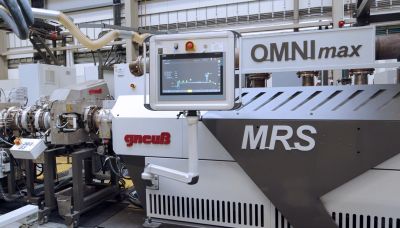
Gneuss’ new range of OMNI machines for closed-loop recycling
Typical applications for the OMNI recycling machines from Gneuss (Booth: 2.1H26) include the processing of PET scrap into high-quality end products such as thermoformed sheet (suitable for food contact), staple fiber, POY, FDY, BCF and strapping. In addition, a wide range of raw materials such as PS, PP, PE, PLA can be recycled.
The OMNI series is also used in the decontamination of post-consumer waste for production of direct food contact products such as HDPE bottle caps and coffee caps, as well as for odor reduction and degassing of PA, SAN or other polymers.
In addition to its compact design, the OMNI series scores highly in terms of flexibility. The fully automatic control of vacuum, extruder, dosing, degassing time, and filter change ensures a consistently high quality of the end products.
The compact design also results in very low energy consumption as energy used in the extrusion process is designed to be used in the next process step. This not only has a noticeable effect on electricity and gas consumption, but also significantly reduces the CO2 footprint of the recycling process.
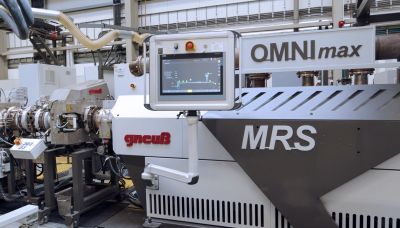
The MRS extruder is based on conventional single screw technology but is equipped with a multiple screw section for devolatilization. It enables very efficient and gentle decontamination of the polymer melt, whilst achieving the requirements for direct food contact standards.
The extruder allows the processing of rPET directly into high-quality end products without pre-drying by using a simple and rugged vacuum system. The satellite screws rotate in the opposite direction to the main screw, which disproportionately increases the surface exchange of the polymer melt.
Gneuss’ top model, the RSFgenius, operates with an integrated back-flushing system offering self-cleaning for very demanding applications. Screens can be automatically re-used up to 400 times and filtration finenesses below 10 microns/1200 mesh are available.
There is a RSFgenius 150 on display at Gneuss’ booth, with an active screen area of 450 cm2/70 square inches, for 1000 kg/h (2.200 lbs) of R-PET with a filtration fineness of 75 microns (200 mesh).
EREMA’s VACUREMA technology well-proven for PET recycling
Bottle systems manufactured by EREMA (Booth: 2.1C55) have been proving for efficient processing of PET waste. Almost half of the bottle systems delivered in last three years have been installed in Asia.
The central element is the VACUREMA technology, which the recycling machine manufacturer is continuously developing further. Over 400 PET systems for food grade are in use worldwide and achieve a total capacity of more than four million tons per year.
In order to produce food compliant, visually flawless rPET pellets from input material of varying quality, reliable recycling performance is required. The key advantage of VACUREMA systems lies in the SafeFlake technology in the vacuum reactor. It combines decontamination, drying and IV treatment and effectively removes moisture and migratory substances before extrusion. This prevents hydrolytic and oxidative degradation of the melt in the extruder.
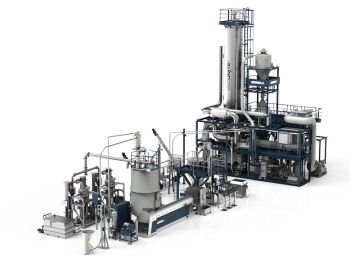
Together with Polymetrix, EREMA has further developed the proven VACUREMA process to include vacuum-assisted SSP in a nitrogen atmosphere. All thermal process steps take place with nitrogen and/or vacuum. Decontamination at the beginning and end of the processing sequence means maximum safety and quality. Another advantage is the improved color values.
In addition to the food sector, food-grade rPET is playing a growing role in the textile industry. Well-known brands are increasingly focusing on rPET that meets the requirements for food grade to offer customers sustainable textiles that are harmless to health. This trend is reflected at EREMA in the increasing sales of bottle-to-fibre applications.