


CEO Dialogues: ENGEL capitalizes on emerging trends to inject momentum into growth

The plastics industry continues to present a range of opportunities. Two significant avenues are the growing demand for sustainable materials and the continuous transition to smart manufacturing. Industries like new energy, automotive, and medical rely on advanced plastics and efficient processing to develop. Emerging regional markets have also opened doors for expansion of companies.
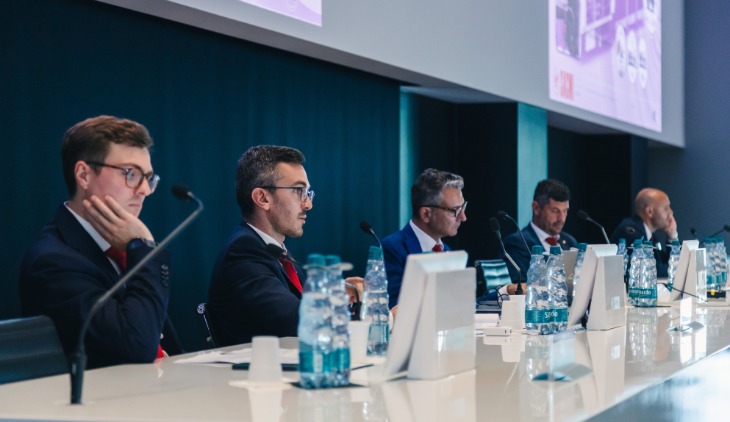
Rita Chu, Vice Chairman of Adsale Group, talked to Stefan Engleder, CEO at ENGEL, on the latest market and technology trends, as well as the company’s strategic planning.

Rita Chu, Vice Chairman of the Adsale Group
Rita Chu pursued her studies at Northwestern University in the US, as well as London School of Economics in the UK. A certified accountant, she joined the Adsale Group in 2010 and became the Vice Chairman of the Group in 2019.
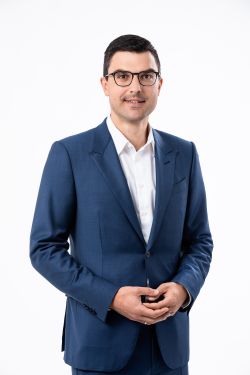
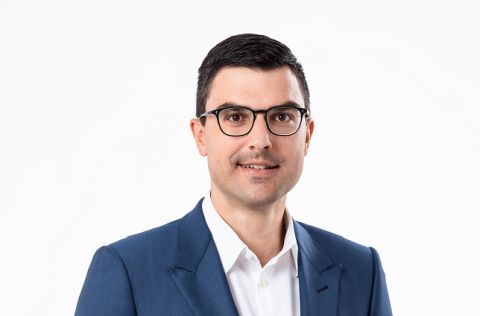
Stefan Engleder, CEO ENGEL
Stefan Engleder joined ENGEL in 2009, where he was responsible for global automation development as plant manager of the robot plant in Dietach, Austria. In 2012, he was appointed to the Executive Board of the ENGEL Group as CTO, and by the end of 2016 he took over as Chairman of the ENGEL Executive Board.
ENGEL AUSTRIA GmbH
Injection molding machine manufacturer ENGEL offers injection molding solutions from a single source. With the development and production of injection molding machines, technologies and digital solutions, ENGEL shapes the plastics processing of the future.
ENGEL’s injection molding machine portfolio ranges from 280 kN to 55,000 kN clamping force, including hydraulic, hybrid and electric or horizontal and vertical machines. The company have nine production plants in Europe, North America and Asia, as well as subsidiaries and representatives in over 85 countries. (Booth: 5.1C42)
E-mobility the main positive market indicator
Chu: Currently, the global economy landscape remains uncertain and the global plastics industry is facing headwinds. In your opinion, what are the driving forces for the global plastics industry in 2024? How does ENGEL plan to capitalize on these opportunities?
Engleder: The plastics industry is still a growing market. At ENGEL we see e-mobility as well as applications in the field of healthcare and pharma as the main driving forces for 2024.
E-Mobility is creating an increased demand for complex plastic parts, for example sensors need to be integrated. Apart from this, the car of the future will consist of an increasing proportion of plastic. There are also a lot of new players in the automotive industry, especially Chinese ones.
Our injection molding machine portfolio, based on our two brands ENGEL and WINTEC, meets their requirements perfectly. WINTEC is our local brand for the Asian market – we develop, manufacture, and sell our WINTEC solutions locally.
Chu: On the other hand, what are the major challenges for the industry? What strategies does ENGEL have in place to address these challenges?
Engleder: Talking about challenges, sustainability and closing material cycles are the main ones in the plastics industry. With a few exceptions, we do not yet have closed material cycles. Therefore, turning the spotlight on circular economy at this year’s CHINAPLAS is an important message to all of us.
The regulations already in place currently mainly affect the packaging industry. In addition, investments are still being held back because there is no willingness to invest due to the high interest rates.
However, for customers who currently have to pay close attention to their costs, we have cost-sensitive solutions in our WINTEC portfolio. They meet the highest quality standards at affordable price. At CHINAPLAS, visitors can experience two new product lines, the t-win SE and the e-win SE for the first time.
Summing up, we hope to experience early signs of market improvement at the CHINAPLAS trade fair this spring.
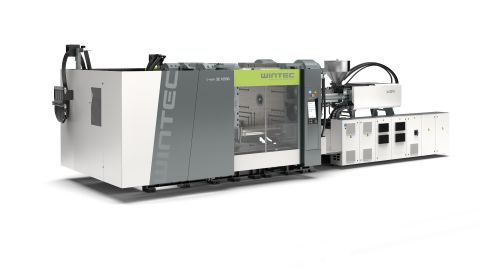
The new WINTEC t-win SE product line makes its debut at CHINAPLAS 2024.
Strategic investments in Americas and Southeast Asia
Chu: From a regional perspective, Mexico and Southeast Asian countries are emerging as potential markets. I know that ENGEL will build a new plant in Mexico. What factors make the Mexican market attractive to the company?
Engleder: We are establishing a hub structure within each of the three regions Americas, Europe, and Asia. With sales, order processing, production, and after sales functions, these hubs will operate mostly independently within their respective regions.
So, the new plant in Mexico is an important precondition to set up the hub structure in Americas. In the first step, we will mainly do assembly there in order to provide the North American as well as the South American market with customer-oriented solutions.
From an employer point of view, the Mexican market is very attractive as people there are very motivated and highly skilled.
Chu: Among the Southeast Asian countries, which countries and application sectors show higher growth potential? Will ENGEL increase its investment in these countries?
Engleder: ENGEL has already invested quite a bit in South East Asia. We have set up a strong team in the major countries over the past few years. Our regional headquarters in Bangkok is well-equipped with a Tech Center for our customers to closely experience the advantages of WINTEC and ENGEL injection molding solutions.
We will definitely continue to invest in those markets to strengthen our sales and service network, because we expect an increase in demand, for example Vietnam is driven by Chinese and Korean investments. When it comes to applications, the main focus is on medical and packaging as well as technical molding.
Growth and stronger portfolios expected for ENGEL in China
Chu: Regarding China, do you expect an increase in order from the market in 2024? What applications will have higher demand for injection molding machines?
Engleder: Our observation is that private spending in China have not recovered yet amid real estate crisis and slower income growth. However, we expect growth in the Chinese market for ENGEL in 2024. As already mentioned, we launch new WINTEC products at CHINAPLAS and the automotive industry will remain strong due to the shift from internal combustion engine (ICE) to battery electric vehicle (BEV), as well as the trend for lightweight and functional integration.
Chu: What are the development plans for ENGEL in China for the coming 2-3 years? How does ENGEL perceive the competition from Chinese machinery manufacturers?
Engleder: We plan to further strengthen our ENGEL and WINTEC portfolios, including digital products. We will also increase the capabilities of our automation center in Shanghai.
Our Chinese competitors are moving forward in more advanced technologies. This is a great motivation for us to continue investing in our portfolio and technologies with a focus on cost and time to market competitiveness.
Injection molding technology leaps forward with digitalization
Chu: When it comes to technology advancement, have you observed any shifts in customer requirements regarding injection molding solutions?
Engleder: The trend to higher number of cavities in order to boost production efficiency continues. And feedback about the advantages of our digital solutions for better process stability are more and more seen. Customers take great use of the simple handling of our iQ solutions, which we are very pleased about.
In addition, we experience the trend of “fast to market” that emphasizes shorter machine delivery times. Again, coming back to digital products, our two-way interface sim link enables data exchange between the simulation software and the injection molding machine, and it is widely used for reduced time from concept to production.
Chu: The pursuit of sustainable development is driving innovation in plastics technology. The demand for processing recycled materials and bioplastics is increasing. What are the technological challenges for meeting the requirements from processing recycled and bio-based materials?
Engleder: First of all, we have to work on establishing non-contaminated, pure material streams with acceptable effort and CO2 footprint. Moreover, we need to find ways to cope with the cost disadvantage of recycled materials compared to virgin materials.
Chu: How do ENGEL’s experts overcome these hurdles?
Engleder: The good thing is that we already have proven solutions, for example digital solutions from our iQ family to compensate the fluctuations in the material stream. In addition, we are happy to provide our two-stage process, a machine technology able to filter and degas recycled materials.
Chu: ENGEL has been at the forefront of promoting smart manufacturing through digitization. Can you update us on ENGEL's inject 4.0 programme?
Engleder: Talking about our iQ family, the overall aim is to simplify the operating of the machines. At CHINAPLAS, we present our new master assistant that guides the machine operator through the iQ systems available on the machine and introduces the correct settings in order to leverage the machine’s full potential. Besides, we also offer iQ system for easy processing of recyclate.
Chu: What are your thoughts on artificial intelligence (AI)/machine learning (ML)? Do you think AI/ML would be the game-changer in injection molding technology?
Engleder: When it comes to AI, we are convinced that this is an incredibly powerful method. We use AI to develop solutions to again simplify the use of injection molding machines. AI is therefore never an end in itself.
One example of the application of AI is our iQ process observer, as it is based on neural networks. The development of our process observer started many years before the advent of AI – so we did not call it “AI” back then. We also use neural networks to analyze data in the aforementioned e-connect production portal.
Strong presence at CHINAPLAS 2024
Chu: You have revealed some exhibits of ENGEL at CHINAPLAS. Can you share more with us the demonstrations the company will showcase at the trade fair?
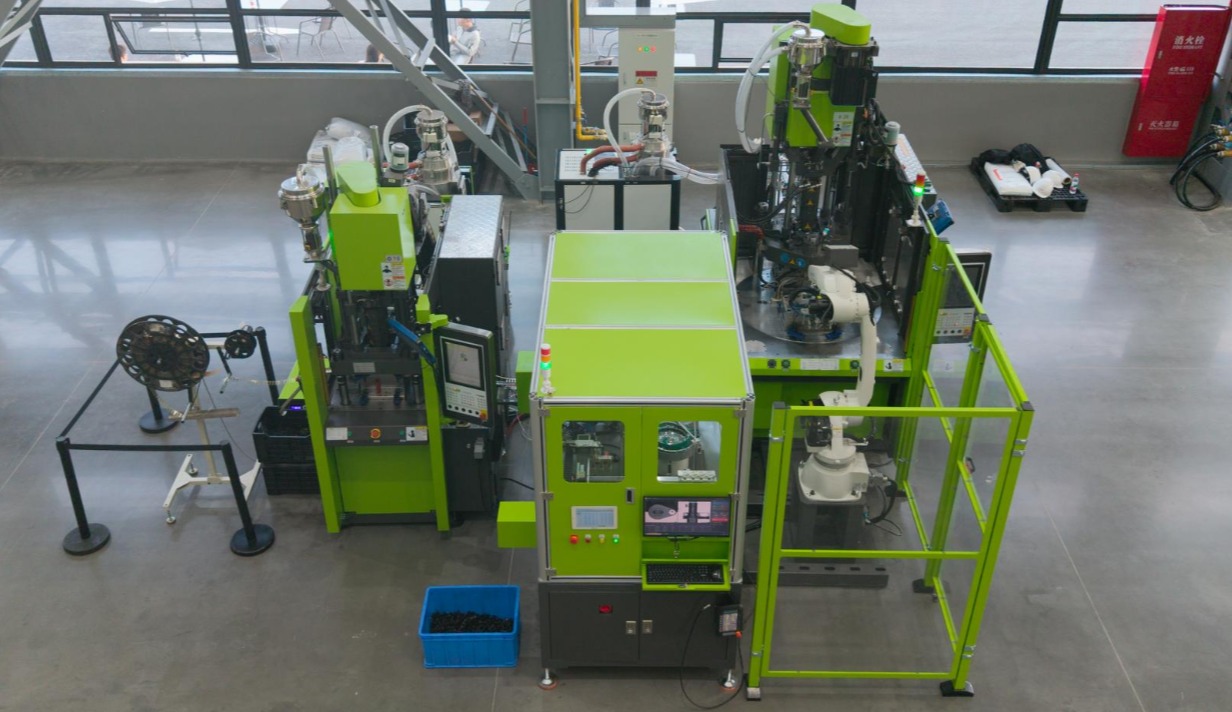
Engleder: We are looking forward to showing solutions that our customers can benefit from in various ways. In the automotive industry, apart from BEV there are also fuel cells that we should take into closer consideration. For this, we demonstrate the flooding of bipolar plates for fuel cells with a silicone seal on an ENGEL insert 100, an injection molding machine from our vertical portfolio.
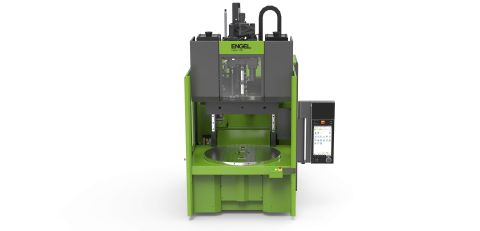
At CHINAPLAS 2024, ENGEL demonstrates an application for fuel cells on an ENGEL insert 100 vertical injection molding machine.
In addition, we give further insights into the ENGEL and WINTEC solutions, from our high performance all-electric e-mac machines to the new edition of our t-win series. Visitors can find out about the features and applications in detail right at the fair.