














Newest materials on stage to boost mobility transition

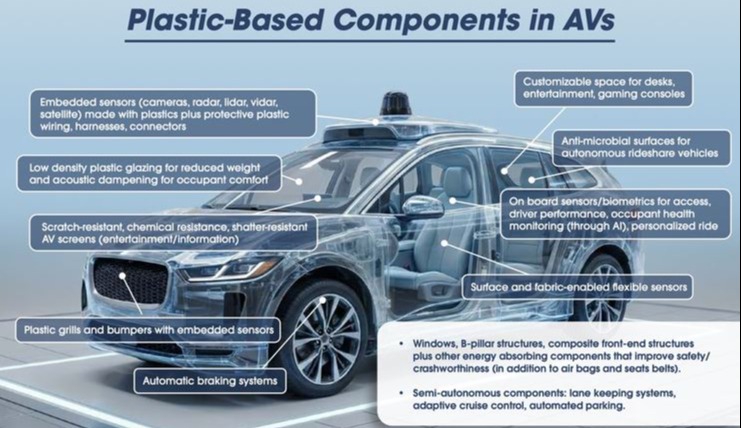
While development on future mobility accelerates, lightweight, high performance and sustainable materials provide superior aesthetic, performance and safety for both interior and exterior of automobiles. At CHINAPLAS 2024, a wide variety of automotive materials are showcased, with some of them making their first appearance in the industry.
Debut materials with high performance and sustainability
Thermoplastic roller forming composite materials using polypropylene resin and glass fiber fabric as raw materials can meet automotive lightweight demands.
China Jushi (Booth: 7.2C09) debuts a new glass fiber product of continuous fiber reinforced thermoplastic material 372, which is especially suitable for continuous GF/PP thermoplastic fabric sheet production process, high production efficiency and can be made of molded sheet with big width with good mechanical properties and oxygen aging properties.
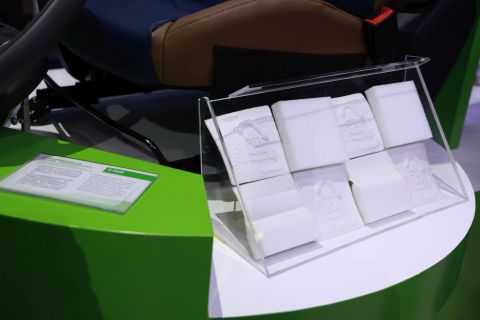
For PU flexible foam recycling, BASF (Booth: 7.2C42) first presents its Design to Recycle Flexible PU Foam Solutions for Automotive and Furniture. The key benefit of this recycling technique is an easy way of recycling end of life flexible PU foams with reduced energy consumption. The reprocessed PU can be incorporated into new PU formulations with recycling content up to 20-30 wt%. The recycling cycles can be repeated multiple times without limitation.
This technology can be used in automotive applications like seating and steering wheel, as well as in furniture applications. Customers will be able to produce PU foams without changing conventional production process, but with lower product carbon footprint values and closed loop recycled content without compensation on the properties.
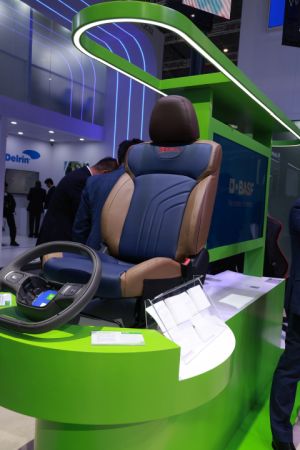
BASF's new Design to Recycle Flexible PU Foam Solutions can be used in automotive applications.
Another debut solution for automotive applications presented at the trade fair is Momentive NEVSil from Momentive (Booth: 6.2C86). This specialty elastomer material provides higher temperature resistant, flame retardant and thermal conductive performance for new energy vehicle (NEV) sealing parts. With these material flame retardant properties, NEVSil enables NEVs with more safety and better thermal management capability.
Last but not least, Cabot (Booth: 8.2F43) presents its new generation of black masterbatches with an excellent blue tone for applications in the automotive interior, consumer and electronics industries. Recommended for use in polypropylene compounds formulations, these masterbatches provide an excellent blue tone without sacrificing jetness or dispersion.
In addition, the specialty compound supplier launched a new generation of low odor black masterbatches for automotive interior applications. These masterbatches are recommended for the development of polypropylene compounds and provide good jetness and blue tone for polypropylene compounds while reducing odor.
The Extra conductive carbon black VULCAN XCmax 22 offers high conductivity at very low loadings. VULCAN XC615 specialty conductive carbon black is primarily suited for electrostatic dissipative (ESD) applications or for a variety of applications requiring protection against electrostatic discharges, and achieves comparatively low hygroscopicity of composites in ESD applications.
Additional solutions worth checking out
Apart from the debuted exhibits, plenty of automotive material solutions are showcased at CHINAPLAS. For example, Kingfa (Booth: 7.2C61) presents halogen-free flame-retardant enhanced PA66. The material is the core material to be applied to NEVs, mainly made into high voltage connectors. With excellent high temperature insulation performance, the material ensures electrical safety.
Compared with traditional products or other similar products, this material from Kingfa shows excellent performance in a wide variety 每 longer service life and long-term heat resistance (RTIEle=160~C), outstanding electrical performance (IPT 2.5kV), exceptional outdoor performance with f(1) certification, and halogen-free thin-wall flame retardant 每 which meet the high requirements of auto parts and greatly ensure electrical safety.
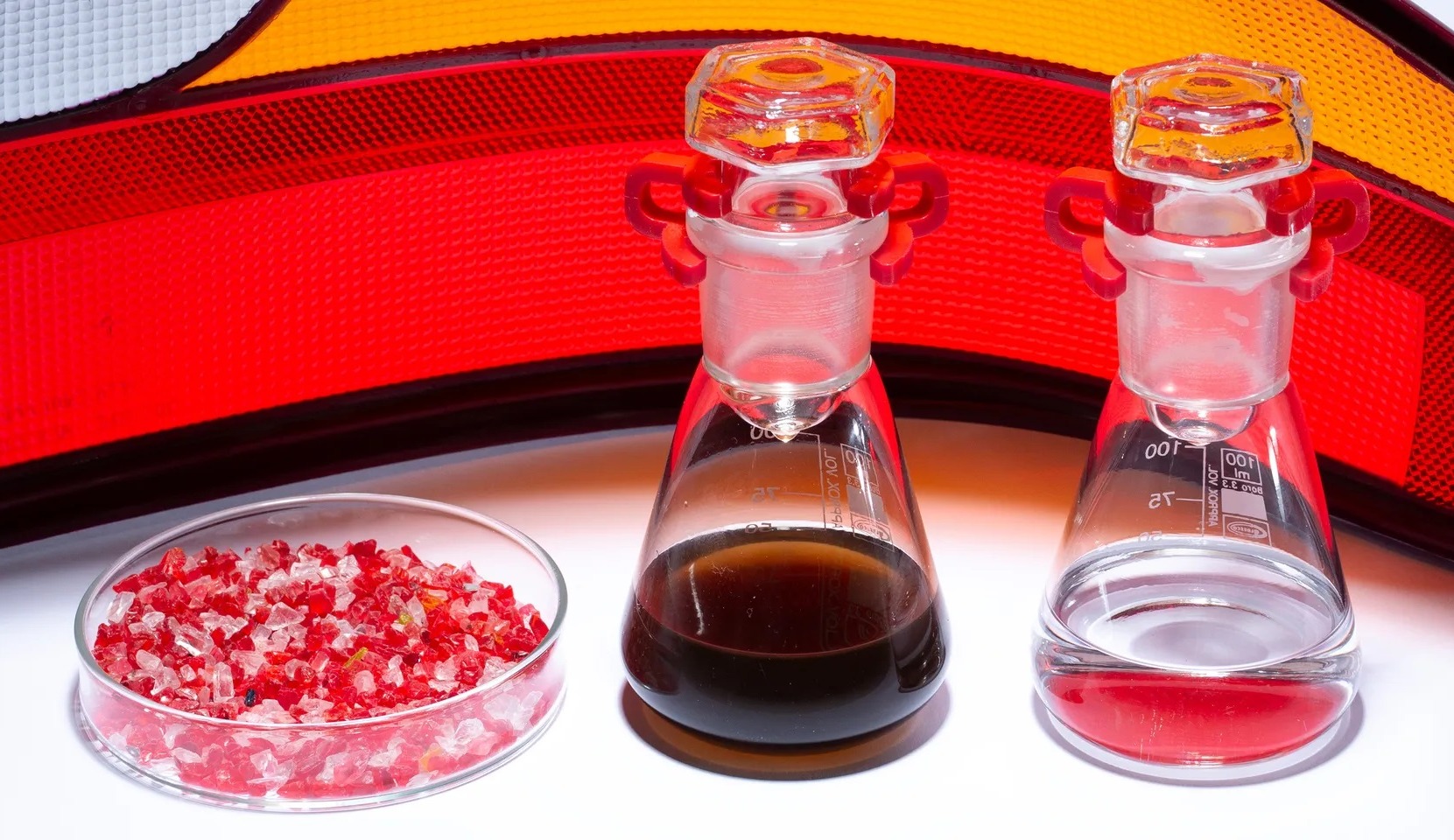
Another solution provider Samyang (Booth: 7.2D48) presents high transmittance PC and transparent flame-retardant PC. High transmittance PC, which was developed for the automotive daytime running lights (DRL) application, has an improved light transmittance, heat stability and less yellowing compared to the general PC by applying a new light transmittance enhancer derived from isosorbide which is a White-Bio material, a biodegradable material synthesized from biomass.
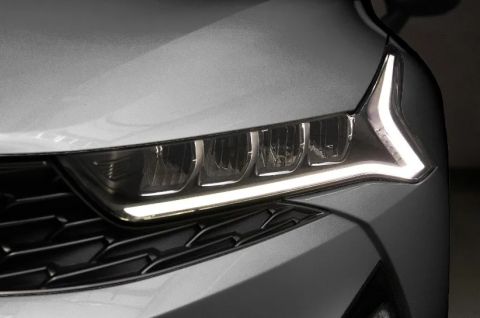
High transmittance PC from Samyang was developed for the automotive DRL application.
For transparent flame-retardant PC, it is characterized by high chemical resistance and low temperature impact strength, surpassing existing flame-retardant PC. It also obtained UL 94 V-0 for flame retardancy and is an eco-friendly approved material for non-detection of substances including PFOS, PFOA, PFHxS and PFCA from SGS*s 74 types of PFAS (Per and Polyfluoroalkyl Substances) detection test, which was possible as halogenated flame-retardant additives are not used.