















SABIC highlights performance and safety in EV solutions at NPE

At NPE 2024, SABIC highlights the performance and safety in its electric vehicle (EV) solutions, including a demonstration of additional validation of its thermoplastic-based thermal runaway barrier, as well as other materials for EV batteries and other automotive applications.
Additional validation of thermoplastic-based thermal runaway barrier
At the show, SABIC reports test results on the high potential of thermoplastic-based thermal runaway barrier solutions to help prevent fire spread in EV batteries.
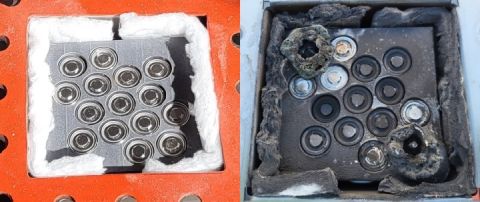
Cylindrical battery cells with SABIC’s flame retardant STAMAX resin before thermal runaway test (left) prove no propagation from trigger cells (top left cell and bottom right cell) to neighboring cells after the test.
The SABIC sub-system level test series showed that a battery module box made from the company’s STAMAX 30YH570 long glass fiber polypropylene (PP) resin with intercellular thickness as low as 1mm can act as an effective thermal barrier solution by preventing thermal runaway propagation in 18650 cylindrical cells.
This flame-retardant material changes phase from solid to liquid and gas and removes heat via latent heat and intumescent capabilities during severe thermal events, allowing it to act as an effective thermal shield to mitigate heat transfer and fire spread.
At SABIC’s booth, visitors can view the tested thermoplastic battery module box in a display area dedicated to BLUEHERO, an initiative designed to help the automotive industry shift to electric power and a low-carbon future.
High-performance solutions for EV batteries and automotive parts
At NPE, SABIC also highlights its advanced thermoplastics in EV battery applications, including a battery module from the 2023 Hyundai IONIQ 6 that uses SABIC PP compound H1030 for module enclosures. It is a 30% glass fiber-reinforced, non-halogenated flame-retardant material that meets China’s GB/T 41467.3-2015 fire safety regulation for EVs surviving five minutes at 1,000°C.
On display is also other EV battery components that demonstrate various performance advantages of thermoplastics over conventional metals, such as enclosures, end plates and busbars, either in production or developed as prototypes. The advantages include weight and cost reduction, increased functional integration, and enhanced electrical and thermal insulation.
In addition to materials for EV batteries, the company highlights technologies and expertise to support potential solutions for automotive structural applications such as tailgates, lighting and smart panels.
Last but not least, an additional display zone is set up to focus on SABIC’s capabilities to support customers’ product development efforts, in which visitors can learn how the company develops customized solutions.