











Patent filings for bioplastics and chemical recycling on the rise

It is safe to say that bioplastics and plastics recycling are the continuing trends that drive the plastics industry sustainable transition. Analyzing the latest global patent filing data, a recently published report reveals the progress in innovation of these two crucial green technologies.
The “Inside Green Innovation: Progress Report -Third Edition”, published by Appleyard Lees, uses the latest global patent filing data to assess green innovation activities, including bioplastics and plastics recycling, among others.
The leading intellectual property law firm hails the ongoing innovations that could help fight the climate crisis, saying that “the latest global patent data shows that companies worldwide have continued to accelerate investment into the green technologies” regardless of different challenges.
Second peak emerges for bioplastics innovation
Bioplastics experienced a double peak of patent applications at 2003 and 2021 before the commercial products really start to make progress in the markets. Notably, the number of filings in 2021 is remarkably seceding the previous peak in 2003.
This may due to early innovation not fully delivering on the initial commercial promise and thereby investment dropped in research and development. As the technology starts to gain commercial traction, a second peak emerges in which early movers consolidate their strengths and successes, while new applicants are attracted by the growing and validated commercial success, says the report.
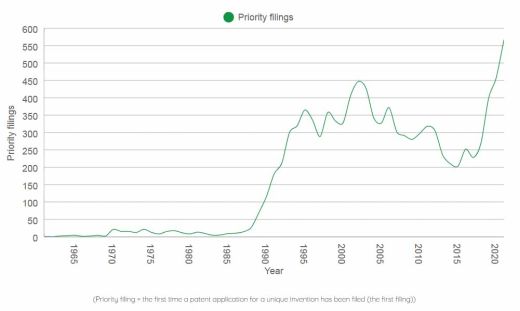
Global priority filings for bioplastic innovations - sixty-year trend (1961-2021). (Source: Appleyard Lees)
Significant territorial shift
Territory-wise, Japanese innovators almost solely created the 2003 peak in global bioplastics filings. However, in 2021, South Korea companies were the key drivers with filing totaling twice as many as Europe, the next most prolific jurisdiction.
The report says that may have resulted from the South Korean government’s announcement in 2020, which sets the target to reduce plastic waste by 20% by 2025, and fully replace fossil-based plastics with bioplastics by 2050.
Besides, though at lower levels, filings from India and China have also grown recently. As the number of South Korean-originated filings in 2021 was still far below Japan’s peak in its heyday, the report comments that the recent global upsurge constituted the combined efforts of countries around the world.
Top three patent filers
The top three filers of patent applications relating to bioplastics in 2021 were LG Chemical, Mitsubishi (in particular, Mitsubishi Chemical), and CJ Cheiljedang. Interestingly, LG Chemical and CJ Cheiljedang, both based in South Korea, filed very few bioplastic patent applications in 2019 and 2020.
According to the repot, LG Chemical’s filing applications focused mainly on improving the properties of existing classes of bioplastics; the company has also made filings relating to superabsorbent polymers. On the other hand, Mitsubishi has generally been focusing on improving the biodegradability of bioplastics.
Meanwhile, the data shows that CJ Cheiljedang’s recent filings all relate to PHA, for example, specific types of PHA and blends of PHAs with other bioplastics such as PBS or PBAT, aiming to provide plastics with good mechanical and optical properties while being biodegradable in natural environment.
Improving mechanical properties and biodegradability
Material-wise, filings related to PLA, PHA and butylene-based polymers all increased by similar rates in 2021, with PLA innovation at a consistently higher level.
The numbers of filings relating to starch blends were lower than the other three types of bioplastics in recent years, suggesting that the poor physical properties of starch blends compared to other bioplastics may be deterring innovation in this area.
The report anticipates two general directions for innovation in bioplastics: improving the mechanical properties and appearance of bioplastics to closely mimic the use of conventional plastics; or improving the biodegradability of bioplastics without undergoing industrial composting.
Sharp increase in chemical recycling related patents
The report also analyzes the data of patent filings for plastics recycling, which indicates a sharp increase in chemical recycling related patent activity after a slow decline from 2010 to 2018.
As there are drawbacks to the established mechanical recycling, the number of filings for chemical recycling increased significantly from 2019 to reach an all-time high at 2021.
According to the report, the innovation in the downstream processes of chemical recycling is also growing. Chemical recycling involves more than just breaking down waste polymer. Once broken down, the resulting mixture must be processed to extract the desired products.
If the number of patent filings relating to the core recycling processes continues to grow, an expansion in related downstream technologies should follow, the report adds.
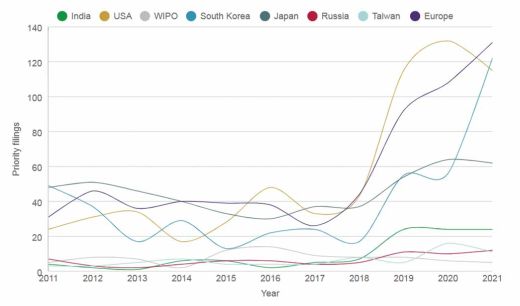
Global priority filings by territory for chemical recycling - ten-year trend (1961-2021). (Source: Appleyard Lees)
Heavily invested companies take the lead
The recent increase in filings for chemical recycling has come primarily from entities operating in the US, Europe and South Korea, with filings from the Asian country doubled from 2020 to 2021.
Eastman Chemical has been the top filer for chemical recycling since 2019 but the US-headquartered company’s dominance has eased. It is because the number of Eastman’s patent filings has dropped and other companies, in particular, SABIC, LG Chemical and IFP Energies Nouvelles, have increased their filings at a higher rate.
Plastics recycling is a capital-intensive sector, the report pinpoints, and the implementation of a single new plant will often result in a large number of related but distinct patent applications. As such, it is expected that the most heavily invested commercial entities would be filing the bulk of the patent applications.
Pyrolysis still the mainstay of innovation
The growing trend of chemical recycling shows no real signs of slowing down, with pyrolysis remains the main area of innovation, the report remarks.
Pyrolysis decompose waste materials by thermal degradation process, which breaks down plastic waste, typically, polyolefins such as PE, PP, PB, PS or PMMA, into a range of basic hydrocarbons, without interacting with oxygen. Basic hydrocarbons form an oil that can be used directly as fuel, or as synthetic building blocks in polymer production.
“The number of companies innovating in this area, and their resulting inventions is growing,” concludes the report. “Combined with the wider political and societal pressure, this reinforces the expectation that chemical recycling growth and innovation is set to continue.”