














Toyota and BMW team up for 3rd generation hydrogen fuel cell system

Sharing a common vision of “realizing a hydrogen society”, Toyota and BMW inked an agreement to co-create a third-generation fuel cell system and improve infrastructure, aiming to expand the lineup of fuel cell passenger cars.
The third-generation fuel cell system will be installed in both automakers’ models to provide customers with a broader range of fuel cell electric vehicles (FCEV). As a first step, BMW plans to launch its first mass-produced FCEV in 2028.
Toyota and BMW will also work to create synergies through collaboration in development and procurement as well as drive down costs by amalgamating powertrain units to expand commercial and passenger vehicle demand.
Given the need to create clusters of demand for hydrogen in the early stages of popularization, Toyota and BMW will encourage sustainable hydrogen supply by creating demand and working closely with hydrogen-producing companies as well as distribution and refueling facilities to ensure a stable hydrogen supply and reduce costs.
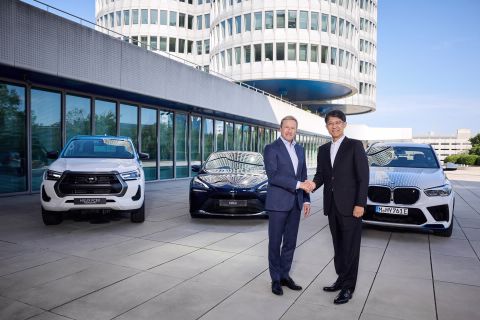
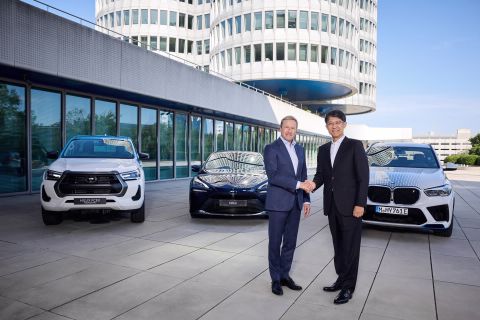
Oliver Zipse, Chairman of the Board of Management, BMW AG and Koji Sato, President of Toyota Motor Corporation.
Koji Sato, President of Toyota Motor Corporation, said, “We are pleased that the collaboration between BMW and Toyota has entered a new stage. We will accelerate our efforts together with BMW and partners across various industries to realize a future where hydrogen energy supports society.”
Oliver Zipse, Chairman of the Board of Management, BMW AG, commented, “Powered by hydrogen and driven by the spirit of our cooperation, it will underscore how technological progress is shaping future mobility. And it will herald an era of significant demand for fuel cell electric vehicles."
Toyota and BMW signed an agreement in December 2011 to establish a mid-long-term cooperative relationship in environmental technology, and have jointly advanced the technologies of fuel cells, sports cars and so on for over a decade.