















LyondellBasell, Braskem, Dow the most ambitious producers for circularity

BloombergNEF assessed the circularity ambition in packaging sector for 40 firms, 20 brand owners and 20 plastic producers. Its analysis reveals a slowdown in ambition to achieve a circular economy in 2023.
BloombergNEF’s Circular Economy Company Ranking measures companies’ circular economy ambition based on publicly announced targets and commitments from their 2023 company reports.
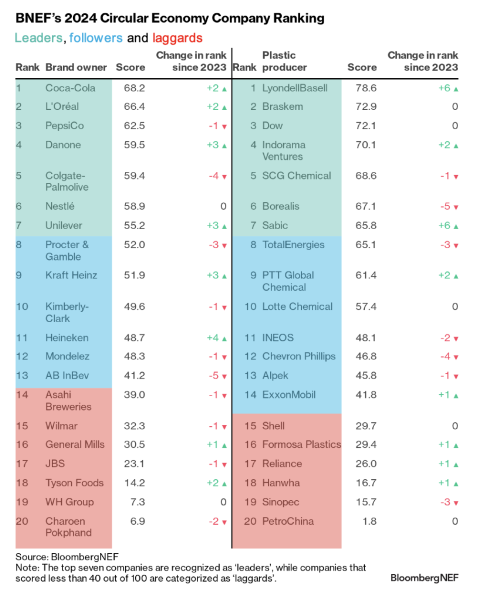
BloombergNEF’s 2024 Circular Economy Company Ranking. (Source: BloombergNEF)
Among the assessed firms, Coca-Cola, L’Oréal and PepsiCo are the leading brand owners in this year’s Circular Economy Company Ranking while LyondellBasell, Braskem and Dow took the highest three spots on the plastic producers’ list.
Brands face difficulties in achieving sustainability targets
From BloombergNEF’s assessment, eleven of the 20 brand owners ranked have set targets to increase the share of recycled materials in their packaging by 2025 or 2030.
In the ranking, Danone which is the only brand owner in this ranking with an absolute packaging reduction target beyond 2030, moved up three places to take fourth place while Colgate-Palmolive, with target only covers plastic packaging, lost its top position in the ranking and dropped to fifth.
L’Oréal and Danone have the highest share of packaging from bio-based or recycled sources, accounting for over 30% in 2023. Both companies also have some of the most ambitious 2025 targets.
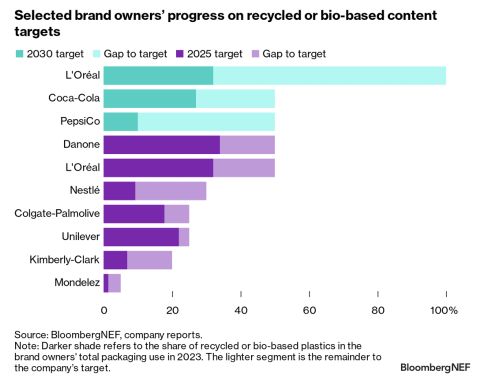
Selected brand owners' progress on circular contetnt targets. (Source: BloombergNEF)
BloombergNEF assessed that the undersupply of high-grade recycled plastic in many markets is stifling brand owners’ ability to achieve their targets, resulting in some delaying or revising their goals.
For example, PepsiCo previously had a target to achieve 25% post-consumer recycled (PCR) content in its packaging by 2025, but this target is no longer mentioned on its website. Instead, the company is aiming for 50% PCR content by 2030.
Another brand Unilever revised its original goal in 2023 to halve virgin plastic consumption by 2025, shifting the target to 30% by 2026 and 40% by 2028.
Some brand owners are investing directly in recycling infrastructure to increase recycled plastic supply. For example, Nestlé agreed to provide a EUR 7 million loan to Impact Recycling to construct a new facility to mechanically recycle flexible plastics in the UK.
On the other hand, some brands are focusing more on reducing virgin plastic packaging use by light-weighting, re-designing and investing in reusable and refillable packaging.
Plastic suppliers counting more on chemical recycling
On the supply side, over 80% of the producers in the ranking have set targets to produce millions of tons of sustainable (recycled or bio-based) materials by 2030 or earlier.
LyondellBasell and SABIC moved up six places in the plastic producer order, to take first and sixth place, respectively. LyondellBasell has one of the most ambitious targets to produce 2 million metric tons of circular polymers by 2030. SABIC also announced a new circular polymer production target for 2030 at the end of 2021.
Borealis lost its top position in this year’s ranking, with a target to produce 1.8 million metric tons of recycled and renewable polymers by 2030.
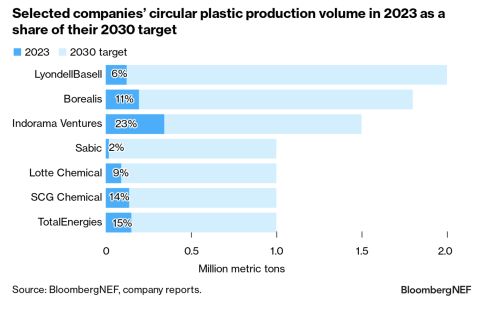
Selected producers' circular plastic production volume in 2023 as a share of their 2030 target. (Source: BloombergNEF)
Companies are reported to face challenges in sourcing scrap or sustainable feedstock to produce circular plastics. To add to the pressure, some producers reported weaker financial results in 2023 due to global overcapacity and flagging demand.
BloombergNEF also added that most producers are counting on chemical recycling to achieve their production targets. All ranked producers, except PetroChina, have announced projects or partnerships involving chemical recycling technologies.
Such processes use chemicals to convert plastic waste into virgin-grade feedstock materials such as recycled naphtha. Data tracked by BloombergNEF shows chemical recycling capacity could reach around 5.3 million tons by 2030, if all the announced capacity comes online.