





Search History
Clear History
{{item.search_key}}
Hot Searches
Change
{{item.name}}
{{item.english_name}}
Subscribe eNews
Once A Week Once Every Two Weeks
{{sum}}
Login Register

Applications

INEOS launches new grade with 70% recycled content for cosmetics packaging

Swiss partnership in bio-based FMCG packaging

Borealis and Messe Düsseldorf conclude successful reusable cup pilot at K 2025

Products

TAIZHOU QIHONG MOULD CO.,LTD

Toray unveils world’s first 160°C-resistant BOPP film

Covestro's new digital configurator enables sustainable polyurethane foam design

Activities

  • Fakuma to celebrate 30th anniversary edition in October 2026

  • Italy pavilion at Plast Eurasia proves its rising presence in Turkish market

  • CHINAPLAS 2026: Grand stage for new material, smart manufacturing and green solutions

Pictorial

Industry Topic

ASEAN: The Next Manufacturing Hub

Innovative and Sustainable Packaging

Green Plastics: News & Insights

CHINAPLAS

CHINAPLAS 2025 Focus

CHINAPLAS 2024 Focus

CHINAPLAS 2023 Focus

Exhibition Topic

CHINA INSIGHT

K 2025 FOCUS

Fakuma 2024 Highlights

News Videos

Haitian South China Headquarters opening

BEILIJIA Double Walled Corrugated Pipe Plant

Magnetic mold changing system developed in-house by Shanghai Qiaotian

Conference Videos

【Mandarin session: Webinar playback】SACMI: Your Digitalized Manufacturing, Your Future Today

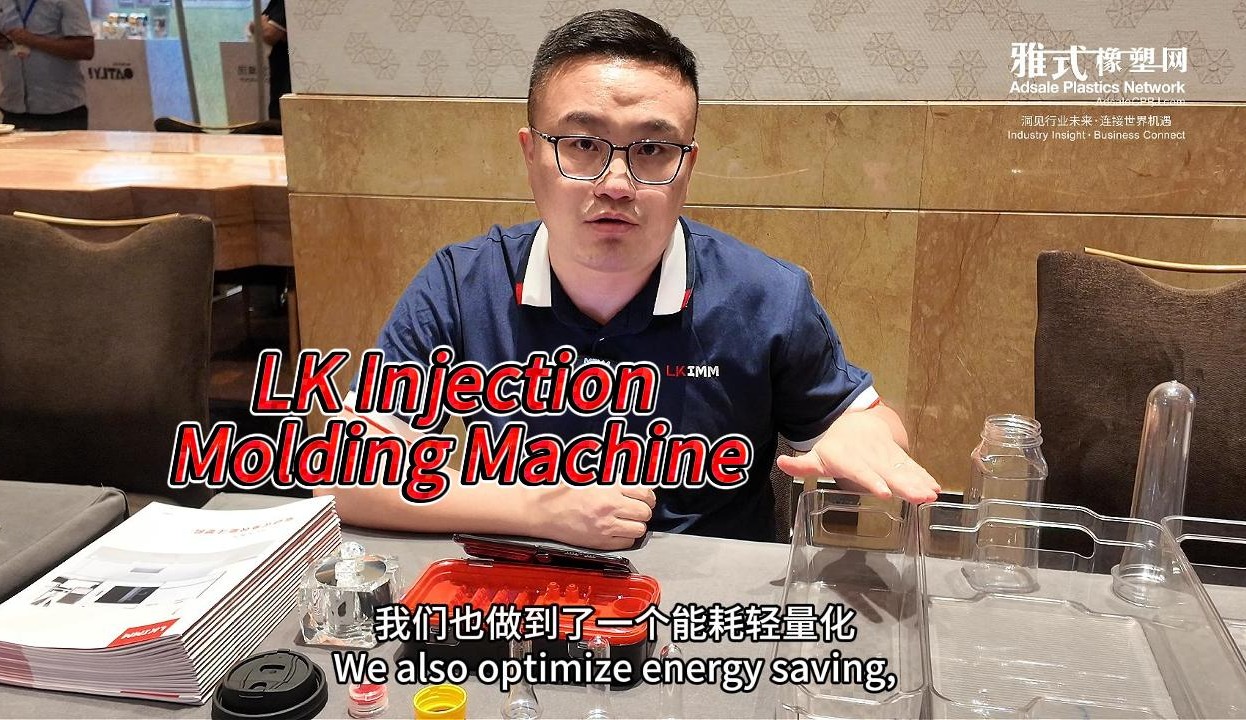
[Live Replay] LK Group: Smart Manufacturing, New Chapters in Southeast Asia: High-Efficiency Solutions in PET Preform & Thin-Wall Packaging

[Live Replay] Fu Chun Shin (FCS): Data-Driven Digital Rebirth and Intelligent Future of Injection Molding

Corporate/Product Videos

Second-hand plastic pipe extruder, 90% new, highly efficient and stable, suitable for processing various pipe specifications. Ideal choice for export.

Small Boss keep moving forward — see you at 2026 IPF Bangladesh exhibition! 💪✨

High-temperature gear pump

Exhibition

Playback TECHHUB 2025@CPRJ Live Streaming for CHINAPLAS

Playback TECHHUB@CPRJ Live Streaming for CHINAPLAS

Events

Playback On April 14, the "6th Edition CHINAPLAS x CPRJ Plastics Recycling and Circular Economy Conference and Showcase" at the Crowne Plaza Shenzhen Nanshan is currently being livestreamed!

Playback 5th Edition CHINAPLAS x CPRJ Plastics Recycling and Circular Economy Conference and Showcase

Home > News > Recycling

ELV plastics circularity: Challenges and solutions

Source:Global Impact Coalition Date :2024-11-15 Editor :VC
Copyright: This article was originally written/edited by Adsale Plastics Network (AdsaleCPRJ.com), republishing and excerpting are not allowed without permission. For any copyright infringement, we will pursue legal liability in accordance with the law.

While recycling rates may seem high, they often mask underlying challenges. For example, Eurostat reported that in 2021, the EU's reuse, recycling, and recovery rate for End-of-life Vehicle (ELV) was 88%.


This impressive figure suggests that the recycling of vehicles is on track. However, a deeper look reveals that these rates are primarily based on the weight of materials recycled, which mostly includes heavy metals, with limited attention to lighter-weight plastics.


Moreover, the EU’s definition of “reuse, recycling, and recovery” includes incineration for energy recovery, meaning that incinerated plastics are counted toward the total recycling rate.


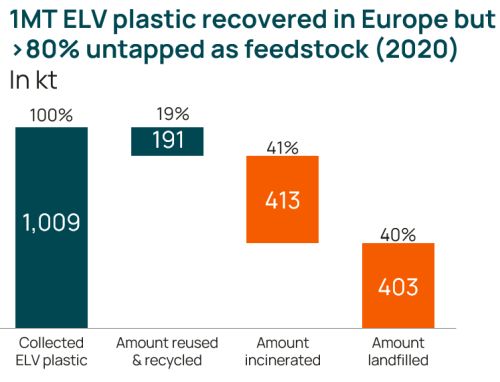
In Europe, only 19% of ELV plastics are recycled each year, while 41% are incinerated for energy and 40% end up in landfills. With over six million vehicles reaching the end of their life each year in Europe, millions of tonnes of valuable materials are lost to the economy annually.

GIC_1_500.jpg

Figure 1: ELV plastic collected, recycled, incinerated and landfilled


Challenges in boosting recycling rates


The EU's updated ELV rules encourage improved ELV treatment quality, reuse, and efficient resource use, covering all aspects of a vehicle's lifecycle. The new EU ELV directive draft aims for 25% of plastic in new cars need to be recycled plastic, of which a minimum of 25% have to be sourced from ELVs (meaning around 6% of plastic should be “closed-loop”).


Most recycled plastic in vehicles currently comes from mechanical recycling, with approximately 80% derived from post-industrial waste, which is more homogeneous and easier to recycle. In contrast, post-consumer plastic is far less recycled due to challenges with collection, separating, sorting, and quality control.


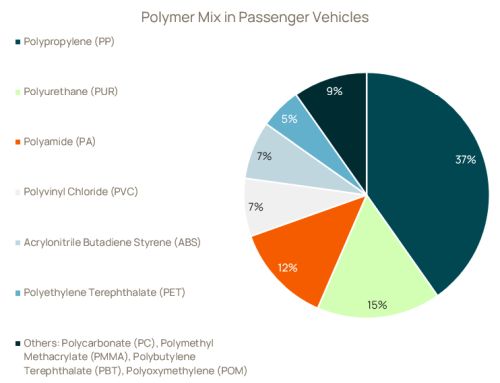
A variety of plastics, each selected for their unique properties, contribute to vehicle aesthetics, functionality, and fuel efficiency. Different polymers are used for various vehicle components, such as dashboards, light fixtures, seat covers, and foam cushions.

GIC_2_500.jpg

Figure 2: Polymer mix in passenger cars


Recycling ELV plastics poses two main challenges:

1. Vehicles contain a complex mix of polymers and multi-material components.

2. When ELVs are dismantled and shredded, plastics that were not initially separated become mixed, complicating and increasing the cost of separation.


As a result, only a small fraction of the recycled plastic in new vehicles originates from ELVs, making the target for 6% closed-loop plastics challenging to achieve.


GIC_3.png

Figure 3: Downstream steps from car collection to polymer recycling


Emerging technologies show potential


Some polymers, like polyethylene terephthalate (PET), are more compatible with mechanical recycling, while others require chemical recycling. Polypropylene (PP), which represents the largest plastic component in vehicles, is already subject to higher recycling standards.


Focusing on light polymers and sustainable management through innovative treatments, such as sorting, dissolution/precipitation, extrusion, catalytic pyrolysis, and plastic upgrading, could significantly increase recycling rates.


These novel approaches have the potential to increase the amount of ELV plastic recycled annually from 3% to 50%, reducing the share of plastics sent to incineration or landfills.


Recycling for materials like polyurethane (PUR) and multi-material components in seats and gaskets is still in the experimental phase and warrants further exploration.


Ideally, each disassembled plastic part should be assessed for the best recycling practices to improve ELV plastic recovery rates. Studies indicate that recycling specific parts, like bumpers and fuel tanks, is more sustainable than using virgin materials.


Industry collaboration toward a solution


To increase the closed-loop and recycled plastic content in new vehicles, it will be critical to engage with vehicle manufacturers (OEMs) together with the full value automotive value chain.


By embracing producer responsibility, OEMs are motivated to partner with suppliers and recyclers to increase both the quality and quantity of recycled materials and move closer to closing the loop.


Through collaboration, industry stakeholders can share expertise, co-invest in critical technologies, and establish offtake agreements to drive large-scale changes.


The Global Impact Coalition is uniting chemical companies, dismantlers, shredders, sorters, and OEMs to streamline the ELV plastic recycling process.


By focusing on disassembly and sorting improvements, they aim to enhance the entire ELV plastics recycling value chain — a crucial step in collecting the ELV plastics needed to meet EU targets and realizing the value of the many polymers found in vehicles.


* Written by Amanda Martin, Global Impact Coalition and Ana de la Cal, Net Zero Chemistry

** Edited by Adsale Plastics Network


 Like 丨  {{details_info.likes_count}}
Automotive
Recycling
Circular economy
 SACMI (SHANGHAI) MACHINERY EQUIPMENT CO., LTD.      
 JUHESHUN ADVANCED MATERIALS CO., LTD.      
 SHANGHAI HAWKWAY PROCESS SOLUTIONS CO., LTD      
 GUANGXI HENGYI NEW MATERIALS CO., LTD.      
 Chongqing Woerfu Chemical Co.,Ltd      
 GUANGXI WUZHOU GUOLONG RECYCLABE RESOURCES DEVELOPMENT CO., LTD.      
 MOTAN TAICANG CO., LTD.      
 YUYAO KAWAGUCHI Manufacturing Co., Ltd.      
 ANHUI ZHONGXIN HONGWEI TECHNOLOGY CO.,LTD      
 FUJIAN NAN'AN STAR RUBBER&PLASTIC MACHINERY CO., LTD.      
 GUANGDONG HTASO NEW MATERIALS TECHNOLOGY CO.,LTD      
 CHUZHOU SEP MATERIAL CO,LTD.      
 ZHANGJIAGANG GREENLANDPLAST MACHINERY CO.,LTD      

The content you're trying to view is for members only. If you are currently a member, Please login to access this content.   Login

Source:Global Impact Coalition Date :2024-11-15 Editor :VC
Copyright: This article was originally written/edited by Adsale Plastics Network (AdsaleCPRJ.com), republishing and excerpting are not allowed without permission. For any copyright infringement, we will pursue legal liability in accordance with the law.

While recycling rates may seem high, they often mask underlying challenges. For example, Eurostat reported that in 2021, the EU's reuse, recycling, and recovery rate for End-of-life Vehicle (ELV) was 88%.


This impressive figure suggests that the recycling of vehicles is on track. However, a deeper look reveals that these rates are primarily based on the weight of materials recycled, which mostly includes heavy metals, with limited attention to lighter-weight plastics.


Moreover, the EU’s definition of “reuse, recycling, and recovery” includes incineration for energy recovery, meaning that incinerated plastics are counted toward the total recycling rate.


In Europe, only 19% of ELV plastics are recycled each year, while 41% are incinerated for energy and 40% end up in landfills. With over six million vehicles reaching the end of their life each year in Europe, millions of tonnes of valuable materials are lost to the economy annually.


GIC_1_500.jpg

Figure 1: ELV plastic collected, recycled, incinerated and landfilled


Challenges in boosting recycling rates


The EU's updated ELV rules encourage improved ELV treatment quality, reuse, and efficient resource use, covering all aspects of a vehicle's lifecycle. The new EU ELV directive draft aims for 25% of plastic in new cars need to be recycled plastic, of which a minimum of 25% have to be sourced from ELVs (meaning around 6% of plastic should be “closed-loop”).


Most recycled plastic in vehicles currently comes from mechanical recycling, with approximately 80% derived from post-industrial waste, which is more homogeneous and easier to recycle. In contrast, post-consumer plastic is far less recycled due to challenges with collection, separating, sorting, and quality control.


A variety of plastics, each selected for their unique properties, contribute to vehicle aesthetics, functionality, and fuel efficiency. Different polymers are used for various vehicle components, such as dashboards, light fixtures, seat covers, and foam cushions.


GIC_2_500.jpg

Figure 2: Polymer mix in passenger cars


Recycling ELV plastics poses two main challenges:

1. Vehicles contain a complex mix of polymers and multi-material components.

2. When ELVs are dismantled and shredded, plastics that were not initially separated become mixed, complicating and increasing the cost of separation.


As a result, only a small fraction of the recycled plastic in new vehicles originates from ELVs, making the target for 6% closed-loop plastics challenging to achieve.


GIC_3.png

Figure 3: Downstream steps from car collection to polymer recycling


Emerging technologies show potential


Some polymers, like polyethylene terephthalate (PET), are more compatible with mechanical recycling, while others require chemical recycling. Polypropylene (PP), which represents the largest plastic component in vehicles, is already subject to higher recycling standards.


Focusing on light polymers and sustainable management through innovative treatments, such as sorting, dissolution/precipitation, extrusion, catalytic pyrolysis, and plastic upgrading, could significantly increase recycling rates.


These novel approaches have the potential to increase the amount of ELV plastic recycled annually from 3% to 50%, reducing the share of plastics sent to incineration or landfills.


Recycling for materials like polyurethane (PUR) and multi-material components in seats and gaskets is still in the experimental phase and warrants further exploration.


Ideally, each disassembled plastic part should be assessed for the best recycling practices to improve ELV plastic recovery rates. Studies indicate that recycling specific parts, like bumpers and fuel tanks, is more sustainable than using virgin materials.


Industry collaboration toward a solution


To increase the closed-loop and recycled plastic content in new vehicles, it will be critical to engage with vehicle manufacturers (OEMs) together with the full value automotive value chain.


By embracing producer responsibility, OEMs are motivated to partner with suppliers and recyclers to increase both the quality and quantity of recycled materials and move closer to closing the loop.


Through collaboration, industry stakeholders can share expertise, co-invest in critical technologies, and establish offtake agreements to drive large-scale changes.


The Global Impact Coalition is uniting chemical companies, dismantlers, shredders, sorters, and OEMs to streamline the ELV plastic recycling process.


By focusing on disassembly and sorting improvements, they aim to enhance the entire ELV plastics recycling value chain — a crucial step in collecting the ELV plastics needed to meet EU targets and realizing the value of the many polymers found in vehicles.


* Written by Amanda Martin, Global Impact Coalition and Ana de la Cal, Net Zero Chemistry

** Edited by Adsale Plastics Network


全文内容需要订阅后才能阅读哦~
立即订阅

Recommended Articles

Recycling
Borealis and Messe Düsseldorf conclude successful reusable cup pilot at K 2025
 2026-01-28
Recycling
Viewpoint: Safeguarding the circle—Proposed measures for temporary pause on rPET imports to the EU
 2026-01-28
Recycling
BoReTech PET recycling technology receives positive EFSA opinion
 2026-01-19
Recycling
Mars Materials CO2-derived product can be turned into raw material for carbon fiber
 2026-01-16
Recycling
Borealis and BlueAlp partner to advance chemical recycling
 2025-12-29
Recycling
SKZ launches research project “CloseT” for sustainable textile recycling
 2025-12-18

You May Be Interested In

Change

  • People
  • Company
loading... No Content
{{[item.truename,item.truename_english][lang]}} {{[item.company_name,item.company_name_english][lang]}} {{[item.job_name,item.name_english][lang]}}
{{[item.company_name,item.company_name_english][lang]}} Company Name    {{[item.display_name,item.display_name_english][lang]}}  

Polyurethane Investment Medical Carbon neutral Reduce cost and increase efficiency CHINAPLAS Financial reports rPET INEOS Styrolution Evonik Borouge Polystyrene (PS) mono-material Sustainability Circular economy BASF SABIC Multi-component injection molding machine All-electric injection molding machine Thermoforming machine

ELV plastics circularity: Challenges and solutions

识别右侧二维码,进入阅读全文
下载
x 关闭
订阅
亲爱的用户,请填写一下信息
I have read and agree to the 《Terms of Use》 and 《Privacy Policy》
立即订阅
Top
Feedback
Chat
News
Market News
Applications
Products
Video
In Pictures
Specials
Activities
eBook
Front Line
Plastics Applications
Chemicals and Raw Material
Processing Technologies
Products
Injection
Extrusion
Auxiliary
Blow Molding
Mold
Hot Runner
Screw
Applications
Packaging
Automotive
Medical
Recycling
E&E
LED
Construction
Others
Events
Conference
Webinar
CHINAPLAS
CPS+ eMarketplace
Official Publications
CPS eNews
Media Kit
Social Media
Facebook
Linkedin