













Sustainable multilayer sausage casing with bio-circular PA6

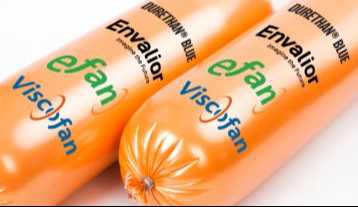
Viscofan, a Spanish food casings leader, has developed a sustainable multilayer sausage casing using bio-circular polyamide 6 (PA6) from Envalior’s Durethan portfolio.
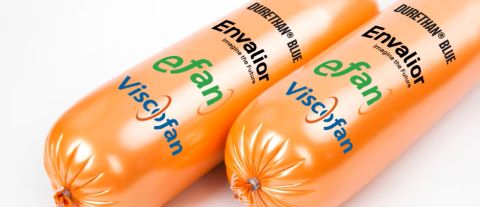
Viscofan has developed a sustainable multilayer sausage casing with bio-circular PA6 from Envalior’s Durethan BLUE.
Sustainable multilayer casing
The outer layer is made of a PA6 grade from Envalior’s Durethan BLUE range, whose raw materials are derived from used cooking oil. This grade is mass-balanced in accordance with the ISCC PLUS standard. It also has a CO2 footprint that is around 80% lower compared to its entirely fossil-based counterpart.
The PA6 raw materials obtained from used cooking oil are processed into caprolactam, the building material for the thermoplastic. The caprolactam with bio-circular content is chemically and physically identical to caprolactam of fossil origin.
Therefore, the PA6 produced with it has the same properties, the same high quality, and the same processing behavior as its purely fossil oil-based counterpart, meeting the same technical specifications and certifications.
For the inner layer, it consists of a ISCC PLUS certified linear low-density polyethylene (LLDPE), whose raw materials are obtained from post-consumer recycling.
Flexible casing for food products
Envalior and Viscofan have collaborated for more than 4 years in developing sustainable packaging casings for food. A new casing system is being marketed under the name eFAN, a one-stop solution for a wide range of products, from sausages or cheese to liquid foods like soups and sauces.
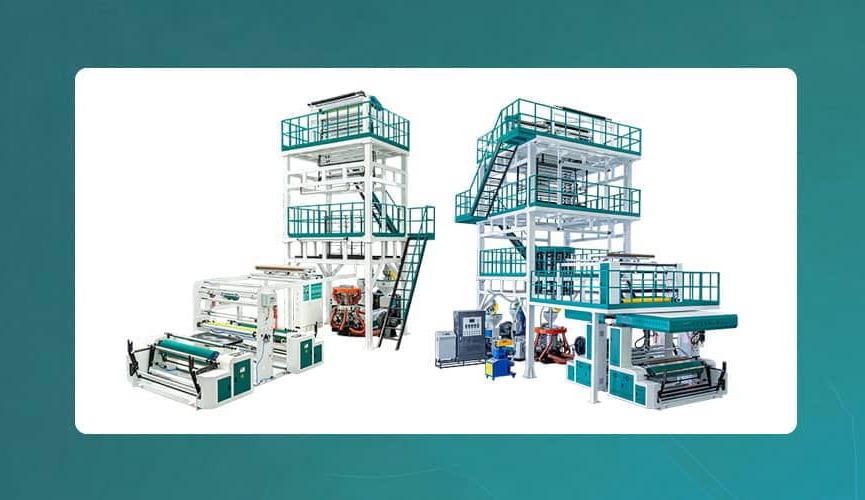
During the production of the sausage casings, the tube-shaped films are stretched lengthwise and crosswise (biaxial) in a controlled manner. This allows the inner structure of the casings to be precisely adjusted and adapted to the specific requirements of the sausage manufacturer.
Viscofan has optimized important properties, such as pliability, strength and elongation, clipping and peel characteristics, shrinkage and temperature resistance (-18°C to +121°C) in tough practical tests.
Before delivery, the extruded film tubes are assembled in partial lengths of 20-100 m and compacted to form shirred sticks of less than one meter in length, making them easy to handle in the meat processing plants. These diameters typically range from 34-180 mm.