















Search History
Clear History
{{item.search_key}}
Hot Searches
Change
{{item.name}}
{{item.english_name}}
Subscribe eNews
Once A Week Once Every Two Weeks
{{sum}}
Login Register

Applications

Greiner Packaging wins two WorldStar 2026 Global Packaging Awards

BoReTech PET recycling technology receives positive EFSA scientific opinion

HRC and SACC sign partnership agreement on composite parts for Airbus A220 wing body

Products

WITTMANN central material supply system reorganizes material handling in injection molding

Brückner BOPET line shines in India

A merchant with over 1000 second-hand high-quality plastic extruders

Activities

  • Fakuma to celebrate 30th anniversary edition in October 2026

  • Italy pavilion at Plast Eurasia proves its rising presence in Turkish market

  • CHINAPLAS 2026: Grand stage for new material, smart manufacturing and green solutions

Pictorial

Industry Topic

ASEAN: The Next Manufacturing Hub

Innovative and Sustainable Packaging

Green Plastics: News & Insights

CHINAPLAS

CHINAPLAS 2025 Focus

CHINAPLAS 2024 Focus

CHINAPLAS 2023 Focus

Exhibition Topic

CHINA INSIGHT

K 2025 FOCUS

Fakuma 2024 Highlights

News Videos

Haitian South China Headquarters opening

BEILIJIA Double Walled Corrugated Pipe Plant

Magnetic mold changing system developed in-house by Shanghai Qiaotian

Conference Videos

【Mandarin session: Webinar playback】SACMI: Your Digitalized Manufacturing, Your Future Today

[Live Replay] LK Group: Smart Manufacturing, New Chapters in Southeast Asia: High-Efficiency Solutions in PET Preform & Thin-Wall Packaging

[Live Replay] Fu Chun Shin (FCS): Data-Driven Digital Rebirth and Intelligent Future of Injection Molding

Corporate/Product Videos

Henan Hengfei - Pulse Mold Waterway Cleaning Machine

DR-24T Cap Compression Molding Machine

leading solutions for large diameter pipe extrusion

Exhibition

Playback TECHHUB 2025@CPRJ Live Streaming for CHINAPLAS

Playback TECHHUB@CPRJ Live Streaming for CHINAPLAS

Events

Playback On April 14, the "6th Edition CHINAPLAS x CPRJ Plastics Recycling and Circular Economy Conference and Showcase" at the Crowne Plaza Shenzhen Nanshan is currently being livestreamed!

Playback 5th Edition CHINAPLAS x CPRJ Plastics Recycling and Circular Economy Conference and Showcase

Home > News > 3D printing

Easy 3D printing technique to make plastics with customized flexibility

Source:Adsale Plastics Network Date :2025-01-07 Editor :RC
Copyright: This article was originally written/edited by Adsale Plastics Network (AdsaleCPRJ.com), republishing and excerpting are not allowed without permission. For any copyright infringement, we will pursue legal liability in accordance with the law.

Princeton engineers have developed an easily scalable 3D printing technique to manufacture soft plastics with programmed stretchiness and flexibility that are also recyclable and inexpensive.


The team led by Emily Davidson, an assistant professor of chemical and biological engineering, used widely available thermoplastic elastomers to create soft 3D-printed structures with tunable stiffness.

Princeton Engineering_researchers_480.jpg

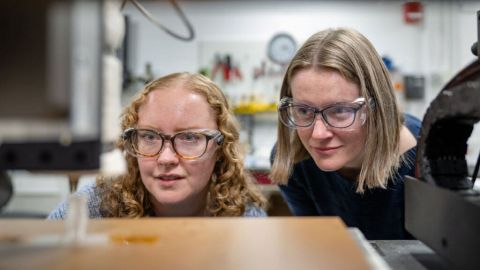
Alice Fergerson (left), a graduate student and lead author of the research article, and Emily Davidson, assistant professor of chemical and biological engineering. (Source: Princeton Engineering)


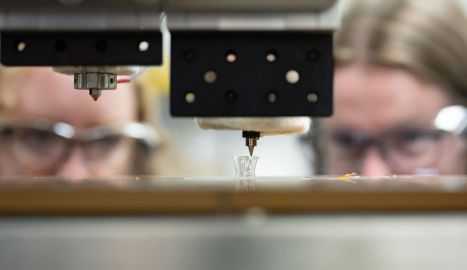
Engineers can design the print path used by the 3D printer to program the plastic’s physical properties so that the resulting material can stretch and flex repeatedly in one direction while remaining rigid in another.


This approach to engineering soft architected materials could have many uses, such as soft robots, medical devices and prosthetics, strong lightweight helmets, and custom high-performance shoe soles.


How to achieve hard and soft in one object?


The key to the material’s performance is its internal structure at the tiniest level. The team used a type of block copolymer which forms stiff cylindrical structures that are 5-7 nanometers thick (for comparison, human hair measures about 90,000 nanometers) inside a stretchy polymer matrix.


By using 3D printing to orient these nanoscale cylinders, the 3D printed material that is hard in one direction but soft and stretchy in nearly all others.


Designers can orient these cylinders in different directions throughout a single object, leading to soft architectures which exhibit stiffness and stretchiness in different regions of an object.
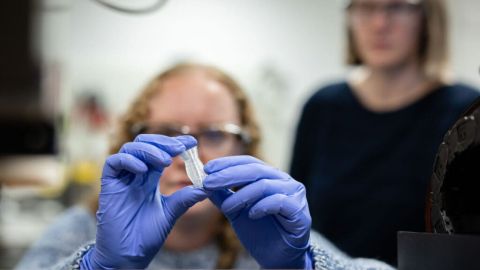

Princeton Engineering_printed material_480.jpg

Engineers can program the material for stiffness and flexibility in different directions. (Source: Princeton Engineering)
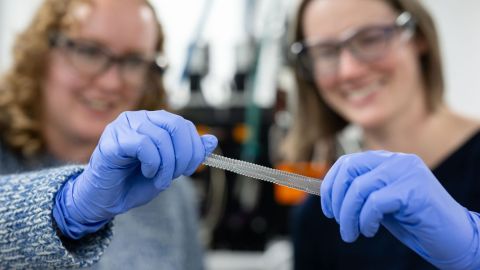
Princeton Engineering_stretching material_480.jpg

The stretchable material can be carefully structured for different properties. (Source: Princeton Engineering)


Choosing the right polymer


The researchers chose a thermoplastic elastomer, which is a block copolymer that can be heated and processed as a polymer melt, and solidifies into an elastic material when it cools.


Block copolymers are made of different homopolymers connected to each other. These different regions of a block copolymer chain separate instead of mixing, like oil and water. With such property, material with stiff cylinders within a stretchy matrix can be achieved.


Developing the 3D printing technique


Based on how the block copolymer nanostructures form and how they respond to flow, the researchers develop a 3D printing technique that effectively induces alignment of these stiff nanostructures.


They found that printing rate and controlled under-extrusion could be used to control the physical properties of the printed material.


One of the keys is thermal annealing, which the controlled heating and cooling of a material, to increase the perfection of the order of internal nanostructures.


Annealing also enables self-healing properties of the material. As part of the work, the researchers can cut a flexible sample of the printed plastic and reattached it by annealing the material. The repaired material demonstrated the same characteristics as the original sample.


As a next step, the research team expects to begin exploring new 3D printable architectures that will be compatible with applications such as wearable electronics and biomedical devices.


Research article published


The article titled “Reprocessable and Mechanically Tailored Soft Architectures Through 3D Printing of Elastomeric Block Copolymers” was published Sept 24, 2024 in the journal Advanced Functional Materials.


Support for the project was provided in part by the National Science Foundation through Princeton PCCM SEED funds from the Princeton Center for Complex Materials, and Princeton Project X Innovation Funds.

 Like 丨  {{details_info.likes_count}}
thermoplastic elastomer (TPE)
3D prinitng

The content you're trying to view is for members only. If you are currently a member, Please login to access this content.   Login

Source:Adsale Plastics Network Date :2025-01-07 Editor :RC
Copyright: This article was originally written/edited by Adsale Plastics Network (AdsaleCPRJ.com), republishing and excerpting are not allowed without permission. For any copyright infringement, we will pursue legal liability in accordance with the law.

Princeton engineers have developed an easily scalable 3D printing technique to manufacture soft plastics with programmed stretchiness and flexibility that are also recyclable and inexpensive.


The team led by Emily Davidson, an assistant professor of chemical and biological engineering, used widely available thermoplastic elastomers to create soft 3D-printed structures with tunable stiffness.


Princeton Engineering_researchers_480.jpg

Alice Fergerson (left), a graduate student and lead author of the research article, and Emily Davidson, assistant professor of chemical and biological engineering. (Source: Princeton Engineering)


Engineers can design the print path used by the 3D printer to program the plastic’s physical properties so that the resulting material can stretch and flex repeatedly in one direction while remaining rigid in another.


This approach to engineering soft architected materials could have many uses, such as soft robots, medical devices and prosthetics, strong lightweight helmets, and custom high-performance shoe soles.


How to achieve hard and soft in one object?


The key to the material’s performance is its internal structure at the tiniest level. The team used a type of block copolymer which forms stiff cylindrical structures that are 5-7 nanometers thick (for comparison, human hair measures about 90,000 nanometers) inside a stretchy polymer matrix.


By using 3D printing to orient these nanoscale cylinders, the 3D printed material that is hard in one direction but soft and stretchy in nearly all others.


Designers can orient these cylinders in different directions throughout a single object, leading to soft architectures which exhibit stiffness and stretchiness in different regions of an object.


Princeton Engineering_printed material_480.jpg

Engineers can program the material for stiffness and flexibility in different directions. (Source: Princeton Engineering)

Princeton Engineering_stretching material_480.jpg

The stretchable material can be carefully structured for different properties. (Source: Princeton Engineering)


Choosing the right polymer


The researchers chose a thermoplastic elastomer, which is a block copolymer that can be heated and processed as a polymer melt, and solidifies into an elastic material when it cools.


Block copolymers are made of different homopolymers connected to each other. These different regions of a block copolymer chain separate instead of mixing, like oil and water. With such property, material with stiff cylinders within a stretchy matrix can be achieved.


Developing the 3D printing technique


Based on how the block copolymer nanostructures form and how they respond to flow, the researchers develop a 3D printing technique that effectively induces alignment of these stiff nanostructures.


They found that printing rate and controlled under-extrusion could be used to control the physical properties of the printed material.


One of the keys is thermal annealing, which the controlled heating and cooling of a material, to increase the perfection of the order of internal nanostructures.


Annealing also enables self-healing properties of the material. As part of the work, the researchers can cut a flexible sample of the printed plastic and reattached it by annealing the material. The repaired material demonstrated the same characteristics as the original sample.


As a next step, the research team expects to begin exploring new 3D printable architectures that will be compatible with applications such as wearable electronics and biomedical devices.


Research article published


The article titled “Reprocessable and Mechanically Tailored Soft Architectures Through 3D Printing of Elastomeric Block Copolymers” was published Sept 24, 2024 in the journal Advanced Functional Materials.


Support for the project was provided in part by the National Science Foundation through Princeton PCCM SEED funds from the Princeton Center for Complex Materials, and Princeton Project X Innovation Funds.

全文内容需要订阅后才能阅读哦~
立即订阅

Recommended Articles

3D printing
No more waste! Turning spoiled milk into 3D printing material
 2026-01-13
3D printing
3D-printed sculptural coffee table with bio-based transparent polyamide
 2025-11-28
3D printing
Formnext: Modular 3D printing solution for large-format components from KraussMaffei
 2025-11-11
3D printing
Arburg withdraws from 3D printing business
 2025-09-15
3D printing
Stratasys and Shin Etsu launch silicone material for industrial 3D printing
 2025-07-23
3D printing
Stratasys launches new version of Fortus 450mc 3D printer
 2025-07-16

You May Be Interested In

Change

  • People
  • Company
loading... No Content
{{[item.truename,item.truename_english][lang]}} {{[item.company_name,item.company_name_english][lang]}} {{[item.job_name,item.name_english][lang]}}
{{[item.company_name,item.company_name_english][lang]}} Company Name    {{[item.display_name,item.display_name_english][lang]}}  

Polyurethane Investment Medical Carbon neutral Reduce cost and increase efficiency CHINAPLAS Financial reports rPET INEOS Styrolution Evonik Borouge Polystyrene (PS) mono-material Sustainability Circular economy BASF SABIC Multi-component injection molding machine All-electric injection molding machine Thermoforming machine

Easy 3D printing technique to make plastics with customized flexibility

识别右侧二维码,进入阅读全文
下载
x 关闭
订阅
亲爱的用户,请填写一下信息
I have read and agree to the 《Terms of Use》 and 《Privacy Policy》
立即订阅
Top
Feedback
Chat
News
Market News
Applications
Products
Video
In Pictures
Specials
Activities
eBook
Front Line
Plastics Applications
Chemicals and Raw Material
Processing Technologies
Products
Injection
Extrusion
Auxiliary
Blow Molding
Mold
Hot Runner
Screw
Applications
Packaging
Automotive
Medical
Recycling
E&E
LED
Construction
Others
Events
Conference
Webinar
CHINAPLAS
CPS+ eMarketplace
Official Publications
CPS eNews
Media Kit
Social Media
Facebook
Linkedin