


Search History
Clear History
{{item.search_key}}
Hot Searches
Change
{{item.name}}
{{item.english_name}}
Subscribe eNews
Once A Week Once Every Two Weeks
{{sum}}
Log in Register

Applications

Toray Toraypearl spherical PA12 powder for 3D printing

Polyplastics, Colgate-Palmolive and PTI unveil new technology for lightweight HDPE bottles

KHS SUPREME PET bottle for oxygen-sensitive beverages

Products

Breakthrough in Lubrizol’s LED Chlorination Technology to elevate CPVC resin performance

3000BPH 2cavity jar blowing machine will show in 2026 Chinaplas Shanghai

NOVA Chemicals commercializes two new SYNDIGO rPE grades

Activities

  • CHINAPLAS 2026: Government blueprint for emerging industries driving new plastics innovation

  • Fakuma to celebrate 30th anniversary edition in October 2026

  • Italy pavilion at Plast Eurasia proves its rising presence in Turkish market

Pictorial

Industry Topic

ASEAN: The Next Manufacturing Hub

Innovative and Sustainable Packaging

Green Plastics: News & Insights

CHINAPLAS

CHINAPLAS 2026 Focus

CHINAPLAS 2025 Focus

CHINAPLAS 2024 Focus

Exhibition Topic

K 2025 FOCUS

CHINA INSIGHT

Fakuma 2024 Highlights

News Videos

Automatic 5L 120mm neck PET jar blowing machine

YZ-ECO2000-4 6000BPH full automatic 4cavity bottle blowing machine

Opening Ceremony of Bechton's New Factory

Conference Videos

【Mandarin session: Webinar playback】SACMI: Your Digitalized Manufacturing, Your Future Today

[Live Replay] LK Group: Smart Manufacturing, New Chapters in Southeast Asia: High-Efficiency Solutions in PET Preform & Thin-Wall Packaging

[Live Replay] Fu Chun Shin (FCS): Data-Driven Digital Rebirth and Intelligent Future of Injection Molding

Corporate/Product Videos

QINGDAO BOUNI introduction video

PVC-O160-400 Production Line Trial Run Video

PVC-O630 production line testing

Exhibition

Playback TECHHUB 2025@CPRJ Live Streaming for CHINAPLAS

Playback TECHHUB@CPRJ Live Streaming for CHINAPLAS

Events

Playback On April 14, the "6th Edition CHINAPLAS x CPRJ Plastics Recycling and Circular Economy Conference and Showcase" at the Crowne Plaza Shenzhen Nanshan is currently being livestreamed!

Playback 5th Edition CHINAPLAS x CPRJ Plastics Recycling and Circular Economy Conference and Showcase

Home > News > Recycling

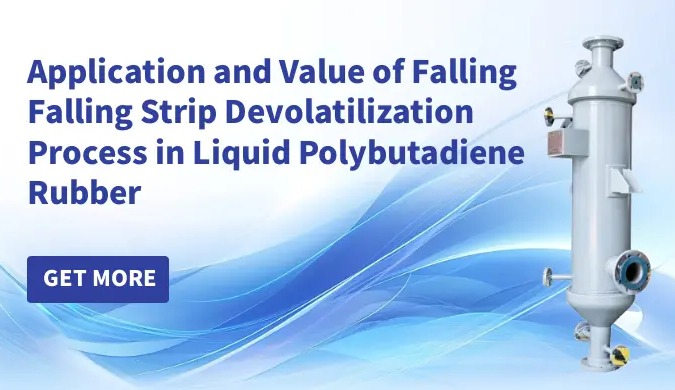
Application and Value of Falling Strip Devolatilization Process in Liquid Polybutadiene Rubber

Shanghai DODGEN Chemical Technology Co., Ltd.
Source:https://www.dgchemtech.com/app Date :2025-02-26 Editor :DODGEN
Copyright: The content was uploaded and published by members of Adsale Plastics Network (AdsaleCPRJ.com). It represents the opinion of the author or the organization; Adsale Plastics Network provides the platform for information release only. For membership registration, please log in on a desktop computer:adsalecprj.com/shor/dMpPW0

Liquid Polybutadiene (LPB) is a synthetic rubber with unique structural characteristics, known for its low molecular weight, high reactivity, excellent mechanical properties, and resistance to chemical corrosion. It is widely used in various fields, including coatings, cross-linking agents, electrical insulation materials, adhesives, and molding materials. However, the traditional wet coagulation process faces certain limitations when handling LPB, such as high energy consumption, operational complexity, and elevated costs. Given the low mass fraction of the polymer product solution, it is necessary to convert a large amount of solvent and unreacted monomers—volatile components in the solution—from liquid to gas, followed by removal under vacuum conditions. Thus, developing an efficient devolatilization process is crucial for enhancing LPB production efficiency, reducing costs, and improving product performance. The Falling Strip Devolatilization process offers a simplified post-treatment procedure, lower equipment investment, and reduced unit product costs, thereby enhancing the competitiveness and economic benefits of enterprises.


Technical Principle

Liquid polybutadiene rubber is produced using a solution polymerization method, with cyclohexane as the solvent system and butadiene as the monomer. Butyllithium is introduced as the initiator. This process strictly adheres to established technical protocols, precisely controlling the proportion of each monomer and employing advanced active anionic solution polymerization technology. The entire polymerization reaction takes place in a sealed environment that is oxygen-free, completely dry, and protected by an inert gas, ultimately yielding a polymer product with low relative molecular weight.

The devolatilization process for liquid polybutadiene rubber is based on the principle of physical separation. It involves heating the polymer solution to volatilize the solvent and unreacted monomers, followed by their separation under vacuum conditions. The process primarily consists of three steps: heating, evaporation, and condensation. During the heating phase, the polymer solution is preheated to a specific temperature. In the evaporation phase, the preheated solution enters the devolatilizer, where the Falling Strip Devolatilization mechanism facilitates the transition of the solvent and unreacted monomers from liquid to vapor phase. Finally, in the condensation phase, the vaporized solvent and monomers are recovered and recycled through a condenser.

The process flow of the liquid polybutadiene devolatilization is shown in the diagram below:
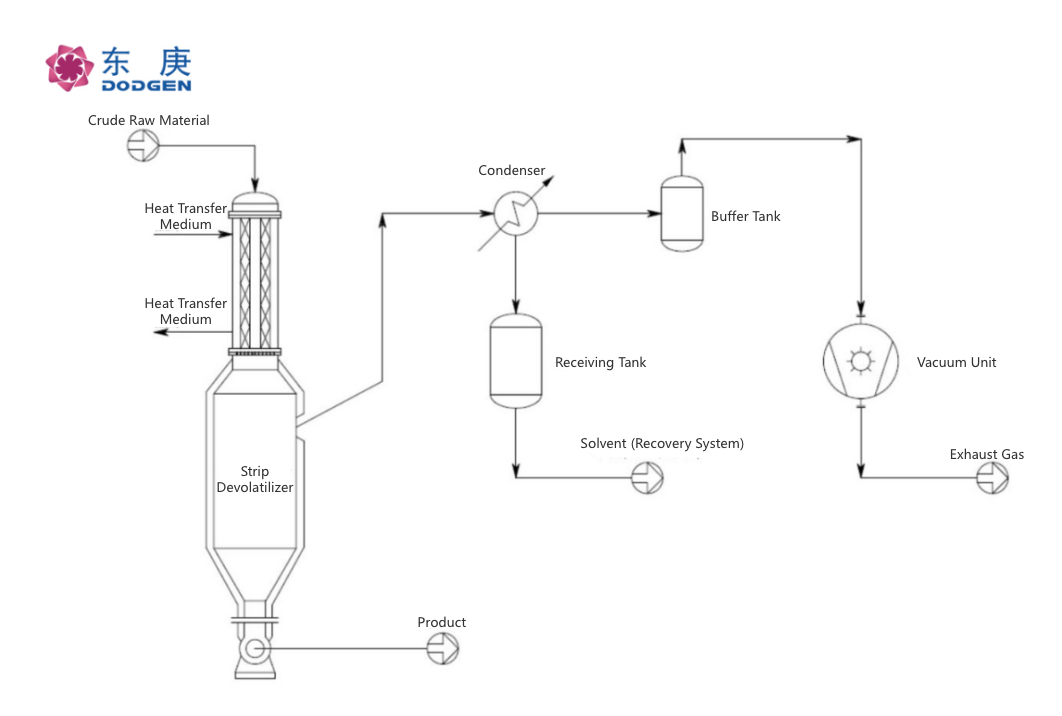
图.png

Application Value of Falling Strip Devolatilization

The application value of Falling Strip Devolatilization in liquid polybutadiene rubber is mainly reflected in the following aspects:

1. Improving Product Quality:

The Falling Strip Devolatilization process is a key step in ensuring the quality of liquid polybutadiene rubber (LPB). By precisely controlling devolatilization conditions, such as temperature, pressure, and flow rate, solvents and unreacted monomers can be effectively removed, preventing these impurities from affecting the final product’s performance. Additionally, optimizing the devolatilization process allows for precise control over LPB’s molecular weight distribution and microstructure, further enhancing its application performance and market competitiveness.

2. Reducing Production Costs:

An optimized Falling Strip Devolatilization process significantly reduces production costs by improving solvent recovery rates and minimizing raw material consumption. Traditional devolatilization methods often result in significant energy and material waste, whereas the strip devolatilizer achieves more efficient solvent removal and recycling, reducing energy consumption. Furthermore, the simplified post-treatment process lowers equipment investment and operating costs, enhancing the economic viability of production. These measures enable companies to maintain product quality while reducing costs, thereby increasing market competitiveness.

3. Enhancing Production Efficiency:

Efficient Falling Strip Devolatilization equipment and processes can significantly shorten production cycles and increase production capacity. In LPB production, rapid devolatilization minimizes material residence time in the equipment, accelerating the production flow and improving overall efficiency. This allows companies to respond quickly to market demand, offering greater production flexibility and adaptability. By boosting production efficiency, businesses can bring products to market faster, meet customer needs, and scale production to achieve greater economic benefits.

4. Breaking Foreign Market Monopolies:

By improving the Falling Strip Devolatilization process, the microstructural content of LPB products can be optimized to rival similar foreign products. This greatly enhances the international competitiveness of domestically produced LPB, helping to break the market monopoly of foreign products and advancing the globalization of domestic LPB products.

5. Promoting Downstream Product Innovation:

The optimized Falling Strip Devolatilization process creates new possibilities for LPB modification. By adjusting operational parameters during devolatilization, LPB with varying microstructures and molecular weight distributions can be produced to meet the demands of different application fields. This flexibility opens up broad opportunities for product innovation, enabling LPB to better fulfill specific performance requirements. Improved LPB quality can further expand its application in high-end markets, such as aerospace, automotive manufacturing, and construction, driving the development of the entire industry chain.

6. Advancing Environmental Protection and Green Production:

The Falling Strip Devolatilization process reduces organic solvent emissions, minimizing environmental impact and aligning with the chemical industry’s trend toward green production and sustainable development. By improving solvent recovery rates and reducing volatile organic compound (VOC) emissions, companies can not only lessen their environmental footprint but also comply with increasingly stringent environmental regulations. Moreover, adopting green production practices enhances a company’s social image and strengthens consumer trust and brand recognition.

7. Enhancing Process Technology Levels:

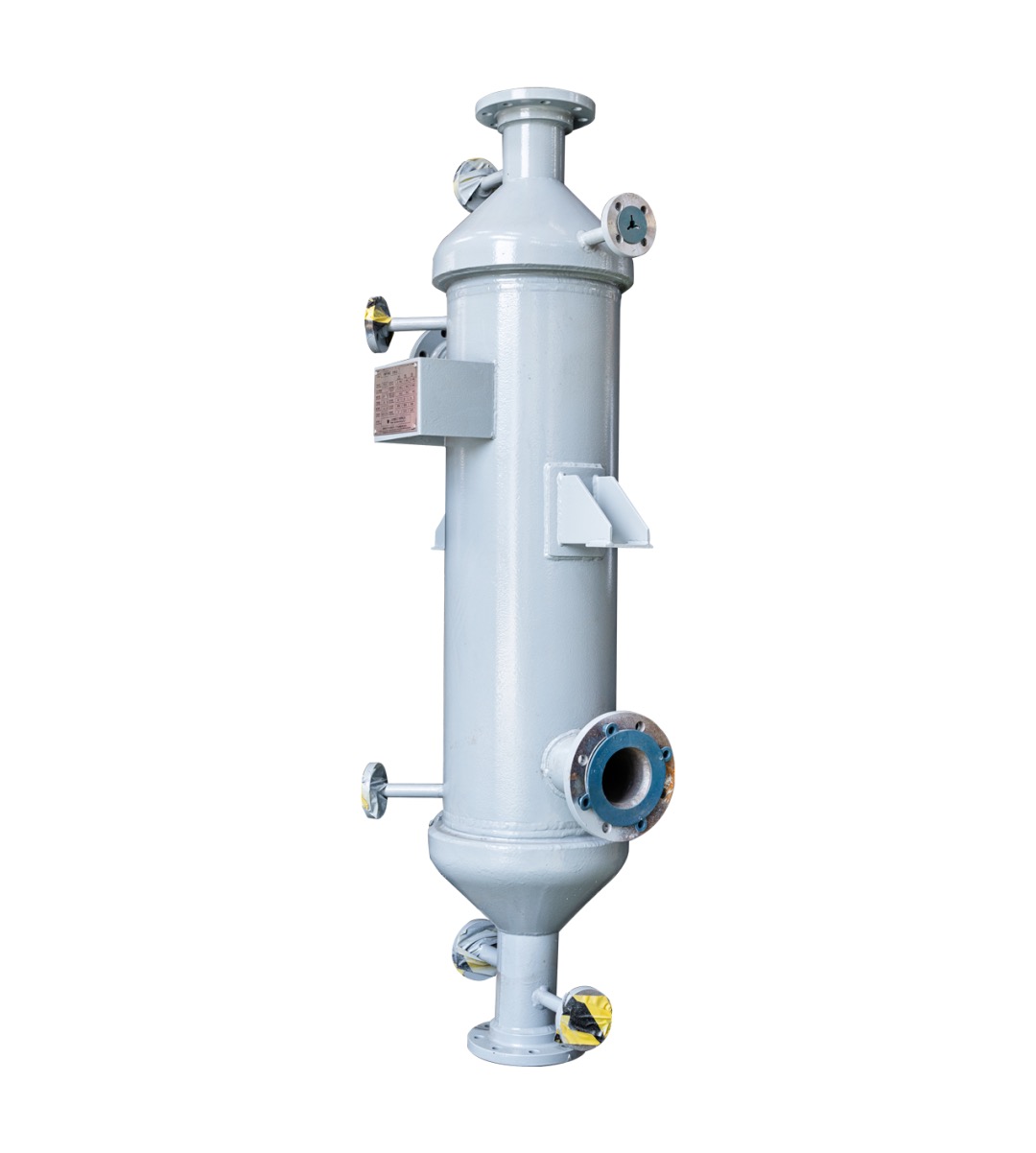
The application of the strip devolatilizer not only elevates LPB production technology but also provides a new technical pathway for devolatilizing other polymers. This technology demonstrates how process innovation can address issues in traditional methods, such as inefficiency and high costs. Additionally, the successful use of Falling Strip Devolatilization offers an efficient solution for other types of polymers, driving technological advancements across the entire polymer industry.

8. Ensuring Operational Safety:

Since LPB is a heat-sensitive material prone to crosslinking and degradation at high temperatures, the optimized devolatilization process mitigates these risks by carefully controlling operating temperature and pressure. Precise process control ensures the stability of LPB during production, preventing product quality degradation or production accidents caused by excessive heat. Furthermore, the improved process reduces safety hazards during production, enhancing the safety of operations for personnel.
20241114104140_44417.jpg

Conclusion

The devolatilization process for liquid polybutadiene rubber (LPB) is a critical step in its production, significantly impacting product quality, cost reduction, production efficiency, and market competitiveness. By optimizing process conditions and employing advanced Falling Strip Devolatilization equipment, efficient production and quality control of LPB can be achieved. In the future, with continuous technological advancements and growing market demand, LPB devolatilization processes will continue to evolve toward greater efficiency, environmental sustainability, and intelligence, creating new development opportunities for the chemical industry and related application fields.


DODGEN Marketing Department Contact Information 18016058776 (same WeChat account)

CHINAPLAS 2025

From April 15th, 2025 to April 18th, 2025

Booth K01 in Hall 16
 Like 丨  {{details_info.likes_count}}
Design
Research institute Recycling
Recycled plastics
Recycling
Plastics recycling
 SACMI (SHANGHAI) MACHINERY EQUIPMENT CO., LTD.      
 DONGGUAN DEHUA PRECISION MOLD CO., LTD      
 JUHESHUN ADVANCED MATERIALS CO., LTD.      
 HEFEI TAIHE INTELLIGENT TECHNOLOGY GROUP CO.,LTD.      
 WINDORA MATERIALS LLC      
 GREENWICH (CHINA) TECHNOLOGY DEVELOPMENT LIMITED      
 GREENCORE RESOURCES LIMITED      
 LINKER NEW MATERIALS CO., LTD      
 SHANGHAI HAWKWAY PROCESS SOLUTIONS CO., LTD      
 GUANGXI HENGYI NEW MATERIALS CO., LTD.      
 TAIZHOU MIXIN MACHINERY CO., LTD.      
 ZHEJIANG ROTOUN PLASTIC TECHNOLOGY CORP.      
 GUANGDONG GUOHENG YOUHE ADVANCED MATERIALS CO., LTD.      
 KADIDE      
 GUANGXI WUZHOU GUOLONG RECYCLABE RESOURCES DEVELOPMENT CO., LTD.      
 HUIZHOU LITUO ADVANCED MATERIALS CO.,LTD.      
 SUZHOU BECHTON PLASTIC MACHINERY CO., LTD      
 YUYAO KAWAGUCHI Manufacturing Co., Ltd.      
 LINYI HUASU ELECTRONIC TECHNOLOGY CO., LTD.      
 XIAMEN XINWANCAI POLYMER TECHNOLOGY CO.,LTD      
 ANHUI ZHONGXIN HONGWEI TECHNOLOGY CO.,LTD      
 FUJIAN NAN'AN STAR RUBBER&PLASTIC MACHINERY CO., LTD.      
 ZHANGJIAGANG GREENLANDPLAST MACHINERY CO.,LTD      
 FOSHAN SHUNDE MINGSANFENG MOULD CO., LTD.      

The content you're trying to view is for members only. If you are currently a member, Please login to access this content.   Log in

Shanghai DODGEN Chemical Technology Co., Ltd.
Source:https://www.dgchemtech.com/app Date :2025-02-26 Editor :DODGEN
Copyright: The content was uploaded and published by members of Adsale Plastics Network (AdsaleCPRJ.com). It represents the opinion of the author or the organization; Adsale Plastics Network provides the platform for information release only. For membership registration, please log in on a desktop computer:adsalecprj.com/shor/dMpPW0

Liquid Polybutadiene (LPB) is a synthetic rubber with unique structural characteristics, known for its low molecular weight, high reactivity, excellent mechanical properties, and resistance to chemical corrosion. It is widely used in various fields, including coatings, cross-linking agents, electrical insulation materials, adhesives, and molding materials. However, the traditional wet coagulation process faces certain limitations when handling LPB, such as high energy consumption, operational complexity, and elevated costs. Given the low mass fraction of the polymer product solution, it is necessary to convert a large amount of solvent and unreacted monomers—volatile components in the solution—from liquid to gas, followed by removal under vacuum conditions. Thus, developing an efficient devolatilization process is crucial for enhancing LPB production efficiency, reducing costs, and improving product performance. The Falling Strip Devolatilization process offers a simplified post-treatment procedure, lower equipment investment, and reduced unit product costs, thereby enhancing the competitiveness and economic benefits of enterprises.


Technical Principle

Liquid polybutadiene rubber is produced using a solution polymerization method, with cyclohexane as the solvent system and butadiene as the monomer. Butyllithium is introduced as the initiator. This process strictly adheres to established technical protocols, precisely controlling the proportion of each monomer and employing advanced active anionic solution polymerization technology. The entire polymerization reaction takes place in a sealed environment that is oxygen-free, completely dry, and protected by an inert gas, ultimately yielding a polymer product with low relative molecular weight.

The devolatilization process for liquid polybutadiene rubber is based on the principle of physical separation. It involves heating the polymer solution to volatilize the solvent and unreacted monomers, followed by their separation under vacuum conditions. The process primarily consists of three steps: heating, evaporation, and condensation. During the heating phase, the polymer solution is preheated to a specific temperature. In the evaporation phase, the preheated solution enters the devolatilizer, where the Falling Strip Devolatilization mechanism facilitates the transition of the solvent and unreacted monomers from liquid to vapor phase. Finally, in the condensation phase, the vaporized solvent and monomers are recovered and recycled through a condenser.

The process flow of the liquid polybutadiene devolatilization is shown in the diagram below:

图.png

Application Value of Falling Strip Devolatilization

The application value of Falling Strip Devolatilization in liquid polybutadiene rubber is mainly reflected in the following aspects:

1. Improving Product Quality:

The Falling Strip Devolatilization process is a key step in ensuring the quality of liquid polybutadiene rubber (LPB). By precisely controlling devolatilization conditions, such as temperature, pressure, and flow rate, solvents and unreacted monomers can be effectively removed, preventing these impurities from affecting the final product’s performance. Additionally, optimizing the devolatilization process allows for precise control over LPB’s molecular weight distribution and microstructure, further enhancing its application performance and market competitiveness.

2. Reducing Production Costs:

An optimized Falling Strip Devolatilization process significantly reduces production costs by improving solvent recovery rates and minimizing raw material consumption. Traditional devolatilization methods often result in significant energy and material waste, whereas the strip devolatilizer achieves more efficient solvent removal and recycling, reducing energy consumption. Furthermore, the simplified post-treatment process lowers equipment investment and operating costs, enhancing the economic viability of production. These measures enable companies to maintain product quality while reducing costs, thereby increasing market competitiveness.

3. Enhancing Production Efficiency:

Efficient Falling Strip Devolatilization equipment and processes can significantly shorten production cycles and increase production capacity. In LPB production, rapid devolatilization minimizes material residence time in the equipment, accelerating the production flow and improving overall efficiency. This allows companies to respond quickly to market demand, offering greater production flexibility and adaptability. By boosting production efficiency, businesses can bring products to market faster, meet customer needs, and scale production to achieve greater economic benefits.

4. Breaking Foreign Market Monopolies:

By improving the Falling Strip Devolatilization process, the microstructural content of LPB products can be optimized to rival similar foreign products. This greatly enhances the international competitiveness of domestically produced LPB, helping to break the market monopoly of foreign products and advancing the globalization of domestic LPB products.

5. Promoting Downstream Product Innovation:

The optimized Falling Strip Devolatilization process creates new possibilities for LPB modification. By adjusting operational parameters during devolatilization, LPB with varying microstructures and molecular weight distributions can be produced to meet the demands of different application fields. This flexibility opens up broad opportunities for product innovation, enabling LPB to better fulfill specific performance requirements. Improved LPB quality can further expand its application in high-end markets, such as aerospace, automotive manufacturing, and construction, driving the development of the entire industry chain.

6. Advancing Environmental Protection and Green Production:

The Falling Strip Devolatilization process reduces organic solvent emissions, minimizing environmental impact and aligning with the chemical industry’s trend toward green production and sustainable development. By improving solvent recovery rates and reducing volatile organic compound (VOC) emissions, companies can not only lessen their environmental footprint but also comply with increasingly stringent environmental regulations. Moreover, adopting green production practices enhances a company’s social image and strengthens consumer trust and brand recognition.

7. Enhancing Process Technology Levels:

The application of the strip devolatilizer not only elevates LPB production technology but also provides a new technical pathway for devolatilizing other polymers. This technology demonstrates how process innovation can address issues in traditional methods, such as inefficiency and high costs. Additionally, the successful use of Falling Strip Devolatilization offers an efficient solution for other types of polymers, driving technological advancements across the entire polymer industry.

8. Ensuring Operational Safety:

Since LPB is a heat-sensitive material prone to crosslinking and degradation at high temperatures, the optimized devolatilization process mitigates these risks by carefully controlling operating temperature and pressure. Precise process control ensures the stability of LPB during production, preventing product quality degradation or production accidents caused by excessive heat. Furthermore, the improved process reduces safety hazards during production, enhancing the safety of operations for personnel.

20241114104140_44417.jpg

Conclusion

The devolatilization process for liquid polybutadiene rubber (LPB) is a critical step in its production, significantly impacting product quality, cost reduction, production efficiency, and market competitiveness. By optimizing process conditions and employing advanced Falling Strip Devolatilization equipment, efficient production and quality control of LPB can be achieved. In the future, with continuous technological advancements and growing market demand, LPB devolatilization processes will continue to evolve toward greater efficiency, environmental sustainability, and intelligence, creating new development opportunities for the chemical industry and related application fields.


DODGEN Marketing Department Contact Information 18016058776 (same WeChat account)

CHINAPLAS 2025

From April 15th, 2025 to April 18th, 2025

Booth K01 in Hall 16
全文内容需要订阅后才能阅读哦~
立即订阅

Recommended Articles

Recycling
WEIMA shredding technology turns 3D printing waste into new printing material
 2026-02-26
Recycling
POSSIBLE project for mechanically recycling rigid PU and GFRP composites
 2026-02-16

Recycling
Borealis and partners to build first fully integrated waste management ecosystem in Indonesia
 2026-02-13
Recycling
EREMA and Lindner Washtech establish subsidiary in India
 2026-02-10
Recycling
True circularity of PET packaging: Sorting food-grade PET or not with Sesotec smart sorting systems
 2026-02-05
Recycling
BoReTech opens subsidiary to tap into Indian recycling market
 2026-02-04

You May Be Interested In

Change

  • People
  • Company
loading... No Content
{{[item.truename,item.truename_english][lang]}} {{[item.company_name,item.company_name_english][lang]}} {{[item.job_name,item.name_english][lang]}}
{{[item.company_name,item.company_name_english][lang]}} Company Name    {{[item.display_name,item.display_name_english][lang]}}  

Polyurethane Investment Medical Carbon neutral Reduce cost and increase efficiency CHINAPLAS Financial reports rPET INEOS Styrolution Evonik Borouge Polystyrene (PS) mono-material Sustainability Circular economy BASF SABIC Multi-component injection molding machine All-electric injection molding machine Thermoforming machine

Application and Value of Falling Strip Devolatilization Process in Liquid Polybutadiene Rubber

识别右侧二维码,进入阅读全文
下载
x 关闭
订阅
亲爱的用户,请填写一下信息
I have read and agree to the 《Terms of Use》 and 《Privacy Policy》
立即订阅
Top
Feedback
Chat
News
Market News
Applications
Products
Video
In Pictures
Specials
Activities
eBook
Front Line
Plastics Applications
Chemicals and Raw Material
Processing Technologies
Products
Injection
Extrusion
Auxiliary
Blow Molding
Mold
Hot Runner
Screw
Applications
Packaging
Automotive
Medical
Recycling
E&E
LED
Construction
Others
Events
Conference
Webinar
CHINAPLAS
CPS+ eMarketplace
Official Publications
CPS eNews
Media Kit
Social Media
Facebook
Linkedin