















Tapping AI’s potential in advancing sustainability

As global pressure to reduce environmental impacts intensifies, the plastics industry is turning to artificial intelligence (AI) in addressing the challenges, from improving mechanical recycling process to increasing traceability of supply chains.
Optimizing recycling for higher efficiency and quality
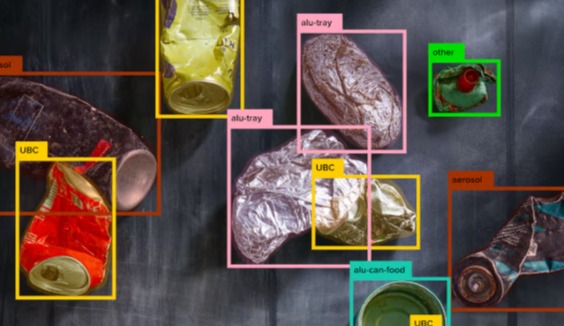
TOMRA Recycling, a leading global sorting solutions provider, has recently introduced a new application for its GAINnext AI ecosystem, designed to improve the sorting of used beverage cans (UBCs). This advanced solution utilizes deep learning, a branch of AI, to effectively remove hard-to-classify materials.
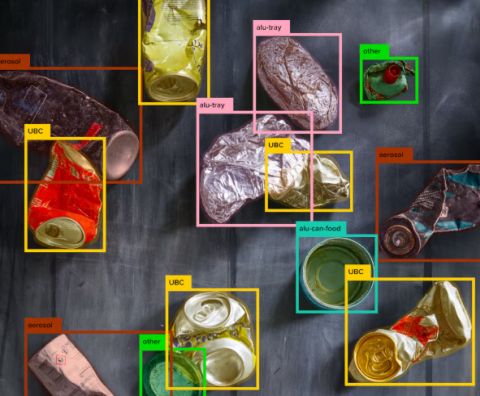
TOMRA’s GAINnext solution leverages AI and machine learning to improve sorting.
The new UBC application achieves over 98% purity without manual sorting, automating the process to enhance capture efficiency in material recovery facilities (MRFs). By using sophisticated AI, GAINnext can instantly identify and eject non-UBC aluminum, such as aerosols and food cans, enabling precise automated sorting.
Equipped with an RGB camera trained on thousands of images, GAINnext recognizes UBCs based on various characteristics and processes up to 2,000 ejections per minute, and the deep learning software identifies overlapping objects and calculates positioning for high-precision.
Before adding the UBC application, TOMRA had launched five new deep learning sorting applications for plastics and paper using GAINnext. Three of these applications efficiently separate food-grade from non-food-grade PET, PP, and HDPE, achieving purity levels of up to 95%.
Additionally, there are two non-food applications: one enhances PET purity for cleaner bottle streams, while the other focuses on deinking paper for improved quality.
BASF has partnered with Endress+Hauser, TechnoCompound, and the Universities of Bayreuth and Jena to study how mechanical recycling of plastics can be improved. Funded by the German Federal Ministry of Education and Research (BMBF), the SpecReK project aims to accurately identifying plastic waste composition during recycling by combining state-of-the-art measuring techniques with AI.
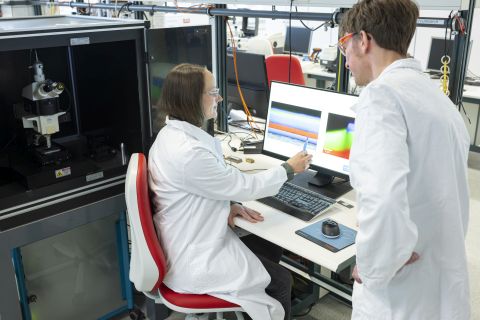
BASF and research partners study how the mechanical recycling of plastics can be improved by integrating AI technology.
Using advanced spectroscopic methods, researchers analyze how the material interacts with light to gather data on the chemical structure of the recycled plastics. This information will be used to determine in real time during processing which plastic grades, additives and contaminants are contained in the material.
An AI algorithm will then recognize patterns in the measurement data, suggesting additional components should be added or how the recycling process should be adapted to improve the quality of the recycled plastic output.
Enhancing traceability for more sustainable supply chains
In response to growing consumer demands and regulatory pressures, Covestro has teamed up with Alibaba Cloud to enhance the traceability of sustainable materials using AI technology.
Under this partnership, Covestro provides more sustainable plastic solutions along with their carbon footprint data. Alibaba Cloud’s AI-driven Energy Expert platform plays a crucial role in realizing the whole life cycle emission accounting from recycled materials to final consumer products leveraging technology such as blockchain.
Their joint solutions are already making an impact in the consumer goods sector. For example, Covestro partnered with Nongfu Spring to recycle water barrels into post-consumer recycled (PCR) polycarbonate, which KACO utilized to produce gel pens. With the AI capabilities of Alibaba Cloud, consumers can scan a QR code on the pen packaging to trace material origins and access detailed carbon footprint information.
Circularise, a provider of digital product passport software, has launched a pilot project with SABIC to enhance traceability and sustainability in supply chains. This initiative aims to validate blockchain's application in mapping Scope 3 emissions and calculating CO2 impacts throughout the value chain.
Circularise collaborates with SABIC on Scope 3 blockchain tracking.
Reporting Scope 3 emissions is complex due to unreliable data and limited visibility beyond tier-1 suppliers. Blockchain technology offers a potentially efficient solution to improve transparency and accountability while reducing risks in supply chains.
In this project, SABIC will use Circularise’s digital product passport to gather Scope 1 and Scope 2 data at the material level, facilitating the tracking of Scope 3 CO2 emissions across targeted industries. This approach enhances traceability and simplifies data collection, benefiting recyclers, converters, and manufacturers by reducing administrative burdens.
Additionally, Circularise has introduced MassBalancer, an ISCC PLUS mass balance bookkeeping automation tool that streamlines data management.