











Search History
Clear History
{{item.search_key}}
Hot Searches
Change
{{item.name}}
{{item.english_name}}
Subscribe eNews
Once A Week Once Every Two Weeks
{{sum}}
Login Register

Applications

Viridor closes European chemical recycling operations

Syensqo advanced materials power US Army’s MV-75 Cheyenne

DePoly inaugurates its depolymerization Showcase Plant in Switzerland

Products

YIZUMI delivers 5500T injection molding machine to Algeria

Songwon introduces first RSPO-certified product

ENGEL sets up clearmelt Competence Center to reduce project complexity

Activities

  • ArabPlast 2027 - Set to Become the Middle East's Largest Gathering for Plastics, Petrochemicals, Polymers, Packaging, Chemicals, Recycling and Rubber industry

  • PLAST 2026 concluded beyond expectations

  • CRRE inks agreement with 5 key players in wind and solar equipment circularity

Pictorial

News Videos

A talk with Italian injection molding expert BMB

Inside Moretto: A tour of their Italian production facilities

Top 10 Technology Trends awards presented at CHINAPLAS 2026

Conference Videos

Summit Dialogue: Policy alignment and practices in plastic recycling across Asia

Interview: Pathways for development of plastics recycling in Malaysia

Driving systemic change: Unilever’s evolution in the circular economy

Corporate/Product Videos

Why do putty bags always burst on arrival? Here's why.

Why Do Shoe Soles Keep Cracking? The Raw Material Truth No One Talks About

Tired of repairing the same roads? 30 seconds to unmask the real troublemaker in your asphalt.

Home > News > Recycling

Aduro succeeds in testing chemical recycling for synthetic turf waste

Source:Adsale Plastics Network Date :2025-08-05 Editor :RC
Copyright: This article was originally written/edited by Adsale Plastics Network (AdsaleCPRJ.com), republishing and excerpting are not allowed without permission. For any copyright infringement, we will pursue legal liability in accordance with the law.

Aduro Clean Technologies has completed successful initial testing of synthetic turf, commonly used in sports stadiums and landscaping, as a feedstock for its proprietary Hydrochemolytic Technology (HCT).
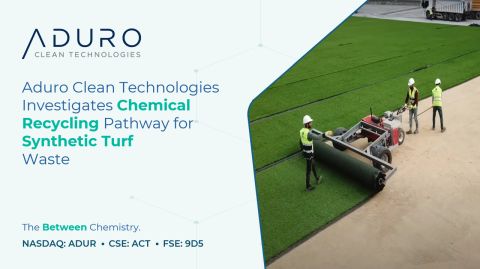

Aduro Clean_synthetic turf chemcial recycling.jpg


Aduro Clean Technologies has completed initial testing of synthetic turf as feedstock for its chemical recycling methods.


Challenges to mechanical recycling multilayer synthetic turf


The samples reflected the typical multilayer structure of modern synthetic turf systems, including polyethylene (PE) grass blades, polypropylene (PP) thatch layers, primary and secondary PP backing layers, residual infill materials such as silica sand and crumb rubber and polyurethane adhesives used to secure the backing and fibers.


This complex composition, which combines multiple plastics, thermoset adhesives, and inorganic materials, poses challenges for mechanical recycling and limits compatibility with conventional chemical recycling methods that rely on cleaner, more uniform input streams.


“Synthetic turf is a good example—its multilayer construction, bonded components, and contamination make it difficult to process through traditional means. These are the kinds of waste streams that may be better suited to right-sized, modular chemical recycling systems like HCT,” said Ofer Vicus, CEO of Aduro.


Aduro Hydrochemolytic Technology (HCT) for chemical recycling


Testing showed that Aduro’s chemical recycling process selectively converted the polyolefin components of the turf into shorter-chain hydrocarbon products, which are relevant as potential feedstocks for steam cracking and new polymer production.


This was achieved without extensive preprocessing, as the process demonstrated tolerance for the mixed materials and contaminants typically present in aged turf systems.


These outcomes contribute to ongoing efforts to evaluate the applicability of Hydrochemolytic Technology to complex waste streams that are not readily addressed by conventional recycling methods.


Future development work


Aduro is continuing development work with industry stakeholders, including additional testing, output characterization, and evaluations related to process economics and scale-up potential.


This work is part of the Company’s broader effort to assess the applicability of Hydrochemolytic Technology to complex waste streams that are underserved by traditional recycling infrastructure.


The Company’s Next Generation Process (NGP) Pilot Plant, currently under construction, is designed with the flexibility to process a broad range of feedstocks. Insights gained from the field turf testing program will help inform future operating strategies and feedstock evaluation protocols at the pilot scale.


Beyond artificial turf, carpet material also poses recovery challenges that would suggest it could be a future candidate for modular, scalable chemical recycling.


 Like 丨  {{details_info.likes_count}}
Chemical recycling

The content you're trying to view is for members only. If you are currently a member, Please login to access this content.   Login

Source:Adsale Plastics Network Date :2025-08-05 Editor :RC
Copyright: This article was originally written/edited by Adsale Plastics Network (AdsaleCPRJ.com), republishing and excerpting are not allowed without permission. For any copyright infringement, we will pursue legal liability in accordance with the law.

Aduro Clean Technologies has completed successful initial testing of synthetic turf, commonly used in sports stadiums and landscaping, as a feedstock for its proprietary Hydrochemolytic Technology (HCT).


Aduro Clean_synthetic turf chemcial recycling.jpg


Aduro Clean Technologies has completed initial testing of synthetic turf as feedstock for its chemical recycling methods.


Challenges to mechanical recycling multilayer synthetic turf


The samples reflected the typical multilayer structure of modern synthetic turf systems, including polyethylene (PE) grass blades, polypropylene (PP) thatch layers, primary and secondary PP backing layers, residual infill materials such as silica sand and crumb rubber and polyurethane adhesives used to secure the backing and fibers.


This complex composition, which combines multiple plastics, thermoset adhesives, and inorganic materials, poses challenges for mechanical recycling and limits compatibility with conventional chemical recycling methods that rely on cleaner, more uniform input streams.


“Synthetic turf is a good example—its multilayer construction, bonded components, and contamination make it difficult to process through traditional means. These are the kinds of waste streams that may be better suited to right-sized, modular chemical recycling systems like HCT,” said Ofer Vicus, CEO of Aduro.


Aduro Hydrochemolytic Technology (HCT) for chemical recycling


Testing showed that Aduro’s chemical recycling process selectively converted the polyolefin components of the turf into shorter-chain hydrocarbon products, which are relevant as potential feedstocks for steam cracking and new polymer production.


This was achieved without extensive preprocessing, as the process demonstrated tolerance for the mixed materials and contaminants typically present in aged turf systems.


These outcomes contribute to ongoing efforts to evaluate the applicability of Hydrochemolytic Technology to complex waste streams that are not readily addressed by conventional recycling methods.


Future development work


Aduro is continuing development work with industry stakeholders, including additional testing, output characterization, and evaluations related to process economics and scale-up potential.


This work is part of the Company’s broader effort to assess the applicability of Hydrochemolytic Technology to complex waste streams that are underserved by traditional recycling infrastructure.


The Company’s Next Generation Process (NGP) Pilot Plant, currently under construction, is designed with the flexibility to process a broad range of feedstocks. Insights gained from the field turf testing program will help inform future operating strategies and feedstock evaluation protocols at the pilot scale.


Beyond artificial turf, carpet material also poses recovery challenges that would suggest it could be a future candidate for modular, scalable chemical recycling.


全文内容需要订阅后才能阅读哦~
立即订阅

Recommended Articles

Recycling
Viridor closes European chemical recycling operations
 2026-07-17
Recycling
DePoly inaugurates its depolymerization Showcase Plant in Switzerland
 2026-07-17
Recycling
A deep dive into China’s 15th Five-Year Plan for Circular Economy Development
 2026-07-14
Recycling
INEOS and Recuro to build chemical recycling facility in Norway
 2026-07-14
Recycling
APR expands PCR Certification Program to whole supply chain
 2026-07-14
Recycling
ENDFOULING project to turn port organic waste into bio-based additive
 2026-07-13

Aduro succeeds in testing chemical recycling for synthetic turf waste

识别右侧二维码,进入阅读全文
下载
x 关闭
订阅
亲爱的用户,请填写一下信息
I have read and agree to the 《Terms of Use》 and 《Privacy Policy》
立即订阅
Top
Feedback
Chat
News
Market News
Applications
Products
Video
In Pictures
Specials
Activities
eBook
Front Line
Plastics Applications
Chemicals and Raw Material
Processing Technologies
Products
Injection
Extrusion
Auxiliary
Blow Molding
Mold
Hot Runner
Screw
Applications
Packaging
Automotive
Medical
Recycling
E&E
LED
Construction
Others
Events
Conference
Webinar
CHINAPLAS
CPS+ eMarketplace
Official Publications
CPS eNews
Media Kit
Social Media
Facebook
Linkedin