












Search History
Clear History
{{item.search_key}}
Hot Searches
Change
{{item.name}}
{{item.english_name}}
Subscribe eNews
Once A Week Once Every Two Weeks
{{sum}}
Log in Register

Applications

Report: Innovative Plastics Technologies Propel Medical Device Advancement

Vianode and Ateios Systems to jointly develop next generation graphite electrodes

Indorama Ventures supports Brazilian project on ocean plastic recycling

Products

Toray sets to commercialize award-winning advanced photosensitive PI patterning technology

Haitian Plastics Machinery delivers injection molding turnkey project to XPENG’s Zhaoqing base

Orinko to unveil three high-performance specialty materials at CHINAPLAS 2026

Activities

  • Must-attend: CHINAPLAS x CPRJ Plastics Recycling and Circular Economy Conference in Shanghai

  • Beyond procurement: Exploring the concurrent events at CHINAPLAS 2026

  • Chinaplas2026 Preview Webinars | Smart Blow Moulding & AI Inspection (FREE)

Pictorial

News Videos

ALPLA: Global packaging, empowering China

Evonik: Going beyond chemical boundary, innovations for limit-less future

Jwell Machinery: Plastic machinery hard power in six major areas

Conference Videos

【Mandarin session: Webinar playback】HUSKY:From Injection Molding Machines to Temperature Controllers – Diversified Product Portfolio Breaks Through Molding Challenges and Empowers Advanced Applications in End-Use Segmented Markets – Pre-Show Analysis for Chinaplas

[Live Replay] ST BlowMoulding Group: How Smart, Energy-Efficient Blow Moulding Technology Drives Sustainability

【Mandarin session: Webinar playback】SACMI: Your Digitalized Manufacturing, Your Future Today

Corporate/Product Videos

Tool Sheds Extrusion Die for PP Furniture Extrusion Line Tooling TianRui Mould

Mingsanfeng professional cap mould, Working together to pave the way for the growth of bottle cap molds.

QINGDAO BOUNI introduction video

Home > News > Market News

K 2025 Insights: American supply chain and Chinese exports under US tariffs

Source:Adsale Plastics Network Date :2025-10-28 Editor :RC
Copyright: This article was originally written/edited by Adsale Plastics Network (AdsaleCPRJ.com), republishing and excerpting are not allowed without permission. For any copyright infringement, we will pursue legal liability in accordance with the law.

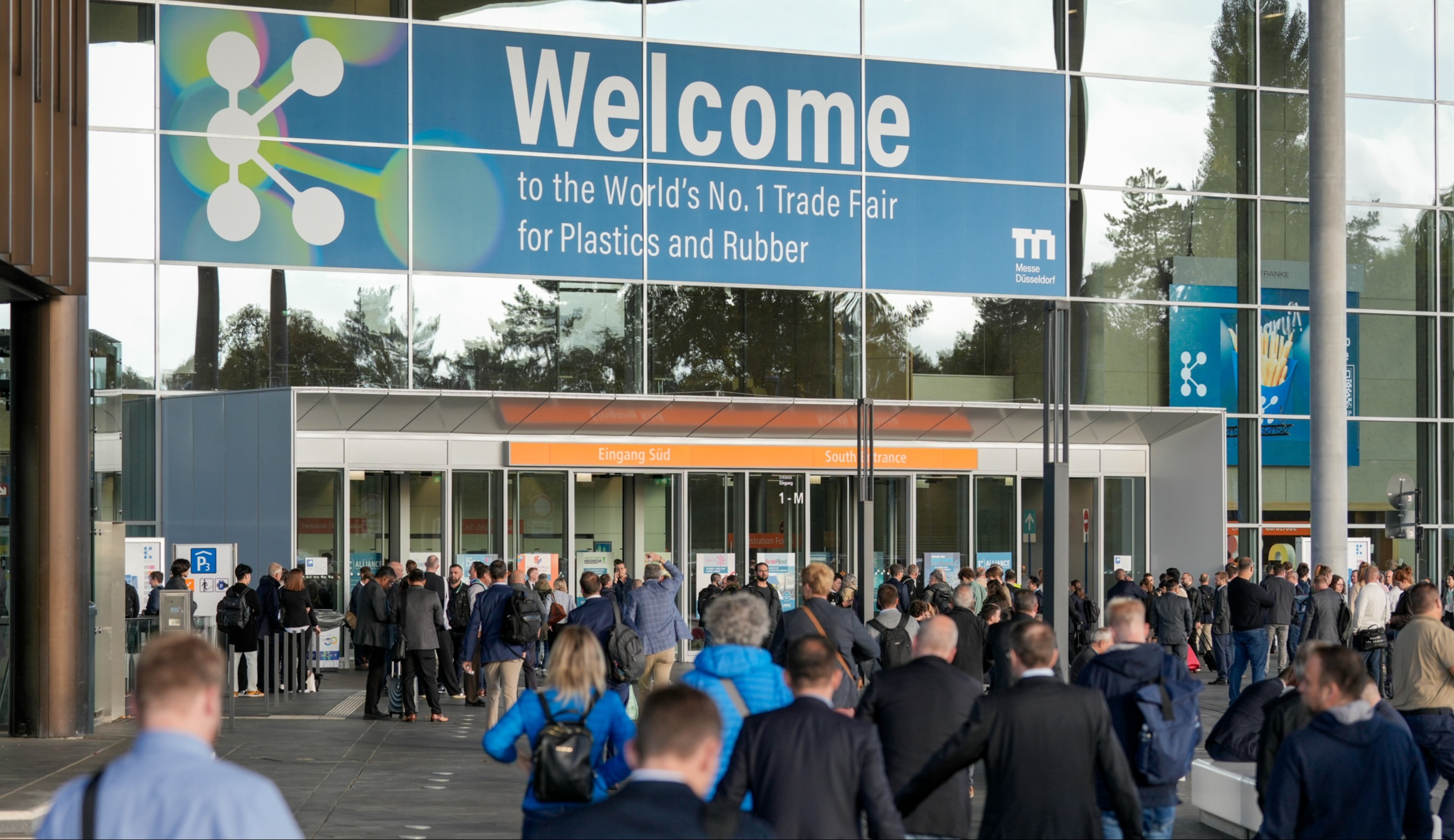
During K 2025, Donald Trump, the President of the United States, announced that the country will impose an additional 100% tariff on Chinese goods, starting November 1, 2025.


This announcement accelerated the discussion on the US tariff among companies in press conference and interactions during K 2025.


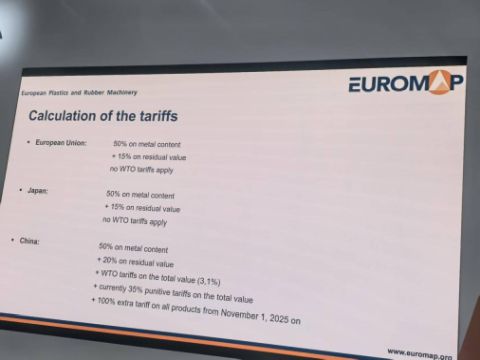
At the press conference of EUROMAP, the organization showed the complicated calculation of tariffs on plastic machinery – tariff regulations vary according to different machinery, such as injection molding machine, extrusion machine, blown film machine, recycling equipment, molds and more.


Take injection molding machine as example, calculation of US tariff on machines exported from the European Union, Japan and China vary. Among them, US tariff on machines exported from China is relatively higher.

K 2025_US tariff_01.jpg


Injection molding factory in US: Limited effect on purchasing mold


With the additional tariff, how will the domestic plastic processing industry in the US be affected?


Adsale Plastics Network has contacted a representative from an injection molding factory in the US, who had an interview with us before. He managed an injection molding factory for a plastic tiles company, which purchase molds mainly from China.


He replied, “I have recently purchased mold from China, and they are transporting to us. Even with the US tariff, the molds cost less than the ones made in the US. The US tariff does not affect our business.”


This response shows that, in short term, additional US tariff has not affected purchase decision for some manufacturing companies. Price and supply chain remain to be key factors for companies to choose where to purchase from.


However, this is just an individual company’s response. How about the overall US plastic processing industry?


Stable operation of plastics industry in the US


The Plastics Industry Association (PLASTICS) released a new economic analysis. When the US announced higher tariffs on imports in 2025 spring, one of the industry’s main concerns was their impact on the industry supply chain. So far, the data shows that there is limited impact.


As of July 2025, the value of US imports of plastic materials and resins, plastic products, plastics machinery, and molds decreased 1.0% year to date. In resin production, there was a 6.9% decrease in May year over year, followed by an increase of 0.7% in June and 7.6% in July year over year.


This reflects that the US plastic material supply remains stable in overall. With the US being a net exporter of plastic materials and resin, the tariffs have not impacted its supply of plastic materials.


For plastics processing, the Industrial Production Index (IPI) for plastic products manufacturing increased in the beginning of 2025 but shifted to a decline since April. Plastic production in August was with a 2.7% pullback.


However, plastic and rubber products manufacturers’ finished goods inventories have remained virtually flat, valued at $15.7 billion in January and $15.5 billion in July, which have not diverged much from $16.8 billion post-COVID-19 peak in 2023. This implies that supply appear to have been mitigated by available inventories.


Highly rely on imported equipment and molds


From trade structure, the tariff affects differently to parts of plastics industry. According to PLASTICS’ recently released 2025 Global Trends Report on plastics trade, domestic shipments for resin and plastic products imports in 2024 were 17.4% and 20.5% respectively.


On the other hand, Plastics equipment and molds for plastic production imports had trade flows as a percentage of domestic shipments of 68.8% and 93.0% respectively. This suggests that higher tariff rates on both could have a greater likelihood of causing supply chain disruptions.


Perc Pineda, Chief Economist of PLASTICS, pointed out that given the capacity utilization rate in plastic products manufacturing has been low, there is sufficient capacity to tap should supply chain disruptions occur via equipment and molds.


Impacts on Chinese plastic products and machinery exports


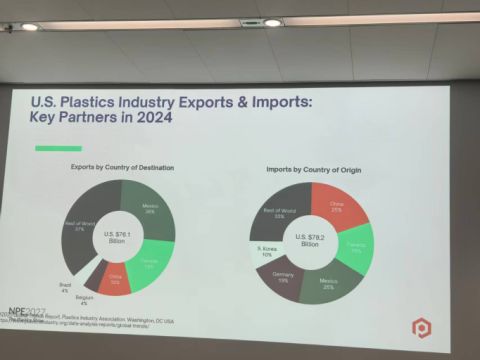
According to the report from PLASTICS, the US plastics industry import of raw materials, processing machines and plastic products valued a total of US$ 78.2 billion in 2024, of which 25% are imported from China.

K 2025_US tariff_02.jpg


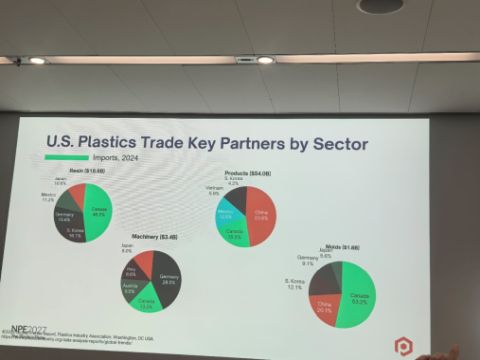
Export of Chinese plastic products and molds to the US valued at around US$ 18.14 billion and US$360 million respectively.

K 2025_US tariff_03.jpg


China’s low-value-added products and molds account for the majority of US imported plastic goods. These are mainly competitive on the price, which may be easily affected by the rise in tariff. If the additional 100% tariff was implemented, related companies may have significant sales reduction in short term while some orders may be shifted to Mexico and Vietnam.


However, speaking in longer term, the US domestic production cost and mold productivity may not fully replace China’s supply chain in short run, especially for mold and extrusion equipment. Chinese companies still own advantages in delivery time, system integration ability, and parts supply.


Notably, this additional tariff may create internal “redistribution effect” in global manufacturing industry. As Chinese plastic equipment has higher cost-performance ratio in European and American markets, other markets, such as Latin America, Middle East and Africa), may also be new markets for expansion. Chinese plastic machinery providers that focus on export should consider multi-market distribution for future strategic development.


Conclusion: Industrial restructuring still under observation


US tariff is undoubtedly the concern for plastics industry. However, the effects caused by it are still unclear.


In short term, supply chain of the US plastic industry will remain stable. As companies have sufficient stock, productivity may not be affected.


In mid-long term, as the high tariff continues to be implemented, importing equipment and molds may cause economic pressure to US companies.


In general, the plastics industry is currently in a new balancing cycle. Although US tariff may shift trading paths of Chinese suppliers, cost, efficiency and technology remain to be core to the industry.


 Like 丨  {{details_info.likes_count}}
K Fair
US
Import and export

The content you're trying to view is for members only. If you are currently a member, Please login to access this content.   Log in

Source:Adsale Plastics Network Date :2025-10-28 Editor :RC
Copyright: This article was originally written/edited by Adsale Plastics Network (AdsaleCPRJ.com), republishing and excerpting are not allowed without permission. For any copyright infringement, we will pursue legal liability in accordance with the law.

During K 2025, Donald Trump, the President of the United States, announced that the country will impose an additional 100% tariff on Chinese goods, starting November 1, 2025.


This announcement accelerated the discussion on the US tariff among companies in press conference and interactions during K 2025.


At the press conference of EUROMAP, the organization showed the complicated calculation of tariffs on plastic machinery – tariff regulations vary according to different machinery, such as injection molding machine, extrusion machine, blown film machine, recycling equipment, molds and more.


Take injection molding machine as example, calculation of US tariff on machines exported from the European Union, Japan and China vary. Among them, US tariff on machines exported from China is relatively higher.


K 2025_US tariff_01.jpg


Injection molding factory in US: Limited effect on purchasing mold


With the additional tariff, how will the domestic plastic processing industry in the US be affected?


Adsale Plastics Network has contacted a representative from an injection molding factory in the US, who had an interview with us before. He managed an injection molding factory for a plastic tiles company, which purchase molds mainly from China.


He replied, “I have recently purchased mold from China, and they are transporting to us. Even with the US tariff, the molds cost less than the ones made in the US. The US tariff does not affect our business.”


This response shows that, in short term, additional US tariff has not affected purchase decision for some manufacturing companies. Price and supply chain remain to be key factors for companies to choose where to purchase from.


However, this is just an individual company’s response. How about the overall US plastic processing industry?


Stable operation of plastics industry in the US


The Plastics Industry Association (PLASTICS) released a new economic analysis. When the US announced higher tariffs on imports in 2025 spring, one of the industry’s main concerns was their impact on the industry supply chain. So far, the data shows that there is limited impact.


As of July 2025, the value of US imports of plastic materials and resins, plastic products, plastics machinery, and molds decreased 1.0% year to date. In resin production, there was a 6.9% decrease in May year over year, followed by an increase of 0.7% in June and 7.6% in July year over year.


This reflects that the US plastic material supply remains stable in overall. With the US being a net exporter of plastic materials and resin, the tariffs have not impacted its supply of plastic materials.


For plastics processing, the Industrial Production Index (IPI) for plastic products manufacturing increased in the beginning of 2025 but shifted to a decline since April. Plastic production in August was with a 2.7% pullback.


However, plastic and rubber products manufacturers’ finished goods inventories have remained virtually flat, valued at $15.7 billion in January and $15.5 billion in July, which have not diverged much from $16.8 billion post-COVID-19 peak in 2023. This implies that supply appear to have been mitigated by available inventories.


Highly rely on imported equipment and molds


From trade structure, the tariff affects differently to parts of plastics industry. According to PLASTICS’ recently released 2025 Global Trends Report on plastics trade, domestic shipments for resin and plastic products imports in 2024 were 17.4% and 20.5% respectively.


On the other hand, Plastics equipment and molds for plastic production imports had trade flows as a percentage of domestic shipments of 68.8% and 93.0% respectively. This suggests that higher tariff rates on both could have a greater likelihood of causing supply chain disruptions.


Perc Pineda, Chief Economist of PLASTICS, pointed out that given the capacity utilization rate in plastic products manufacturing has been low, there is sufficient capacity to tap should supply chain disruptions occur via equipment and molds.


Impacts on Chinese plastic products and machinery exports


According to the report from PLASTICS, the US plastics industry import of raw materials, processing machines and plastic products valued a total of US$ 78.2 billion in 2024, of which 25% are imported from China.


K 2025_US tariff_02.jpg


Export of Chinese plastic products and molds to the US valued at around US$ 18.14 billion and US$360 million respectively.


K 2025_US tariff_03.jpg


China’s low-value-added products and molds account for the majority of US imported plastic goods. These are mainly competitive on the price, which may be easily affected by the rise in tariff. If the additional 100% tariff was implemented, related companies may have significant sales reduction in short term while some orders may be shifted to Mexico and Vietnam.


However, speaking in longer term, the US domestic production cost and mold productivity may not fully replace China’s supply chain in short run, especially for mold and extrusion equipment. Chinese companies still own advantages in delivery time, system integration ability, and parts supply.


Notably, this additional tariff may create internal “redistribution effect” in global manufacturing industry. As Chinese plastic equipment has higher cost-performance ratio in European and American markets, other markets, such as Latin America, Middle East and Africa), may also be new markets for expansion. Chinese plastic machinery providers that focus on export should consider multi-market distribution for future strategic development.


Conclusion: Industrial restructuring still under observation


US tariff is undoubtedly the concern for plastics industry. However, the effects caused by it are still unclear.


In short term, supply chain of the US plastic industry will remain stable. As companies have sufficient stock, productivity may not be affected.


In mid-long term, as the high tariff continues to be implemented, importing equipment and molds may cause economic pressure to US companies.


In general, the plastics industry is currently in a new balancing cycle. Although US tariff may shift trading paths of Chinese suppliers, cost, efficiency and technology remain to be core to the industry.


全文内容需要订阅后才能阅读哦~
立即订阅

Recommended Articles

Market News
Amid Middle East turmoil and soaring oil prices, are recycled plastics really benefiting?
 2026-03-25
Corporate News
OMV agrees with ADNOC on delay of Borouge Group International listing, exchange offer and capital increase
 2026-03-25
Market News
BOLE Intelligent Machinery unveils innovative injection molding solutions at CHINAPLAS 2026
 2026-03-24
Market News
Vietnam drives ASEAN towards a modern economy
 2026-03-24
Focus
Strengthening Global Presence Through Key International Exhibitions
 2026-03-23
  ZHEJIANG BASTONE TECHNOLOGY CO.,LTD. 标准会员

Market News
Plastic Antistatic Agent
 2026-03-23
  DA CHUANG NEW MATERIAL TECHNOLOGY (SHANDONG) CO., LTD 标准会员

You May Be Interested In

Change

  • People
  • Company
loading... No Content
{{[item.truename,item.truename_english][lang]}} {{[item.company_name,item.company_name_english][lang]}} {{[item.job_name,item.name_english][lang]}}
{{[item.company_name,item.company_name_english][lang]}} Company Name    {{[item.display_name,item.display_name_english][lang]}}  

Polyurethane Investment Medical Carbon neutral Reduce cost and increase efficiency CHINAPLAS Financial reports rPET INEOS Styrolution Evonik Borouge Polystyrene (PS) mono-material Sustainability Circular economy BASF SABIC Multi-component injection molding machine All-electric injection molding machine Thermoforming machine

K 2025 Insights: American supply chain and Chinese exports under US tariffs

识别右侧二维码,进入阅读全文
下载
x 关闭
订阅
亲爱的用户,请填写一下信息
I have read and agree to the 《Terms of Use》 and 《Privacy Policy》
立即订阅
Top
Feedback
Chat
News
Market News
Applications
Products
Video
In Pictures
Specials
Activities
eBook
Front Line
Plastics Applications
Chemicals and Raw Material
Processing Technologies
Products
Injection
Extrusion
Auxiliary
Blow Molding
Mold
Hot Runner
Screw
Applications
Packaging
Automotive
Medical
Recycling
E&E
LED
Construction
Others
Events
Conference
Webinar
CHINAPLAS
CPS+ eMarketplace
Official Publications
CPS eNews
Media Kit
Social Media
Facebook
Linkedin