























Plastics manufacturing outpaces comparable materials in value added in US

The Plastics Industry Association (PLASTICS) releases its “Size and Impact Report” every year to quantifies the size of the plastics industry and its economic impact. One of the metrics in the report is the industry’s value added compared to that of the overall manufacturing sector.
The economic concept of value added refers to the amount by which the value of an article increases at each stage of its production, excluding initial costs. According to the definition by the Bureau of Economic Analysis (BEA) of the US, value added is an industry’s gross output minus its intermediate inputs, representing its contribution to the nation’s Gross Domestic Product (GDP).
In 2024, PLASTICS’ report shows that the inflation-adjusted value added of plastics manufacturing increased by 2.0% from 1997 to 2024, while that of overall US manufacturing decreased by 0.1% over the same period.
Perc Pineda, Chief Economist from PLASTICS, said that this suggests plastics manufacturing, as the eighth-largest manufacturing sector in the US economy (based on the dollar value of shipments), continues to make a positive contribution to US GDP. Moreover, it indicates the material’s broad acceptance as the material of choice across many sectors of the economy.
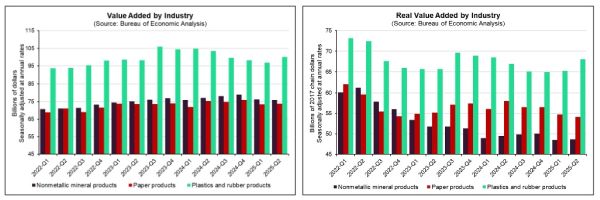
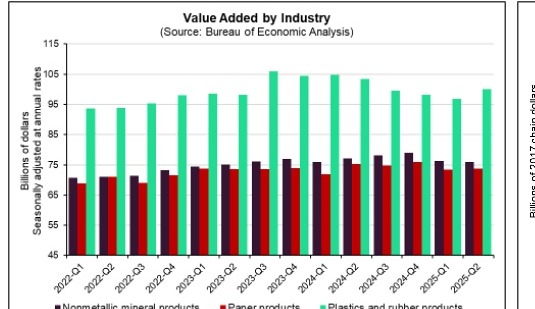
Quarterly data confirm that plastics manufacturing value added exceeds that of paper and glass (nonmetallic mineral products) manufacturing. It can be observed that during the pandemic, manufacturing activity picked up across the three sectors. As economic activity normalized, manufacturing in these sectors pulled back accordingly.
In the second quarter of 2025, it was estimated that the inflation-adjusted value added of plastics manufacturing was US$68.1 billion. This was 26% higher than that of paper products and 40% higher than that of nonmetallic mineral products, which include glass.
Without adjusting for inflation, the value added of plastics manufacturing edged up from US$96.7 billion in the first quarter to US$100.1 billion in the second quarter, a 3.4% quarterly increase.
Given the wide range of plastics applications across the manufacturing sector, it is not surprising that the value added of plastics manufacturing exceeds that of other materials with similar applications, such as paper and glass in packaging. Notably, plastics have a myriad of applications beyond packaging.
In short, plastics manufacturing continues to outpace comparable materials in value added, highlighting its significant and growing contribution to the US manufacturing sector and the macro-economy.