












Search History
Clear History
{{item.search_key}}
Hot Searches
Change
{{item.name}}
{{item.english_name}}
Subscribe eNews
Once A Week Once Every Two Weeks
{{sum}}
Log in Register

Applications

COLINES recyclable pouch with ExxonMobil Signature Polymers

Dr. Boy machines to demonstrate high-precision medical components at CHINAPLAS 2026

Market report: Three key application areas boosting upgrades in plastic packaging

Products

Syensqo to show high-performance sustainable solutions at JEC World

Analysis: US-Israel strike on Iran creates uncertainty for China's chemical imports

WITTMANN vertical machine supports efficient automation for complex metal-plastic assemblies

Activities

  • Chinaplas2026 Preview Webinars | Smart Blow Moulding & AI Inspection (FREE)

  • CHINAPLAS 2026: Government blueprint for emerging industries driving new plastics innovation

  • Fakuma to celebrate 30th anniversary edition in October 2026

Pictorial

News Videos

Automatic 5L 120mm neck PET jar blowing machine

YZ-ECO2000-4 6000BPH full automatic 4cavity bottle blowing machine

Opening Ceremony of Bechton's New Factory

Conference Videos

【Mandarin session: Webinar playback】SACMI: Your Digitalized Manufacturing, Your Future Today

[Live Replay] LK Group: Smart Manufacturing, New Chapters in Southeast Asia: High-Efficiency Solutions in PET Preform & Thin-Wall Packaging

[Live Replay] Fu Chun Shin (FCS): Data-Driven Digital Rebirth and Intelligent Future of Injection Molding

Corporate/Product Videos

QINGDAO BOUNI introduction video

PVC-O160-400 Production Line Trial Run Video

PVC-O630 production line testing

Home > News > 3D printing

No more waste! Turning spoiled milk into 3D printing material

Source:Adsale Plastics Network Date :2026-01-13 Editor :RC
Copyright: This article was originally written/edited by Adsale Plastics Network (AdsaleCPRJ.com), republishing and excerpting are not allowed without permission. For any copyright infringement, we will pursue legal liability in accordance with the law.

Two professors from University of Wisconsin-Plateville have found a way to transform dairy waste into a sustainable, biodegradable material for 3D printing.


The approved patent, titled “Development of Bio-Composite Materials for 3D Printing Using Milk Proteins”, has opened the opportunity for spoiled milk to reduce environmental footprint of 3D printing materials.
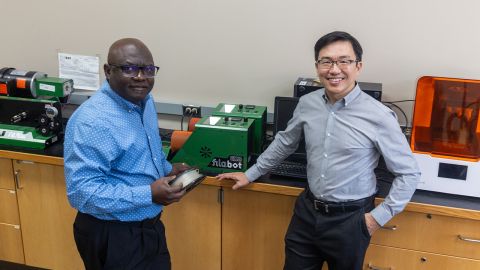

University of Wisconsin-Plateville_milk 3D printing material.jpg

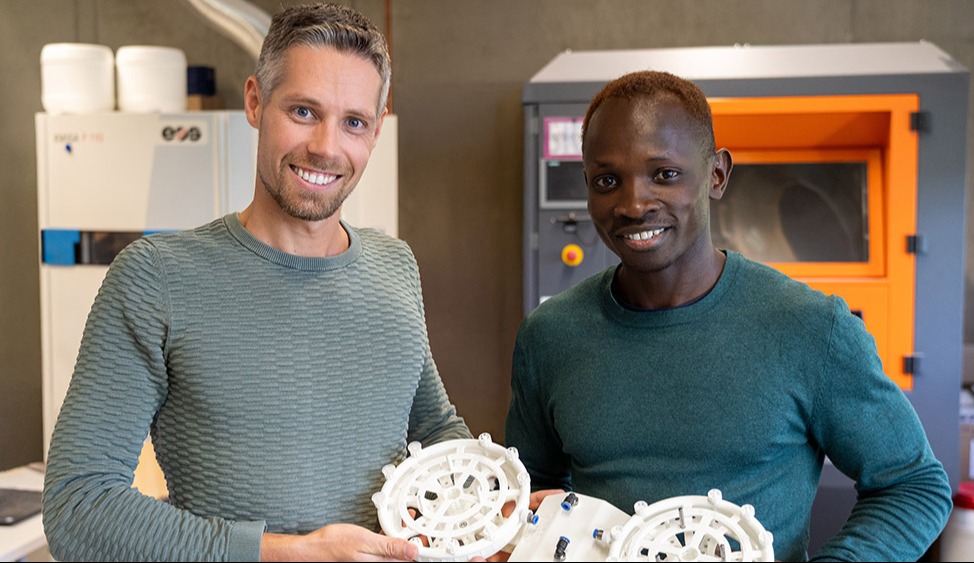
Dr John Obielodan (left) and Dr Joseph Wu (right) in the lab following the announcement of their US patent. (Source: University of Wisconsin-Plateville)


This novel method repurposes proteins from dairy waste, such as casein and whey, into useful products. This reduces dependency on petroleum-derived polymers. Moreover, this could provide a new revenue stream for dairy farmers.


“Who would have thought 3D printing and dairy protein could be combined to create a new material? My hope is that it will help both the 3D printing industry and dairy farmers in Wisconsin,” explained Dr Joseph Wu, associate professor of chemistry, one of the researchers in the project.


Finding the right kind and form of protein


The biggest challenge was determining what kind of protein, and in what form, would yield the optimum result.


The research team started by creating their own proteins, then tested some commercially available ones before finding the one that gave the best results. These proteins were used with existing 3D printing materials.


It is also important to have the right mix of ingredients for the polymer as the amounts used affect how strong and flexible it turns out. This meant some adjustments had to be made to get the best results.


Next step towards sustainability


The next step would involve further development of the technology and the transfer of intellectual property to industry partners for commercialization. 


“Looking ahead, a variety of products could be made using proteins derived from milk. From 3D printing filaments to other engineered materials, the possibilities are wide-ranging,” concluded Dr John Obielodan, professor and chair of the Department of Mechanical and Industrial Engineering, another researcher in the project.

 Like 丨  {{details_info.likes_count}}
Biodegradable
Sustainability
Circular economy
3D Print material
3D prinitng
Milk
 JIANGSU LISIDE NEW MATERIAL CO., LTD      
 SHANGHAI JANTON PLASTIC AND CHEMICAL CO.,LTD      
 HANSON PULP MOLDING TECHNOLOGY CO.,LTD.      
 FUJIAN NAN'AN STAR RUBBER&PLASTIC MACHINERY CO., LTD.      
 DMAC PRECISION TECHNOLOGY CO.,LTD      

The content you're trying to view is for members only. If you are currently a member, Please login to access this content.   Log in

Source:Adsale Plastics Network Date :2026-01-13 Editor :RC
Copyright: This article was originally written/edited by Adsale Plastics Network (AdsaleCPRJ.com), republishing and excerpting are not allowed without permission. For any copyright infringement, we will pursue legal liability in accordance with the law.

Two professors from University of Wisconsin-Plateville have found a way to transform dairy waste into a sustainable, biodegradable material for 3D printing.


The approved patent, titled “Development of Bio-Composite Materials for 3D Printing Using Milk Proteins”, has opened the opportunity for spoiled milk to reduce environmental footprint of 3D printing materials.


University of Wisconsin-Plateville_milk 3D printing material.jpg

Dr John Obielodan (left) and Dr Joseph Wu (right) in the lab following the announcement of their US patent. (Source: University of Wisconsin-Plateville)


This novel method repurposes proteins from dairy waste, such as casein and whey, into useful products. This reduces dependency on petroleum-derived polymers. Moreover, this could provide a new revenue stream for dairy farmers.


“Who would have thought 3D printing and dairy protein could be combined to create a new material? My hope is that it will help both the 3D printing industry and dairy farmers in Wisconsin,” explained Dr Joseph Wu, associate professor of chemistry, one of the researchers in the project.


Finding the right kind and form of protein


The biggest challenge was determining what kind of protein, and in what form, would yield the optimum result.


The research team started by creating their own proteins, then tested some commercially available ones before finding the one that gave the best results. These proteins were used with existing 3D printing materials.


It is also important to have the right mix of ingredients for the polymer as the amounts used affect how strong and flexible it turns out. This meant some adjustments had to be made to get the best results.


Next step towards sustainability


The next step would involve further development of the technology and the transfer of intellectual property to industry partners for commercialization. 


“Looking ahead, a variety of products could be made using proteins derived from milk. From 3D printing filaments to other engineered materials, the possibilities are wide-ranging,” concluded Dr John Obielodan, professor and chair of the Department of Mechanical and Industrial Engineering, another researcher in the project.

全文内容需要订阅后才能阅读哦~
立即订阅

Recommended Articles

3D printing
Toray Toraypearl spherical PA12 powder for 3D printing
 2026-03-02
3D printing
No more waste! Turning spoiled milk into 3D printing material
 2026-01-13
3D printing
3D-printed sculptural coffee table with bio-based transparent polyamide
 2025-11-28
3D printing
Formnext: Modular 3D printing solution for large-format components from KraussMaffei
 2025-11-11
3D printing
Arburg withdraws from 3D printing business
 2025-09-15
3D printing
Stratasys and Shin Etsu launch silicone material for industrial 3D printing
 2025-07-23

You May Be Interested In

Change

  • People
  • Company
loading... No Content
{{[item.truename,item.truename_english][lang]}} {{[item.company_name,item.company_name_english][lang]}} {{[item.job_name,item.name_english][lang]}}
{{[item.company_name,item.company_name_english][lang]}} Company Name    {{[item.display_name,item.display_name_english][lang]}}  

Polyurethane Investment Medical Carbon neutral Reduce cost and increase efficiency CHINAPLAS Financial reports rPET INEOS Styrolution Evonik Borouge Polystyrene (PS) mono-material Sustainability Circular economy BASF SABIC Multi-component injection molding machine All-electric injection molding machine Thermoforming machine

No more waste! Turning spoiled milk into 3D printing material

识别右侧二维码,进入阅读全文
下载
x 关闭
订阅
亲爱的用户,请填写一下信息
I have read and agree to the 《Terms of Use》 and 《Privacy Policy》
立即订阅
Top
Feedback
Chat
News
Market News
Applications
Products
Video
In Pictures
Specials
Activities
eBook
Front Line
Plastics Applications
Chemicals and Raw Material
Processing Technologies
Products
Injection
Extrusion
Auxiliary
Blow Molding
Mold
Hot Runner
Screw
Applications
Packaging
Automotive
Medical
Recycling
E&E
LED
Construction
Others
Events
Conference
Webinar
CHINAPLAS
CPS+ eMarketplace
Official Publications
CPS eNews
Media Kit
Social Media
Facebook
Linkedin