












Search History
Clear History
{{item.search_key}}
Hot Searches
Change
{{item.name}}
{{item.english_name}}
Subscribe eNews
Once A Week Once Every Two Weeks
{{sum}}
Log in Register

Applications

KRAIBURG TPE medical-grade TPE for otoscope device components

CANNON’s POSSIBLE project for mechanically recycling rigid PU and GFRP composites

Market report: New Energy Market Expands as Plastics Solidify Foundations

Products

Covestro, Fertiglobe and TA’ZIZ explore strategic ammonia collaboration

Evonik expands hydroxyl-terminated polybutadienes global production capacity

Austria's first fully electric SAM-C automation Cell from Sumitomo (SHI) Demag

Activities

  • CHINAPLAS 2026: Government blueprint for emerging industries driving new plastics innovation

  • Fakuma to celebrate 30th anniversary edition in October 2026

  • Italy pavilion at Plast Eurasia proves its rising presence in Turkish market

Pictorial

Industry Topic

Green Plastics: News & Insights

ASEAN: The Next Manufacturing Hub

Injection Molding: What's Next?

CHINAPLAS

CHINAPLAS 2025 Focus

CHINAPLAS 2024 Focus

CHINAPLAS 2023 Focus

Exhibition Topic

CHINA INSIGHT

K 2025 FOCUS

K 2022 FOCUS

News Videos

Haitian South China Headquarters opening

BEILIJIA Double Walled Corrugated Pipe Plant

Magnetic mold changing system developed in-house by Shanghai Qiaotian

Conference Videos

【Mandarin session: Webinar playback】SACMI: Your Digitalized Manufacturing, Your Future Today

[Live Replay] LK Group: Smart Manufacturing, New Chapters in Southeast Asia: High-Efficiency Solutions in PET Preform & Thin-Wall Packaging

[Live Replay] Fu Chun Shin (FCS): Data-Driven Digital Rebirth and Intelligent Future of Injection Molding

Corporate/Product Videos

Langfang Zhongfeng Mechanical Technology Co., Ltd., the leading pioneer of manufacturing high speed film blowing machine and bag making machines in China

PolySuper South China Branch Grandly & Officially Launched!

Bag-making machine waste collection machine

Exhibition

Playback TECHHUB 2025@CPRJ Live Streaming for CHINAPLAS

Playback TECHHUB@CPRJ Live Streaming for CHINAPLAS

Events

Playback On April 14, the "6th Edition CHINAPLAS x CPRJ Plastics Recycling and Circular Economy Conference and Showcase" at the Crowne Plaza Shenzhen Nanshan is currently being livestreamed!

Playback 5th Edition CHINAPLAS x CPRJ Plastics Recycling and Circular Economy Conference and Showcase

Home > News > Recycling

CANNON’s POSSIBLE project for mechanically recycling rigid PU and GFRP composites

Source:Adsale Plastics Network Date :2026-02-16 Editor :RC
Copyright: This article was originally written/edited by Adsale Plastics Network (AdsaleCPRJ.com), republishing and excerpting are not allowed without permission. For any copyright infringement, we will pursue legal liability in accordance with the law.

CANNON has developed a revolutionary approach to recycling polyurethane (PU) and PU-glass fiber composites (GFRPs).


The project, named POSSIBLE, for “PrOduce SuStainabLE Industrial Bodies”, has laid the groundwork for PU and GFRPs end-of-life recycling and reuse, successfully demonstrating that ground foam and granulated parts can be used as secondary reinforcement materials in new composite formulations.


The approach is developed in close cooperation with PU processor MAP S.p.A. and the University of Bergamo, with co-funding from the Italian strategic plan for the EU recovery fund NextGenerationEU.


CANNON will present this innovative recycling approach at JEC World 2026 on March 10-12 at Paris Nord Villepinte.


Previous challenge: Slow and expensive


Scientific research has developed several potential chemical recycling routes for thermosets, but these work are on a laboratory scale and are often too slow, too expensive, or incompatible with existing PU manufacturing processes.


CANNON therefore decided to focus on a more direct approach, reintegrating pure or composite rigid PU waste through two complementary methods, both compatible with their high-pressure systems.


First approach: Transforming into micrometric powders


The first approach involved transforming rigid foam waste into micrometric powders, which were then dispersed into the polyol to form a slurry and dosed as a liquid component using a mixing head.


Rigid foam waste is transformed into two types of powder, a fine powder (PU-A), with most particles below 75 µm, and a coarser powder (PU-B), between 300 and 500 µm. The dispersions were made by introducing the dried powders into a reactor with polyol, up to 20% by weight of the polyol stream, equal to about 5% of the foam.


To handle these dense slurries, CANNON divided the isocyanate and the polyol into two streams, one “clean” and one “loaded.” This way, the mixing energy remains high, and the system remains stable, even with viscosities that can exceed 10,000 mPa·s.


Then, the slurry is dosed via a scraper cylinder. Subsequent analyses show homogeneous panels with good distribution for the recycled powder. Furthermore, the thermal conductivity increases by only about 4% compared to the reference, which allows for maintaining valid insulating performance even with 3% recycled content in the foam.


Second approach: Introducing as solid filler into mixture


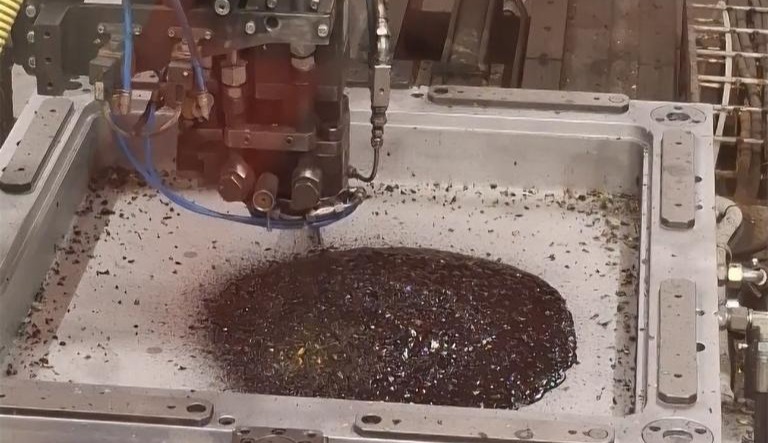
The second involved using rigid PU granulate and polyurethane-glass fiber composite, introduced as a solid filler into the mixture using dedicated dosing systems combined with the FPL 36 IW mixing head for Interwet-LFI (Long Fiber Injection) technology patented by CANNON.

CANNON_FPL 36 IW high-pressure mixing head.JPG

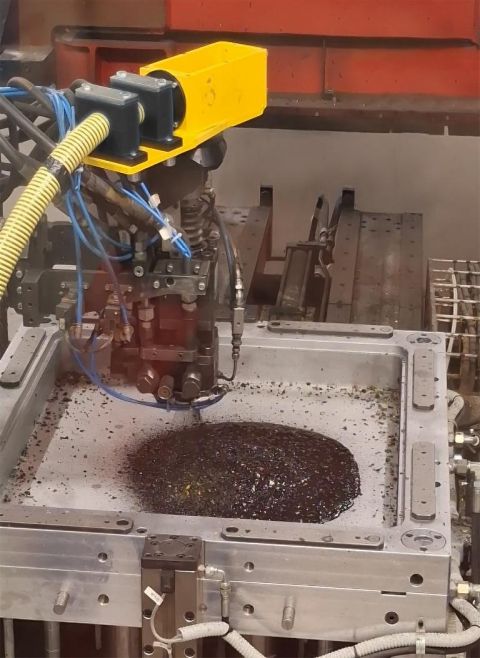
CANNON FPL 36 IW high-pressure mixing head.


PU waste, including polyurethane-glass fiber composites, is transformed into granules. These are then dosed as a solid filler directly into the Interwet-LFI head. This technology is already in use to combine polyurethane and shredded glass fiber and allows recycled granules to be integrated into the mixing flow.


To determine the most efficient feeding system, both pneumatic fluid bed transport and a flexible screw conveyor were tested. The former offers good results with dense, regular granules, but becomes unstable with light or powdery materials.


The flexible screw conveyor proved to be more versatile: it allows flow rates from a few grams to over 100 g/s, without pulsations or bridging, making it ideal for GFRP granules from waste. With this configuration, panels containing up to 40% recycled granules by weight were produced, with uniform distribution throughout the thickness.


True circularity in thermosets, and going beyond


Subsequent testing by CANNON showed that recycling rigid polyurethanes and GFRP composites can become an integral part of production lines. They do not require invasive processes or radical changes to formulations but transform waste into a material that can be reused in the process, with immediate economic and environmental benefits.


This is a concrete step towards circularity in thermosets, a family of materials for which recycling was previously considered almost impossible.


Based on research conducted during POSSIBLE, CANNON is now working on commercially viable solutions for recycling PU and GFRPs that will enter the market in the near future.


 Like 丨  {{details_info.likes_count}}
Polyurethane
Recycling
Glass fiber
 SACMI (SHANGHAI) MACHINERY EQUIPMENT CO., LTD.      
 DONGGUAN DEHUA PRECISION MOLD CO., LTD      
 JUHESHUN ADVANCED MATERIALS CO., LTD.      
 GREENWICH (CHINA) TECHNOLOGY DEVELOPMENT LIMITED      
 LINKER NEW MATERIALS CO., LTD      
 SHANGHAI HAWKWAY PROCESS SOLUTIONS CO., LTD      
 GUANGXI HENGYI NEW MATERIALS CO., LTD.      
 GUANGXI WUZHOU GUOLONG RECYCLABE RESOURCES DEVELOPMENT CO., LTD.      
 YUYAO KAWAGUCHI Manufacturing Co., Ltd.      
 ANHUI ZHONGXIN HONGWEI TECHNOLOGY CO.,LTD      
 FUJIAN NAN'AN STAR RUBBER&PLASTIC MACHINERY CO., LTD.      
 ZHANGJIAGANG GREENLANDPLAST MACHINERY CO.,LTD      

The content you're trying to view is for members only. If you are currently a member, Please login to access this content.   Log in

Source:Adsale Plastics Network Date :2026-02-16 Editor :RC
Copyright: This article was originally written/edited by Adsale Plastics Network (AdsaleCPRJ.com), republishing and excerpting are not allowed without permission. For any copyright infringement, we will pursue legal liability in accordance with the law.

CANNON has developed a revolutionary approach to recycling polyurethane (PU) and PU-glass fiber composites (GFRPs).


The project, named POSSIBLE, for “PrOduce SuStainabLE Industrial Bodies”, has laid the groundwork for PU and GFRPs end-of-life recycling and reuse, successfully demonstrating that ground foam and granulated parts can be used as secondary reinforcement materials in new composite formulations.


The approach is developed in close cooperation with PU processor MAP S.p.A. and the University of Bergamo, with co-funding from the Italian strategic plan for the EU recovery fund NextGenerationEU.


CANNON will present this innovative recycling approach at JEC World 2026 on March 10-12 at Paris Nord Villepinte.


Previous challenge: Slow and expensive


Scientific research has developed several potential chemical recycling routes for thermosets, but these work are on a laboratory scale and are often too slow, too expensive, or incompatible with existing PU manufacturing processes.


CANNON therefore decided to focus on a more direct approach, reintegrating pure or composite rigid PU waste through two complementary methods, both compatible with their high-pressure systems.


First approach: Transforming into micrometric powders


The first approach involved transforming rigid foam waste into micrometric powders, which were then dispersed into the polyol to form a slurry and dosed as a liquid component using a mixing head.


Rigid foam waste is transformed into two types of powder, a fine powder (PU-A), with most particles below 75 µm, and a coarser powder (PU-B), between 300 and 500 µm. The dispersions were made by introducing the dried powders into a reactor with polyol, up to 20% by weight of the polyol stream, equal to about 5% of the foam.


To handle these dense slurries, CANNON divided the isocyanate and the polyol into two streams, one “clean” and one “loaded.” This way, the mixing energy remains high, and the system remains stable, even with viscosities that can exceed 10,000 mPa·s.


Then, the slurry is dosed via a scraper cylinder. Subsequent analyses show homogeneous panels with good distribution for the recycled powder. Furthermore, the thermal conductivity increases by only about 4% compared to the reference, which allows for maintaining valid insulating performance even with 3% recycled content in the foam.


Second approach: Introducing as solid filler into mixture


The second involved using rigid PU granulate and polyurethane-glass fiber composite, introduced as a solid filler into the mixture using dedicated dosing systems combined with the FPL 36 IW mixing head for Interwet-LFI (Long Fiber Injection) technology patented by CANNON.


CANNON_FPL 36 IW high-pressure mixing head.JPG

CANNON FPL 36 IW high-pressure mixing head.


PU waste, including polyurethane-glass fiber composites, is transformed into granules. These are then dosed as a solid filler directly into the Interwet-LFI head. This technology is already in use to combine polyurethane and shredded glass fiber and allows recycled granules to be integrated into the mixing flow.


To determine the most efficient feeding system, both pneumatic fluid bed transport and a flexible screw conveyor were tested. The former offers good results with dense, regular granules, but becomes unstable with light or powdery materials.


The flexible screw conveyor proved to be more versatile: it allows flow rates from a few grams to over 100 g/s, without pulsations or bridging, making it ideal for GFRP granules from waste. With this configuration, panels containing up to 40% recycled granules by weight were produced, with uniform distribution throughout the thickness.


True circularity in thermosets, and going beyond


Subsequent testing by CANNON showed that recycling rigid polyurethanes and GFRP composites can become an integral part of production lines. They do not require invasive processes or radical changes to formulations but transform waste into a material that can be reused in the process, with immediate economic and environmental benefits.


This is a concrete step towards circularity in thermosets, a family of materials for which recycling was previously considered almost impossible.


Based on research conducted during POSSIBLE, CANNON is now working on commercially viable solutions for recycling PU and GFRPs that will enter the market in the near future.

全文内容需要订阅后才能阅读哦~
立即订阅

Recommended Articles

Recycling
CANNON’s POSSIBLE project for mechanically recycling rigid PU and GFRP composites
 2026-02-16
Recycling
Borealis and partners join forces on Indonesia’s first fully integrated circular waste management ecosystem
 2026-02-13
Recycling
EREMA and Lindner Washtech establish subsidiary in India
 2026-02-10
Recycling
True circularity of PET packaging: Sorting food-grade PET or not with Sesotec smart sorting systems
 2026-02-05
Recycling
BoReTech opens subsidiary to tap into Indian recycling market
 2026-02-04
Recycling
CRRA and Adsale ink agreement on flagship recycling expo come 2026
 2026-02-02

You May Be Interested In

Change

  • People
  • Company
loading... No Content
{{[item.truename,item.truename_english][lang]}} {{[item.company_name,item.company_name_english][lang]}} {{[item.job_name,item.name_english][lang]}}
{{[item.company_name,item.company_name_english][lang]}} Company Name    {{[item.display_name,item.display_name_english][lang]}}  

Polyurethane Investment Medical Carbon neutral Reduce cost and increase efficiency CHINAPLAS Financial reports rPET INEOS Styrolution Evonik Borouge Polystyrene (PS) mono-material Sustainability Circular economy BASF SABIC Multi-component injection molding machine All-electric injection molding machine Thermoforming machine

CANNON’s POSSIBLE project for mechanically recycling rigid PU and GFRP composites

识别右侧二维码,进入阅读全文
下载
x 关闭
订阅
亲爱的用户,请填写一下信息
I have read and agree to the 《Terms of Use》 and 《Privacy Policy》
立即订阅
Top
Feedback
Chat
News
Market News
Applications
Products
Video
In Pictures
Specials
Activities
eBook
Front Line
Plastics Applications
Chemicals and Raw Material
Processing Technologies
Products
Injection
Extrusion
Auxiliary
Blow Molding
Mold
Hot Runner
Screw
Applications
Packaging
Automotive
Medical
Recycling
E&E
LED
Construction
Others
Events
Conference
Webinar
CHINAPLAS
CPS+ eMarketplace
Official Publications
CPS eNews
Media Kit
Social Media
Facebook
Linkedin