










Search History
Clear History
{{item.search_key}}
Hot Searches
Change
{{item.name}}
{{item.english_name}}
Subscribe eNews
Once A Week Once Every Two Weeks
{{sum}}
Log in Register

Applications

Report: Innovative Plastics Technologies Propel Medical Device Advancement

Vianode and Ateios Systems to jointly develop next generation graphite electrodes

Indorama Ventures supports Brazilian project on ocean plastic recycling

Products

Toray sets to commercialize award-winning advanced photosensitive PI patterning technology

Haitian Plastics Machinery delivers injection molding turnkey project to XPENG’s Zhaoqing base

Orinko to unveil three high-performance specialty materials at CHINAPLAS 2026

Activities

  • Must-attend: CHINAPLAS x CPRJ Plastics Recycling and Circular Economy Conference in Shanghai

  • Beyond procurement: Exploring the concurrent events at CHINAPLAS 2026

  • Chinaplas2026 Preview Webinars | Smart Blow Moulding & AI Inspection (FREE)

Pictorial

News Videos

ALPLA: Global packaging, empowering China

Evonik: Going beyond chemical boundary, innovations for limit-less future

Jwell Machinery: Plastic machinery hard power in six major areas

Conference Videos

【Mandarin session: Webinar playback】HUSKY:From Injection Molding Machines to Temperature Controllers – Diversified Product Portfolio Breaks Through Molding Challenges and Empowers Advanced Applications in End-Use Segmented Markets – Pre-Show Analysis for Chinaplas

[Live Replay] ST BlowMoulding Group: How Smart, Energy-Efficient Blow Moulding Technology Drives Sustainability

【Mandarin session: Webinar playback】SACMI: Your Digitalized Manufacturing, Your Future Today

Corporate/Product Videos

Tool Sheds Extrusion Die for PP Furniture Extrusion Line Tooling TianRui Mould

Mingsanfeng professional cap mould, Working together to pave the way for the growth of bottle cap molds.

QINGDAO BOUNI introduction video

Home > News > Market News

40% surge in a week: Middle East conflict ignites global plastics storm

Source:Adsale Plastics Network Date :2026-03-16 Editor :Vicky
Copyright: This article was originally written/edited by Adsale Plastics Network (AdsaleCPRJ.com), republishing and excerpting are not allowed without permission. For any copyright infringement, we will pursue legal liability in accordance with the law.


At the beginning of March, a military conflict in the Middle East is rapidly reshaping the price curve of the global plastics market.


On March 9, international crude oil prices surged at the market open, with both WTI and Brent Crude futures prices breaking through the US$110 per barrel threshold for the first time in over three years.


1.jpg

As of the morning of March 9, the latest international crude oil prices. (Source: Economic view)


Meanwhile, the domestic plastics market also experienced sharp fluctuations — with the prices of certain raw materials such as ABS and PC surging by over 40% within a week.


In Zhangmutou, Dongguan, a key plastics trading hub in Southern China, a rare scene emerged: "warehouses were full to bursting, with trucks lining up for hours".


From oil futures to plastic pellets, from the Middle East straits to warehouses in China, a clear price transmission chain is taking shape. Behind this volatility lies not just a short-term conflict risk, but yet another manifestation of global supply chain fragility.


From the Strait of Hormuz to plastic pellets: How is the price transmitted


The reason the Middle East situation can rapidly impact the plastics industry comes down to one geographical node: the Strait of Hormuz.


Approximately 20% of the world's oil trade passes through this strait. Once shipping is disrupted, market concerns over energy supply are quickly reflected in oil prices.


Recent tensions have led to increased shipping risks, causing international crude oil prices to climb rapidly. As oil prices rise, a chain reaction across the chemical industry is triggered.


Plastics are typical petroleum-based products. Following an increase in crude oil prices, the costs of basic chemical feedstocks like naphtha, ethylene, and propylene rise simultaneously. This, in turn, drives up the prices of engineering plastics such as ABS, PC, and PA.


This process often exhibits a clear "step-by-step transmission":

Crude Oil → Basic Chemical Feedstocks → Commodity Plastics → Modified Materials → Downstream Manufacturing


In this recent shock, market sentiment has also amplified price volatility. Fearing further cost increases, traders began stockpiling, securing supplies, and withholding inventory, while downstream companies, worried about more expensive future procurement, rushed to place orders in advance to lock in prices.


This resonance of supply-demand psychology rapidly pushed prices higher in a short period.


Zhangmutou: The “wind vane” of the plastics market


The ripple effects of rising oil prices quickly became visible in Zhangmutou, Dongguan—a key plastics trading hub in China.


As one of the country’s largest distribution centers for plastic raw materials, it brings together resources from over 60 countries, more than 900 petrochemical plants, and over 3,000 new materials companies.


In 2024, Zhangmutou’s plastic raw material trading volume reached approximately 15 million tons, with transaction value exceeding 100 billion RMB. Its price index is often regarded as a “barometer” of the domestic plastics market.


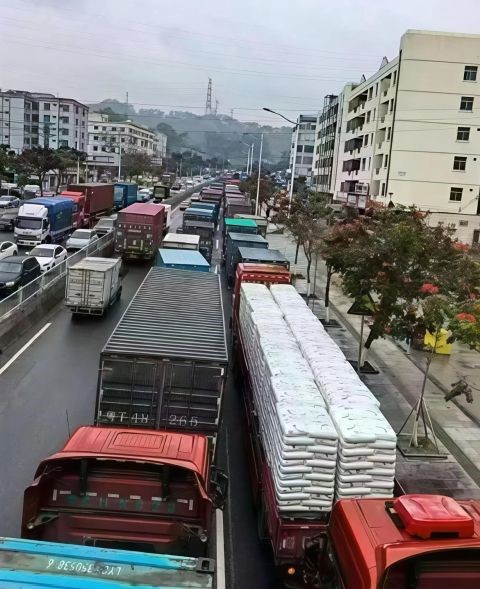
A recent video circulating online showed severe traffic congestion around the Zhangmutou plastics market, with long queues of trucks waiting to enter warehouses for pickup, and local public storage facilities reportedly at full capacity.
3.jpg

Persistent “massive traffic jam” around the plastics market in Zhangmutou, Dongguan. (Source: 21st Century Business Herald)


The plastics industry traditionally experiences a peak season known as "Golden March and Silver April". However, this year’s market movement has clearly deviated from the conventional cycle. According to industry platform statistics, since the escalation of the Middle East conflict on February 28, some raw materials like ABS and PC have seen extreme pricing situations, with quotes reportedly changing “every hour”.


Against this backdrop, how will various segments of the industrial chain respond?


Industry chain response: Price hikes, locked-in supply, and wait-and-see


Upstream companies are taking the lead in responding to rising costs by raising prices and controlling output.


On March 1, Wanhua Chemical announced a 5% to 10% price hike on its PA12 series products.


On March 4, BASF announced a global price increase for its antioxidants, process stabilizers, and light stabilizers, with some products seeing hikes of up to 20%.


Also on March 4, Zhuhai Kingfa Biomaterials Co., Ltd. issued a price adjustment notice, raising PBAT resin by RMB 700/ton and modified materials by RMB 500/ton.


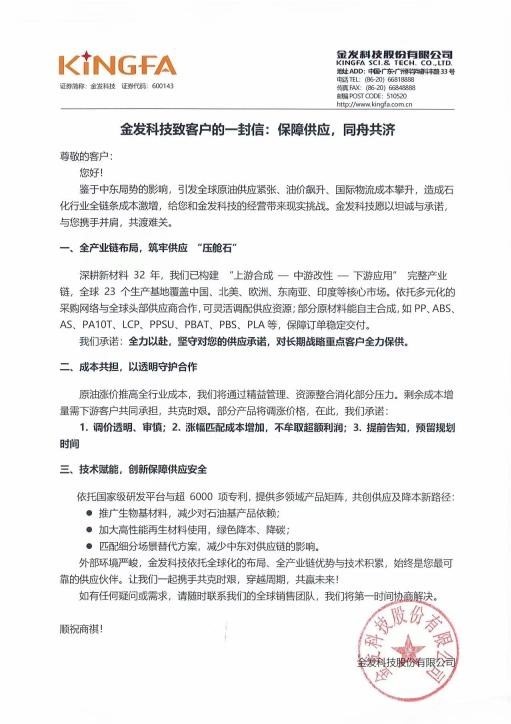
On March 7, Kingfa Science & Technology issued an open letter to its customers, stating that it would ensure supply through global sourcing and in-house synthesis of certain raw materials, while also adjusting prices on some products in line with raw material cost increases.

2.jpg

On March 7, Kingfa Science & Technology released an open letter to customers. (Source: Kingfa)


In contrast, midstream modified material producers are facing greater operational pressure: rising raw material costs, difficulties in synchronizing order prices, and limited room to renegotiate long-term contracts. Many of these companies have little choice but to lock in high-priced raw materials to maintain production, while renegotiating order prices with customers.


Downstream companies are taking divergent approaches:

Some, fearing further price increases, are choosing to procure early and lock in inventory. Others are adopting a more cautious approach—signing periodic supply agreements or deferring orders to reduce procurement risk.


Overall, a clear transmission path is taking shape across the market:

Upstream: price hikes and supply control → Midstream: locked-in material costs and absorption → Downstream: a mix of panic buying and wait-and-see


How long will the price hikes last?


Looking at historical trends, sharp increases in plastic prices often follow a distinct cyclical pattern.


In the short term, war, transport risks, and market sentiment may continue to drive prices upward. However, in the long run, price trends are still determined by supply and demand.


At present, global chemical production capacity remains relatively ample, while end-user demand has not seen a corresponding surge. Once market panic subsides and logistics return to normal, prices tend to ease.


Thus, the industry consensus is: in the coming period, plastic prices may continue to fluctuate upward, but the likelihood of sustained sharp hikes is low.


Beyond the war: A quiet shift in the industry chain


Although this round of price hikes may be a temporary fluctuation, it once again highlights a key reality: the global plastics industry chain remains highly dependent on oil and geopolitics.


When energy supplies become uncertain, the materials sector is often the first to feel the impact.


This is prompting more companies to rethink a few critical questions:

• Is there a greater need for regionalized supply chains?

• Should the shift toward recycled and bio-based materials be accelerated?

• Can technological innovation reduce reliance on raw materials?


In other words, the price volatility triggered by conflict may be more than just a short-term market movement—it could serve as a catalyst for industrial transformation.



 Like 丨  {{details_info.likes_count}}
Packaging
Recycling
 KunRun Machinery(Shanghai) Co.,Ltd.      
 SACMI (SHANGHAI) MACHINERY EQUIPMENT CO., LTD.      
 Guangdong Yilong Advanced Materials Technology Co Ltd      
 DONGGUAN DEHUA PRECISION MOLD CO., LTD      
 HENAN TENGYUE MACHINERY TECHNOLOGY CO.,LTD.      
 ZHONGSHAN SAMPROMOLD MAKING CO.,LTD      
 ZHANGJIAGANG XINRONG MACHINERY CO.,LTD      
 NANJING SAGE ADVANCED MATERIALS CO.,LTD      
 GOOD VISION & MOTION(SHENZHEN)CO,. LTD.      
 JUHESHUN ADVANCED MATERIALS CO., LTD.      
 ANHUI LITUO ENVIRONMENTAL PROTECTION NEW MATERIAL TECHNOLOGY CO.. LTD.      
 HEFEI TAIHE INTELLIGENT TECHNOLOGY GROUP CO.,LTD.      
 OQ Marketing (Shanghai) Co., Ltd.      
 BEIJING ENERGY ENGINEERING TECHNOLOGIES CO.,LTD.      
 FCS-Group      
 WINDORA MATERIALS LLC      
 GREENWICH (CHINA) TECHNOLOGY DEVELOPMENT LIMITED      
 TIANJIN PENGFEI PACKAGING PRODUCTS CO., LTD      
 WUHAN CHANGXIN PLASTIC MACHINERY CO.,LTD.      
 GREENCORE RESOURCES LIMITED      
 HAITIAN INTERNATIONAL HOLDINGS LIMITED      
 LINKER NEW MATERIALS CO., LTD      
 DSP CHEMICAL CO.,LTD      
 SHANGHAI HAWKWAY PROCESS SOLUTIONS CO., LTD      
 GUANGXI HENGYI NEW MATERIALS CO., LTD.      
 TAIZHOU MIXIN MACHINERY CO., LTD.      
 ZHEJIANG ROTOUN PLASTIC TECHNOLOGY CORP.      
 GUANGDONG GUOHENG YOUHE ADVANCED MATERIALS CO., LTD.      
 FOSHAN AILE PLASTIC MOULD CO., LTD      
 KADIDE      
 GUANGXI WUZHOU GUOLONG RECYCLABE RESOURCES DEVELOPMENT CO., LTD.      
 Shantou Bond Machinery Co., Ltd.      
 TAIZHOU HAIHUI MOULD CO.,LTD.      
 MOTAN TAICANG CO., LTD.      
 INTERNATIONAL STANDARD MACHINERY (SHANTOU) CO.,LTD      
 SUZHOU BECHTON PLASTIC MACHINERY CO., LTD      
 YUYAO KAWAGUCHI Manufacturing Co., Ltd.      
 LINYI HUASU ELECTRONIC TECHNOLOGY CO., LTD.      
 ANHUI ZHONGXIN HONGWEI TECHNOLOGY CO.,LTD      
 GUANGZHOU PULISI TECHNOLOGY CO.,LTD.      
 FUJIAN NAN'AN STAR RUBBER&PLASTIC MACHINERY CO., LTD.      
 Wuxi Jiahong Plastics Technology CO.,Ltd      
 TAIZHOU HUANGYAN TAIXIANG PLASTIC MACHINERY CO.,LTD.      
 BRUECKNER MASCHINENBAU GMBH      
 ZHANGJIAGANG GREENLANDPLAST MACHINERY CO.,LTD      
 JIANGSU GROUPSMART NEW MATERIAL CO.,LTD      
 WENZHOU DETAI PLASTICS CO., LTD      
 FOSHAN SHUNDE MINGSANFENG MOULD CO., LTD.      

The content you're trying to view is for members only. If you are currently a member, Please login to access this content.   Log in

Source:Adsale Plastics Network Date :2026-03-16 Editor :Vicky
Copyright: This article was originally written/edited by Adsale Plastics Network (AdsaleCPRJ.com), republishing and excerpting are not allowed without permission. For any copyright infringement, we will pursue legal liability in accordance with the law.


At the beginning of March, a military conflict in the Middle East is rapidly reshaping the price curve of the global plastics market.


On March 9, international crude oil prices surged at the market open, with both WTI and Brent Crude futures prices breaking through the US$110 per barrel threshold for the first time in over three years.


1.jpg

As of the morning of March 9, the latest international crude oil prices. (Source: Economic view)


Meanwhile, the domestic plastics market also experienced sharp fluctuations — with the prices of certain raw materials such as ABS and PC surging by over 40% within a week.


In Zhangmutou, Dongguan, a key plastics trading hub in Southern China, a rare scene emerged: "warehouses were full to bursting, with trucks lining up for hours".


From oil futures to plastic pellets, from the Middle East straits to warehouses in China, a clear price transmission chain is taking shape. Behind this volatility lies not just a short-term conflict risk, but yet another manifestation of global supply chain fragility.


From the Strait of Hormuz to plastic pellets: How is the price transmitted


The reason the Middle East situation can rapidly impact the plastics industry comes down to one geographical node: the Strait of Hormuz.


Approximately 20% of the world's oil trade passes through this strait. Once shipping is disrupted, market concerns over energy supply are quickly reflected in oil prices.


Recent tensions have led to increased shipping risks, causing international crude oil prices to climb rapidly. As oil prices rise, a chain reaction across the chemical industry is triggered.


Plastics are typical petroleum-based products. Following an increase in crude oil prices, the costs of basic chemical feedstocks like naphtha, ethylene, and propylene rise simultaneously. This, in turn, drives up the prices of engineering plastics such as ABS, PC, and PA.


This process often exhibits a clear "step-by-step transmission":

Crude Oil → Basic Chemical Feedstocks → Commodity Plastics → Modified Materials → Downstream Manufacturing


In this recent shock, market sentiment has also amplified price volatility. Fearing further cost increases, traders began stockpiling, securing supplies, and withholding inventory, while downstream companies, worried about more expensive future procurement, rushed to place orders in advance to lock in prices.


This resonance of supply-demand psychology rapidly pushed prices higher in a short period.


Zhangmutou: The “wind vane” of the plastics market


The ripple effects of rising oil prices quickly became visible in Zhangmutou, Dongguan—a key plastics trading hub in China.


As one of the country’s largest distribution centers for plastic raw materials, it brings together resources from over 60 countries, more than 900 petrochemical plants, and over 3,000 new materials companies.


In 2024, Zhangmutou’s plastic raw material trading volume reached approximately 15 million tons, with transaction value exceeding 100 billion RMB. Its price index is often regarded as a “barometer” of the domestic plastics market.


A recent video circulating online showed severe traffic congestion around the Zhangmutou plastics market, with long queues of trucks waiting to enter warehouses for pickup, and local public storage facilities reportedly at full capacity.

3.jpg

Persistent “massive traffic jam” around the plastics market in Zhangmutou, Dongguan. (Source: 21st Century Business Herald)


The plastics industry traditionally experiences a peak season known as "Golden March and Silver April". However, this year’s market movement has clearly deviated from the conventional cycle. According to industry platform statistics, since the escalation of the Middle East conflict on February 28, some raw materials like ABS and PC have seen extreme pricing situations, with quotes reportedly changing “every hour”.


Against this backdrop, how will various segments of the industrial chain respond?


Industry chain response: Price hikes, locked-in supply, and wait-and-see


Upstream companies are taking the lead in responding to rising costs by raising prices and controlling output.


On March 1, Wanhua Chemical announced a 5% to 10% price hike on its PA12 series products.


On March 4, BASF announced a global price increase for its antioxidants, process stabilizers, and light stabilizers, with some products seeing hikes of up to 20%.


Also on March 4, Zhuhai Kingfa Biomaterials Co., Ltd. issued a price adjustment notice, raising PBAT resin by RMB 700/ton and modified materials by RMB 500/ton.


On March 7, Kingfa Science & Technology issued an open letter to its customers, stating that it would ensure supply through global sourcing and in-house synthesis of certain raw materials, while also adjusting prices on some products in line with raw material cost increases.


2.jpg

On March 7, Kingfa Science & Technology released an open letter to customers. (Source: Kingfa)


In contrast, midstream modified material producers are facing greater operational pressure: rising raw material costs, difficulties in synchronizing order prices, and limited room to renegotiate long-term contracts. Many of these companies have little choice but to lock in high-priced raw materials to maintain production, while renegotiating order prices with customers.


Downstream companies are taking divergent approaches:

Some, fearing further price increases, are choosing to procure early and lock in inventory. Others are adopting a more cautious approach—signing periodic supply agreements or deferring orders to reduce procurement risk.


Overall, a clear transmission path is taking shape across the market:

Upstream: price hikes and supply control → Midstream: locked-in material costs and absorption → Downstream: a mix of panic buying and wait-and-see


How long will the price hikes last?


Looking at historical trends, sharp increases in plastic prices often follow a distinct cyclical pattern.


In the short term, war, transport risks, and market sentiment may continue to drive prices upward. However, in the long run, price trends are still determined by supply and demand.


At present, global chemical production capacity remains relatively ample, while end-user demand has not seen a corresponding surge. Once market panic subsides and logistics return to normal, prices tend to ease.


Thus, the industry consensus is: in the coming period, plastic prices may continue to fluctuate upward, but the likelihood of sustained sharp hikes is low.


Beyond the war: A quiet shift in the industry chain


Although this round of price hikes may be a temporary fluctuation, it once again highlights a key reality: the global plastics industry chain remains highly dependent on oil and geopolitics.


When energy supplies become uncertain, the materials sector is often the first to feel the impact.


This is prompting more companies to rethink a few critical questions:

• Is there a greater need for regionalized supply chains?

• Should the shift toward recycled and bio-based materials be accelerated?

• Can technological innovation reduce reliance on raw materials?


In other words, the price volatility triggered by conflict may be more than just a short-term market movement—it could serve as a catalyst for industrial transformation.



全文内容需要订阅后才能阅读哦~
立即订阅

Recommended Articles

Market News
Amid Middle East turmoil and soaring oil prices, are recycled plastics really benefiting?
 2026-03-25
Corporate News
OMV agrees with ADNOC on delay of Borouge Group International listing, exchange offer and capital increase
 2026-03-25
Market News
BOLE Intelligent Machinery unveils innovative injection molding solutions at CHINAPLAS 2026
 2026-03-24
Market News
Vietnam drives ASEAN towards a modern economy
 2026-03-24
Focus
Strengthening Global Presence Through Key International Exhibitions
 2026-03-23
  ZHEJIANG BASTONE TECHNOLOGY CO.,LTD. 标准会员
Market News
Plastic Antistatic Agent
 2026-03-23
  DA CHUANG NEW MATERIAL TECHNOLOGY (SHANDONG) CO., LTD 标准会员

You May Be Interested In

Change

  • People
  • Company
loading... No Content
{{[item.truename,item.truename_english][lang]}} {{[item.company_name,item.company_name_english][lang]}} {{[item.job_name,item.name_english][lang]}}
{{[item.company_name,item.company_name_english][lang]}} Company Name    {{[item.display_name,item.display_name_english][lang]}}  

Polyurethane Investment Medical Carbon neutral Reduce cost and increase efficiency CHINAPLAS Financial reports rPET INEOS Styrolution Evonik Borouge Polystyrene (PS) mono-material Sustainability Circular economy BASF SABIC Multi-component injection molding machine All-electric injection molding machine Thermoforming machine

40% surge in a week: Middle East conflict ignites global plastics storm

识别右侧二维码,进入阅读全文
下载
x 关闭
订阅
亲爱的用户,请填写一下信息
I have read and agree to the 《Terms of Use》 and 《Privacy Policy》
立即订阅
Top
Feedback
Chat
News
Market News
Applications
Products
Video
In Pictures
Specials
Activities
eBook
Front Line
Plastics Applications
Chemicals and Raw Material
Processing Technologies
Products
Injection
Extrusion
Auxiliary
Blow Molding
Mold
Hot Runner
Screw
Applications
Packaging
Automotive
Medical
Recycling
E&E
LED
Construction
Others
Events
Conference
Webinar
CHINAPLAS
CPS+ eMarketplace
Official Publications
CPS eNews
Media Kit
Social Media
Facebook
Linkedin