



















Amid Middle East turmoil and soaring oil prices, are recycled plastics really benefiting?

As military strikes by the US and Israel against Iran continue to escalate, international oil prices have surged, triggering persistent volatility in the energy market and pushing up prices for virgin plastics.
This has led to industry speculation: Will recycled plastics finally see their spring?
In this article, we analyze the logic behind this trend.
Virgin vs recycled plastics: Divergent price movements
According to market data tracked by OPIS, as of the week ending March 20, 2026, virgin PET in the Chinese market has become more expensive than recycled PET flakes.
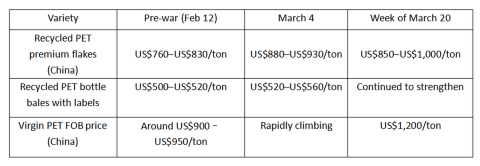
PET price movements as of March 20, 2026
As such, in cost-sensitive applications, the price gap between virgin and recycled material is narrowing, which theoretically gives manufacturers greater formulation flexibility.
The situation is more complex in Europe, however.
Virgin PET prices surged rapidly from around EUR 900/ton in late February to a peak of EUR 1,300/ton in early March, representing an increase of roughly 40%.
Meanwhile, European food-grade recycled PET pellets remain elevated at around EUR 1,800/ton, still at a substantial premium to virgin material.
In the view of Adsale Plastics Network, this round of price hikes has opened a tangible substitution window in the Chinese market, whereas in Europe the premium status of recycled material has not been materially undermined.
Behind the seemingly positive outlook, recycled plastics producers face a dual squeeze
A glance at the price gap alone might suggest a "boom time" for recycled plastics. Yet a closer look at the industry chain reveals that recycled plastics enterprises are undergoing a test of "fire and ice".
Fire: Rising inquiries on the demand side
According to OPIS, spot prices of recycled PET flakes, pellets and preforms in Europe rose by roughly EUR 60-100/ton during the week of March 20, with buyers largely attributing the increase to panic stockpiling triggered by the conflict.
Ice: A simultaneous spike in costs
Recycled plastics processing is highly energy-intensive. Waste transport (diesel), shredding and sorting (electricity), and washing and pelletizing (heat)—every step relies heavily on energy.
In its latest report, ICIS noted: "Electricity represents the main energy cost for the recycling processing chain. Wholesale power prices across Europe have risen broadly since the onset of the Middle East conflict."
Adding to industry anxiety is the price of natural gas.
Take recent natural gas trends in Europe as an example:
Pre-war baseline: around EUR 32/MWh
March 19 (post-Iranian attack): briefly exceeded EUR 70/MWh
ING forecast (if disruptions persist): EUR 80–100/MWh
Paul Sanderson, CEO of the UK Recycling Association, aptly commented: "There is significant uncertainty around rising energy and transport costs, which could dampen the value of certain materials."
A warning signal: recycled plastic giants halt production?
In this market environment where the industry would most expect to benefit, a thought-provoking development has emerged from Europe's recycled plastics sector.
On March 11, Indorama Ventures, one of Europe’s largest recycled PET producers, announced that its 230,000 ton/year recycled PET plant in Poland could not fulfill scheduled deliveries for March and April due to technical faults and force majeure.
This means that in the context of soaring energy prices, even as orders pour in, manufacturers may find it difficult to fulfill them due to high costs or supply chain pressures.
If industry giants that should have been the "beneficiaries" are facing such difficulties, the plight of small and medium-sized enterprises can well be imagined.
Conclusion & reflections
Returning to the original question: With oil prices remaining high, can recycled plastics truly benefit?
Our preliminary assessment is as follows:
In the short term, a pricing window has indeed emerged. In the Chinese market, recycled materials are beginning to show cost advantages, laying a foundation for substitution logic.
However, realizing these benefits depends on certain conditions—not only on the price of virgin materials, but also on the stability of energy costs and the resilience of recycled plastics manufacturers' own supply chains.
Moreover, it is worth noting that the recovery of end-consumer demand remains uncertain. Rising fuel and energy prices may further dampen consumer spending, which could in turn erode upstream demand. The opening of a substitution window does not guarantee that orders will translate into stable business.
The price volatility triggered by this geopolitical conflict may serve as a stress test for the recycling industry: when the substitution window opens, are your capacity, costs, and supply chain truly ready?
Adsale Plastics Network will continue to follow the latest developments.