








Search History
Clear History
{{item.search_key}}
Hot Searches
Change
{{item.name}}
{{item.english_name}}
Subscribe eNews
Once A Week Once Every Two Weeks
{{sum}}
Login Register

Applications

hubergroup expands UV offset portfolio with low tack ink grade

FDA confirms food-grade rHDPE and rPP from Coperion recycling technology

Wacoal and BASF expand “Melooop” 3D fiber molding technology to automotive interior

Products

Clariant expands flame retardant portfolio for e-mobility

ARLANXEO and Covestro advance sustainable production for synthetic rubber

Orion S.A. launches circular carbon black production in China

Activities

  • Fakuma 2026: Multi-faceted program for plastics industry

  • Plast 2026 expects 200 new exhibitors and strong international presence

  • 350,000+ visitors! CHINAPLAS 2026 shatters every record in the book

Pictorial

News Videos

A talk with Italian injection molding expert BMB

Inside Moretto: A tour of their Italian production facilities

Top 10 Technology Trends awards presented at CHINAPLAS 2026

Conference Videos

Summit Dialogue: Policy alignment and practices in plastic recycling across Asia

Interview: Pathways for development of plastics recycling in Malaysia

Driving systemic change: Unilever’s evolution in the circular economy

Corporate/Product Videos

For Rubber & Plastic Extrusion Equipment, trust Hebei Zhongsen! Custom Extruders, Traction Machines & Vulcanizing Lines

Is Your Mold Supplier Really Giving You Peace of Mind?

Kurtz GmbH & Co.

Home > News > Chemicals

Stronger, heat-healable and biodegradable plastic developed

Source:Adsale Plastics Network Date :2023-11-10 Editor :RC
Copyright: This article was originally written/edited by Adsale Plastics Network (AdsaleCPRJ.com), republishing and excerpting are not allowed without permission. For any copyright infringement, we will pursue legal liability in accordance with the law.

Researchers at the University of Tokyo developed an innovative plastic VPR by adding the molecule polyrotaxane to an epoxy resin vitrimer. The new material is stronger and stretchier than the existed standard type and can be healed with heat, remembers its shape and partially biodegradable.


Limitations of epoxy resin vitrimer


Vitrimers are a relatively new class of plastics, which are solid and strong at low temperatures, like thermoset plastics used to make heat-resistance tableware, but can also be reshaped multiple times at higher temperatures, like thermoplastics used for plastic bottles.


However, vitrimers are typically brittle and cannot be stretched far before breaking. By adding polyrotaxane, the researchers were able to create a dramatically improved version VPR.


Stronger, heat-healable and biodegradable VPR


VPR remembers its shape, holds its form and has strong internal chemical bonds at low temperatures.


Professor Shota Ando, Project Assistant from the Graduate School of Frontier Sciences, stated that VPR is over five times as resistant to breaking as a typical epoxy resin vitrimer. It also repairs itself 15 times as fast and recovers it is original memorized shape twice as fast.
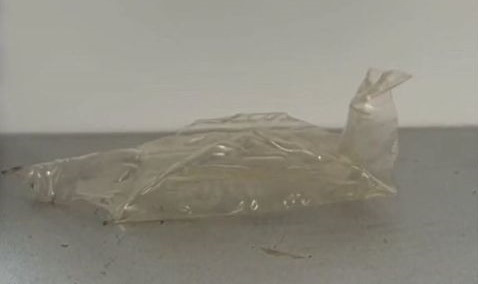

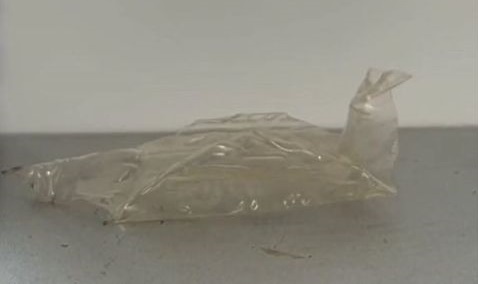
TokyoUni_good memory_480.jpg


The complex shape of an origami crane was restored using heat after being flattened.


The improved toughness of VPR implies that more complex shapes could be created and retained even at low temperatures.


Another feature of VPR is its ability to be healed with heat. At temperatures above 150°C, the material’s strong internal chemical bonds recombine and the material can be reformed into different shapes.
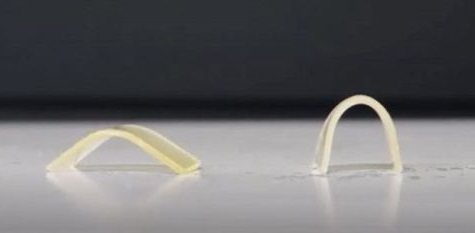

TokyoUni_shape recovery_480.jpg


Shape recovery test of VPR (left) and vitrimer (right) heated to 120°C on a hot plate.


Last but not least, VPR can be chemically recycled and is partially biodegradable, which fulfils present demands on resource recycling.


Researchers discovered that by applying heat and a solvent, VPR breaks down into its raw components. VPR can be chemically recycled 10 times as fast as the typical vitrimer.


“Although this resin is insoluble in various solvents at room temperature, it can be easily broken down to the raw material level when immersed in a specific solvent and heated,” explained Prof Ando.


Originally, vitrimer does not undergo any apparent biodegradation. For VPR, however, submerging it in seawater for 30 days resulted in 25% biodegradation, with the polyrotaxane breaking down into a food source for marine life.


These all prove that disposal or recycling can be easier with VPR.


Wide range of practical and playful applications


Professor Ando pointed out that VPR is expected to fit both practical and playful applications from areas including engineering, fashion, robotics, medicine and so on.


Infrastructure materials for roads and bridges are often composed of epoxy resins mixed with compounds such as concrete and carbon. By using VPR, these would be easier to maintain as they would be stronger and healable using heat.


For vehicle manufacture, due to it hard but stretchable feature, VPR can strongly bond materials of different hardness and elongation.


Furthermore, for a more playful use, with its shape memory, editing and recovery capabilities, users may even be able to rearrange silhouette of clothes with hair dryer or steam iron.


“I have always thought that existing plastics are very difficult to recover and dispose of because they are subdivided according to their uses. It would be ideal if we could solve many of the world's problems with a single material like this,” said Prof Ando.


The team’s next step will be to work with companies to determine the feasibility of its various ideas for VPR, as well as continuing its research in the lab.


More: 

Watch the demo: Features of heat-healable VPR

 Like 丨  {{details_info.likes_count}}
Epoxy resin
 SHANGHAI HUAZHENG COMPOSITES CO.;LTD      
 HENAN KEWEI FLAME RETARDANT NEW MATERIALS CO., LTD      

The content you're trying to view is for members only. If you are currently a member, Please login to access this content.   Login

Source:Adsale Plastics Network Date :2023-11-10 Editor :RC
Copyright: This article was originally written/edited by Adsale Plastics Network (AdsaleCPRJ.com), republishing and excerpting are not allowed without permission. For any copyright infringement, we will pursue legal liability in accordance with the law.

Researchers at the University of Tokyo developed an innovative plastic VPR by adding the molecule polyrotaxane to an epoxy resin vitrimer. The new material is stronger and stretchier than the existed standard type and can be healed with heat, remembers its shape and partially biodegradable.


Limitations of epoxy resin vitrimer


Vitrimers are a relatively new class of plastics, which are solid and strong at low temperatures, like thermoset plastics used to make heat-resistance tableware, but can also be reshaped multiple times at higher temperatures, like thermoplastics used for plastic bottles.


However, vitrimers are typically brittle and cannot be stretched far before breaking. By adding polyrotaxane, the researchers were able to create a dramatically improved version VPR.


Stronger, heat-healable and biodegradable VPR


VPR remembers its shape, holds its form and has strong internal chemical bonds at low temperatures.


Professor Shota Ando, Project Assistant from the Graduate School of Frontier Sciences, stated that VPR is over five times as resistant to breaking as a typical epoxy resin vitrimer. It also repairs itself 15 times as fast and recovers it is original memorized shape twice as fast.


TokyoUni_good memory_480.jpg


The complex shape of an origami crane was restored using heat after being flattened.


The improved toughness of VPR implies that more complex shapes could be created and retained even at low temperatures.


Another feature of VPR is its ability to be healed with heat. At temperatures above 150°C, the material’s strong internal chemical bonds recombine and the material can be reformed into different shapes.


TokyoUni_shape recovery_480.jpg


Shape recovery test of VPR (left) and vitrimer (right) heated to 120°C on a hot plate.


Last but not least, VPR can be chemically recycled and is partially biodegradable, which fulfils present demands on resource recycling.


Researchers discovered that by applying heat and a solvent, VPR breaks down into its raw components. VPR can be chemically recycled 10 times as fast as the typical vitrimer.


“Although this resin is insoluble in various solvents at room temperature, it can be easily broken down to the raw material level when immersed in a specific solvent and heated,” explained Prof Ando.


Originally, vitrimer does not undergo any apparent biodegradation. For VPR, however, submerging it in seawater for 30 days resulted in 25% biodegradation, with the polyrotaxane breaking down into a food source for marine life.


These all prove that disposal or recycling can be easier with VPR.


Wide range of practical and playful applications


Professor Ando pointed out that VPR is expected to fit both practical and playful applications from areas including engineering, fashion, robotics, medicine and so on.


Infrastructure materials for roads and bridges are often composed of epoxy resins mixed with compounds such as concrete and carbon. By using VPR, these would be easier to maintain as they would be stronger and healable using heat.


For vehicle manufacture, due to it hard but stretchable feature, VPR can strongly bond materials of different hardness and elongation.


Furthermore, for a more playful use, with its shape memory, editing and recovery capabilities, users may even be able to rearrange silhouette of clothes with hair dryer or steam iron.


“I have always thought that existing plastics are very difficult to recover and dispose of because they are subdivided according to their uses. It would be ideal if we could solve many of the world's problems with a single material like this,” said Prof Ando.


The team’s next step will be to work with companies to determine the feasibility of its various ideas for VPR, as well as continuing its research in the lab.


More: 

Watch the demo: Features of heat-healable VPR


全文内容需要订阅后才能阅读哦~
立即订阅

Recommended Articles

Chemicals
Clariant expands flame retardant portfolio for e-mobility
 2026-06-22
Chemicals
ARLANXEO and Covestro advance sustainable production for synthetic rubber
 2026-06-22
Chemicals
Orion S.A. launches circular carbon black production in China
 2026-06-18
Chemicals
Americhem launches Laser Marking Solutions platform
 2026-06-12
Chemicals
Röhm’s LiMA technology for MMA production runs at industrial scale
 2026-06-12
Chemicals
Super carbon fiber lattices: Foam-like weight + aluminum-level performance
 2026-06-11

You May Be Interested In

Change

  • People
  • Company
loading... No Content
{{[item.truename,item.truename_english][lang]}} {{[item.company_name,item.company_name_english][lang]}} {{[item.job_name,item.name_english][lang]}}
{{[item.company_name,item.company_name_english][lang]}} Company Name    {{[item.display_name,item.display_name_english][lang]}}  

Polyurethane Investment Medical Carbon neutral Reduce cost and increase efficiency CHINAPLAS Financial reports rPET INEOS Styrolution Evonik Borouge Polystyrene (PS) mono-material Sustainability Circular economy BASF SABIC Multi-component injection molding machine All-electric injection molding machine Thermoforming machine

Stronger, heat-healable and biodegradable plastic developed

识别右侧二维码,进入阅读全文
下载
x 关闭
订阅
亲爱的用户,请填写一下信息
I have read and agree to the 《Terms of Use》 and 《Privacy Policy》
立即订阅
Top
Feedback
Chat
News
Market News
Applications
Products
Video
In Pictures
Specials
Activities
eBook
Front Line
Plastics Applications
Chemicals and Raw Material
Processing Technologies
Products
Injection
Extrusion
Auxiliary
Blow Molding
Mold
Hot Runner
Screw
Applications
Packaging
Automotive
Medical
Recycling
E&E
LED
Construction
Others
Events
Conference
Webinar
CHINAPLAS
CPS+ eMarketplace
Official Publications
CPS eNews
Media Kit
Social Media
Facebook
Linkedin