



















22 global CEOs urge governments to agree on INC-5

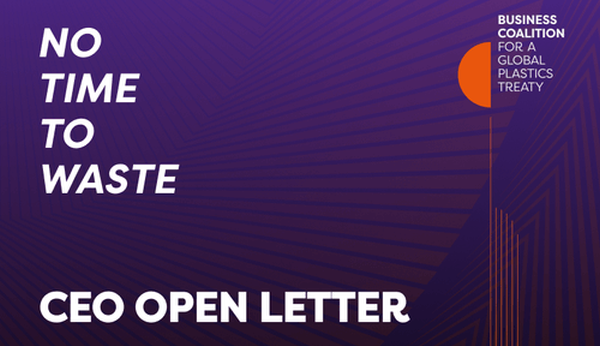
Global CEOs from Business Coalition for a Global Plastics Treaty deliver an open letter to urge governments to unite, agree on INC-5, and deliver a treaty to address plastic pollution at a global level.
An open letter from global CEOs emphasizes the important role of governments in INC-5.
Background
INC-5 will take place in Busan, Republic of Korea from November 25 to December 1. The meeting aims to finalized international legally binding instrument on plastic pollution, including in the marine environment.
Members of the Business Coalition for a Global Plastics Treaty include more than 250 global businesses, financial institutions and NGOs.
Senders of the open letter involve CEO/Chairman of Danone, AJE, DECATHLON, Henkel, SAP, Johnson, Unilever, Inter IKEA Group, Berry Global, Nestlé, Essity, Amcor, ALPLA, Mars Inc, PepsiCo, Ternova, SIG, Borealis, Gemini Corporation, ALDI SOUTH Group, Terracycle and Tomra.
Calling on the unity of governments
To catalyze a circular economy and minimize plastic waste and pollution, global businesses have committed to transform business models. However, these voluntary efforts are insufficient to address plastic pollution at a global scale.
Treaty with binding global rules can harmonize the policy landscape, strengthen national legislation, and help businesses scale proven solutions for priority sectors such as packaging. They can also reduce long-term public spending on waste management and mobilizing investment to create jobs across the value chain.
Business leaders call on governments to reach agreement at the INC-5 on:
Global criteria and lists that enable the restriction and phase out of chemicals of concern as well as problematic and avoidable plastic products.
Sector-specific approaches and global criteria for circular product design of plastic products, such as packaging.
Common definitions and key principles for the effective implementation of Extended Producer Responsibility (EPR) schemes.
A strong mandate for the governing body to strengthen the agreement over time.