





Hosokawa Alpine on mono-material in blown film extrusion

Mono-material has been an increasingly hot topic in packaging sector. Konstantin Klein, Sales Director of Blown Film at Hosokawa Alpine, discuss this topic in the VDMA interview on the road to K 2025.
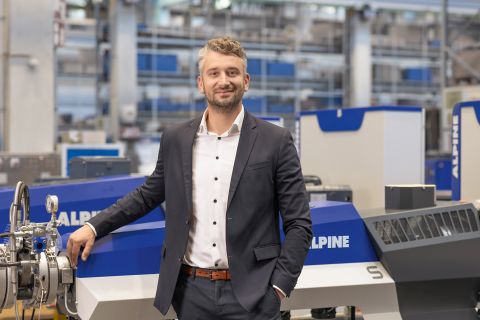
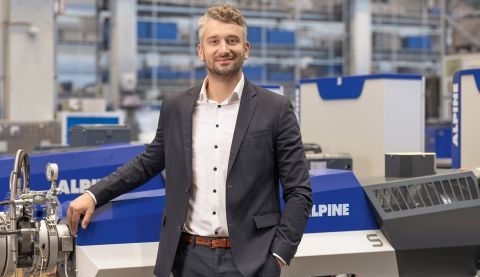
Konstantin Klein, Sales Director of Blown Film at Hosokawa Alpine.
Mr. Klein, where does the sustainability concept in blown film extrusion start at Hosokawa Alpine?
Klein: We presented the first recyclable PE packaging and the first mono-material composite at K 2013. At that time, the topic was hardly discussed at all. The mono-material composites are produced with our MDO technology, which is based on the monoaxial stretching of blown film.
Meanwhile, mono-material composites are on the rise.
Klein: That's right. At K 2016, we saw the first signs of growing interest. Then a breakthrough came in 2019, with demand increasing enormously. For us as a blown film line manufacturer, the topic of sustainable packaging is based on three pillars: the production of recyclable packaging from mono-materials, downgauging, and packaging made from post-industrial or post-consumer recyclates. In the past six or seven years, the momentum in these fields has increased significantly.
What challenges does mono-material packaging face?
Klein: Plastic packaging has become increasingly complex over the years. Today, packaging combines ergonomics, feel, design, freedom of form, and product safety. At present, a single-material packaging can cover the full range of packaging performance. We now have a number of options for creating barrier properties. The major challenges in terms of maximum output, minimum waste and good further processability have therefore been overcome.
What tasks remain to be done?
Klein: Customers are increasingly demanding higher quality end products and greater machine efficiency. This is the key issue in the production of MDO films. On the one hand, we achieve this through our technologies, such as the Trio System for minimizing edge trimming, or the vacuum roller, which, in addition to reducing edge trimming, also ensures a high level of process reliability. On the other hand, we achieve it through our flexible machines, which enable an immediate response to market changes, and thereby a swift increase in capacity utilization. Automation plays an important role in that regard.
How flexible must machines be today?
Klein: The large machines – especially those used to manufacture mono-packaging – have to be extremely flexible. Such a machine must be able to produce an extremely wide range of products. A typical requirement from our markets is a seven-layer system with an MDO unit that can be used to produce stretched films for food packaging, i.e. stretched films with or without a barrier. At the same time, this machine can also be used to produce standard products made of polyethylene or standard barrier films. This gives our customers the opportunity to serve existing markets while also driving innovation in their packaging.
What role do recyclates play in flexible packaging?
Klein: We are witnessing a continuous increase in demand for flexible packaging, particularly from the established European market. Spain and Germany are currently developing very well in this area. Packaging manufacturers are placing ever more importance on increasing the share of recycled materials, either in simple packaging products such as bin liners with up to 100% recycled materials, or in more sophisticated packaging with virgin and recycled materials. The challenges in processing recyclates lie in the inhomogeneous quality of the recycled materials. It is therefore challenging to produce a consistently high film quality.