






Volkswagen to invest EUR 90M in Zwickau vehicle plant for circular economy

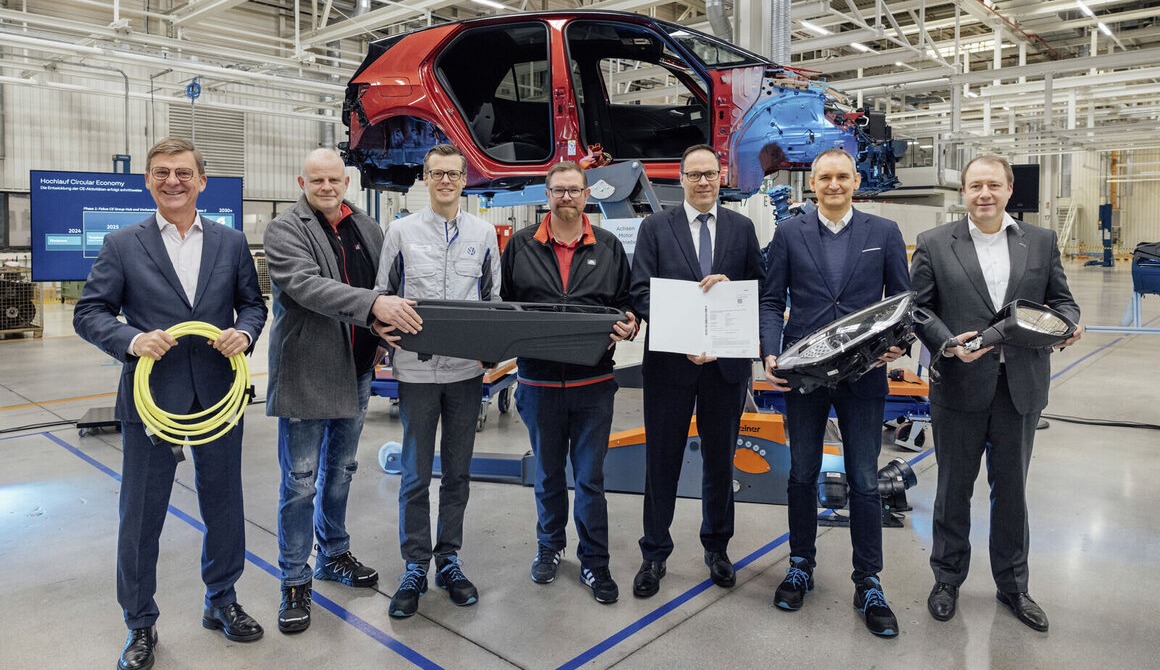
The Volkswagen Group plans to invest a total of up to EUR 90 million in Zwickau vehicle plant, Germany over the next few years, focusing on the central competence center for circular economy within the Group.
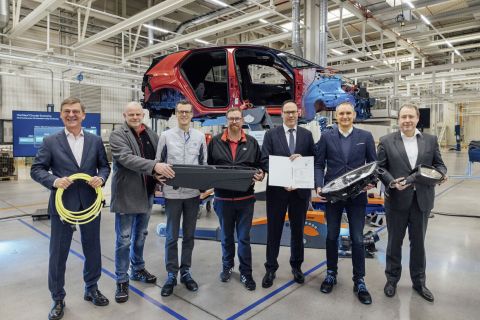
Volkswagen Group launches new business area for circular economy in Zwickau vehicle plant in Germany.
“The circular economy will become increasingly important for Volkswagen AG in the coming years. It addresses key challenges facing the automotive industry: raw material resilience, decarbonisation, economic efficiency and employment. Specifically, we are pursuing the goal of reusing raw materials for the construction of new vehicles,” said Andreas Walingen, Head of Group Circular Economy.
The Free State of Saxony is also funding the overall project with up to EUR 10.7 million.
Contributing to circular economy worldwide
The implementation of the circular economy at the Zwickau site was decided during collective bargaining negotiations in December 2024. In Zwickau, new business areas in the circular economy will be examined for economic viability, standards will be set and the knowledge gained will be made available to other locations worldwide.
Technical innovations and the use of AI are being developed and standardized. By using data platforms and AI, Volkswagen can efficiently track and control material flows, recycling processes and business models, and set new standards.
In addition to its central function, Zwickau will initially start with the systematic disassembly of vehicles to recover valuable raw materials and reuse components. Dismantling processes will be defined, tested and validated at the site in order to set standards for all other sites.
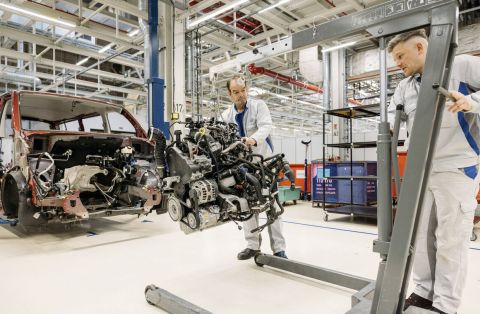
Removal of the engine from an old Volkswagen T6 before it is dismantled.
This will give Volkswagen access to parts and components that, after proper testing and processing, can be returned to the cycle, e.g. for used vehicles. Another focus is on separating materials cleanly in order to obtain pure recyclates. A gradual increase in capacity to 15,000 vehicles per year is planned by 2030.
Volkswagen Group’s circular economy strategy
The Volkswagen Group's circular economy strategy follows the principle of “REDUCE & GROW” – the use of primary raw materials and emissions are consistently reduced, while at the same time new value creation, resilience and innovative business models are established.
In this way, Volkswagen secures its own value creation in the long term and develops it further – both ecologically and economically. New business models such as recycling, refurbishment (vehicle reconditioning) and second-life applications open up additional market and revenue potential.