


















Call for innovative, flexible, and open circular procurement

Procurement plays a crucial role in an organization by controlling costs and quality, maintaining competitiveness, and driving success. By incorporating circularity and innovation, procurement can generate greater value not only for the organization but also for the circular economy and global sustainability.
Lina Svensberg, Innovation Manager at Compare/DigitalWell Arena and Lead Expert on Innovation Enhancing Procurement at the United Nations Economic Commission for Europe (UNECE), outlines a holistic and comprehensive approach to circular and innovation-enhancing procurement.
Many companies and governments view procurement primarily as a means to reduce order costs or select the supplier with the lowest price. This traditional, linear perspective on supply chains sees value flowing in one direction—from raw materials to products to waste.
In contrast, circular systems emphasize loops: repair, reuse, remanufacturing, and recycling. These loops rely on upstream decisions, such as material selection and product design, being aligned with downstream processes at the end of a product's lifecycle.
The concept of circularity also calls for a fundamental shift in how we perceive value. Much of today's procurement logic begins with a defined need and focuses on specifying and sourcing a solution. However, in circular systems, value often arises from existing resources, materials, and by-products, as well as from exploring their potential uses.
Therefore, innovation and experimentation must take place throughout entire value networks—not just around products and materials, but also concerning processes such as logistics, information flows, and the movement of components and resources back into circulation.

Lina Svensberg, Innovation Manager at Compare/DigitalWell Arena and Lead Expert on Innovation Enhancing Procurement at UNECE.
Advancements underway in Europe
Svensberg highlights that an important shift is currently underway in Europe. Traditionally, design for circularity and sustainable purchasing have been viewed as related but largely separate issues. Today, these perspectives are increasingly interconnected. Products are expected to be designed with their entire lifecycle in mind, while procurement practices are expected to support those design choices by organizing demand accordingly.
Regulations like the Ecodesign for Sustainable Products reflect this change. The focus is no longer solely on what is purchased at a single point in time; instead, it emphasizes how products are designed to last longer, be repaired, reused, and ultimately recycled. This also places greater importance on transparency, requiring that information about materials and components be available throughout a product's lifecycle. This alignment bolsters the connection between design requirements and purchasing decisions.
This shift makes one thing clear: circularity cannot be achieved by any single organization acting independently. Value is generated when designers, manufacturers, users, service providers, and end-of-life stakeholders coordinate around shared material flows.
Moreover, these European advancements are not isolated; they align with broader global trends as supply chains in Asia and beyond adapt to similar expectations for transparency, durability, and the circular use of materials.
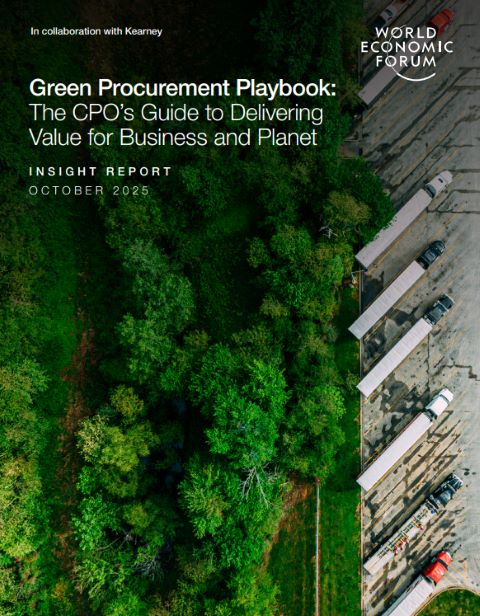
The World Economic Forum, in collaboration with management consulting firm Kearney, has developed a playbook for Chief Procurement Officers to transform sustainability ambitions into tangible actions. (Photo: World Economic Forum)
Circular procurement as an ongoing learning process
When buyers and purchasing managers prioritize recycling in their procurement decisions, one significant challenge they encounter is that recycling is often framed as a matter of selecting the "right" product—namely, one produced according to circular principles. Svensberg acknowledges that while this approach is valid, it is also limited.
She emphasizes that a circular economy cannot be created by merely choosing individual solutions; it relies on how value is created, used, and recovered across a broader value network. Thus, achieving effective recycling at scale necessitates greater interaction among those who design products, supply materials, utilize them, and manage them at the end of their lifecycle.
"Knowledge about materials, processing, regulations, and real world use needs to meet in order to figure out what can work in practice. This calls for experimentation and learning, not only compliance with predefined requirements," she states.
An innovative and flexible approach
Many organizations still assume that innovation occurs first, with procurement stepping in later to select and contract solutions. However, in circular systems, this sequence often proves ineffective. Svensberg recommends embracing circular solutions that include flexible contracts, allowing for learning, adaptation, and collaboration over time instead of trying to specify every detail upfront.
She notes that innovation procurement has frequently been narrowly defined as merely a set of procedures for acquiring innovative products, rather than as part of a broader strategy for organizing innovation, learning, and market development. In practice, this entails moving beyond rigid product specifications and utilizing procurement to foster collaboration among different stakeholders in real-world settings. It also involves understanding how products, services, and processes evolve over time and making adjustments as needed.
"More innovative approaches involve engaging procurement earlier in exploration and learning, creating space to test materials, designs or service models, and accepting a degree of uncertainty as part of the process," she explains.
An open mindset and business model
For organizations navigating circular transitions, the crucial question may not only be how to procure more sustainably, but also how to organize demand, collaboration, and value creation in ways that facilitate the emergence and maturation of circular solutions over time. Those who view procurement as a driver of experimentation will be better positioned to translate circular ambitions into everyday economic practices.
Svensberg observes that many discussions around circularity still concentrate on individual decisions—what to design, what to buy, or what to recycle. While these considerations are important, they risk overlooking the broader context.
She concludes that circularity is ultimately about how systems are structured and how different stakeholders are empowered to collaborate around shared material flows. Progress, therefore, will depend less on perfect specifications and more on creating environments for interaction, learning, and experimentation across organizational boundaries.
In this light, procurement should not be viewed solely as a compliance function or a transactional mechanism, but as part of the infrastructure that enables collaboration and innovation at scale.