

















Microcell technology enables 20% material savings in plastic packaging

Promix Solutions offers Microcell technology, an economically and ecologically compelling solution to reduce packaging weight by around 20%, fully preserves mechanical properties, and enables true recyclability.
Details on Microcell technology
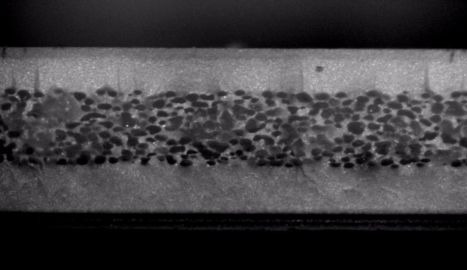
Microcell technology incorporates environmentally neutral gases such as CO₂ or N₂ into the plastic. This creates a fine-pored, microcellular foam structure.
Cell size and cell distribution are crucial: a very fine and homogeneous structure ensures that cups or trays achieve the same stability as conventionally manufactured packaging even after thermoforming—despite significantly reduced density.
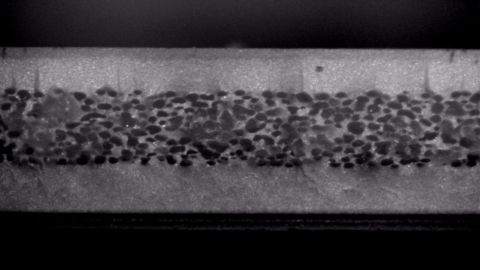
Microcell structure in the core layer of an FFS sheet.
A typical extrusion line for packaging film with an output of 800 kg/h saves up to 3.8 tons of plastic daily using Microcell technology. Extrapolated over a year, this results in a reduction of around 1,000 tons of plastic per line.
The lower film weight at the same film thickness not only reduces energy consumption during thermoforming but also reduces transport weight—which leads to an overall improved carbon footprint.
The technology is suitable for virtually all polymers and can be seamlessly integrated into both existing and new systems.
Environmentally friendly and fully recyclable
Since Microcell uses environmentally neutral blowing agents and no environmentally harmful additives, the packaging remains fully recyclable. Even production residues generated during thermoforming can be easily recycled, as the additive does not accumulate in the material as chemical blowing agents do.
Suitable for wide range of packaging applications
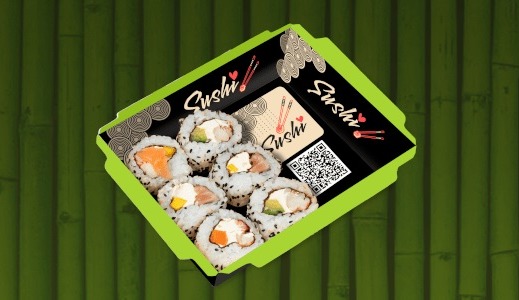
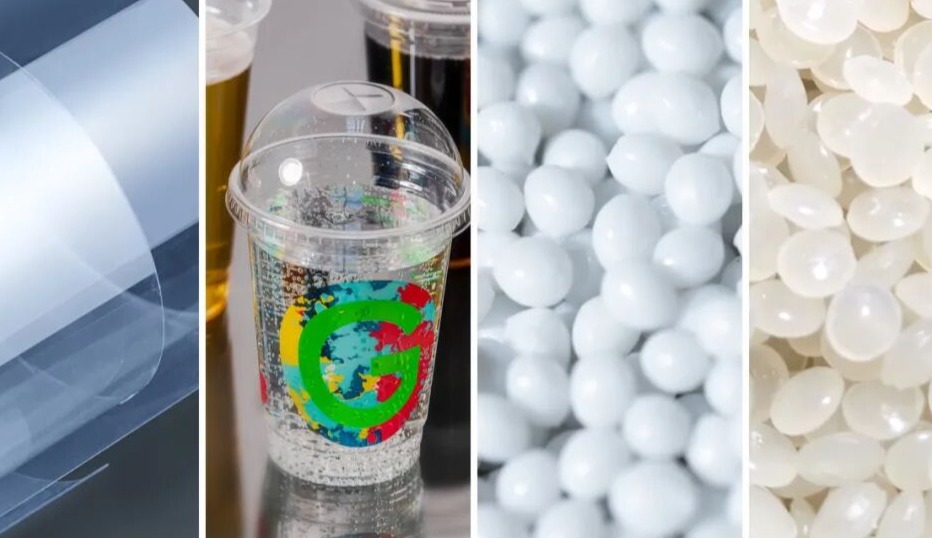
Microcell technology is suitable for a wide range of packaging applications produced via extrusion and thermoforming processes: food packaging such as cups or trays, boxes, and technical packaging, as well as form-fill-seal (FFS) applications.
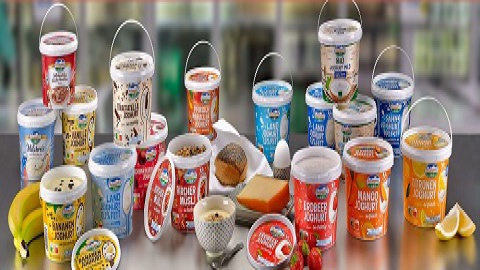
For yogurt cups, which are often produced using the FFS process, Microcell enables a 20–25% reduction in material without compromising shelf life or product protection. While polystyrene is traditionally used, polypropylene and polyester are becoming increasingly important.
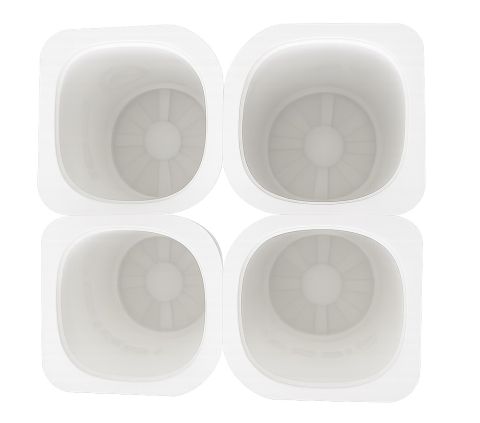
Yoghurt cup produced with Microcell use 20-25% less plastics.
In a 3-layer PP clamshell tray, the Microcell core layer forms the heart of the design. Sandwiched between two solid outer layers, it significantly improves insulation and withstands temperatures of up to 100°C. The foam structure considerably reduces material density by 40% in this example - without compromising the durability.