


















Super carbon fiber lattices: Foam-like weight + aluminum-level performance

Researchers at Department of Mechanical Engineering in the Seoul National University (SNU) have developed a new class of ultralight structural materials that combine the load-bearing strength of engineering materials with the weight of foam.
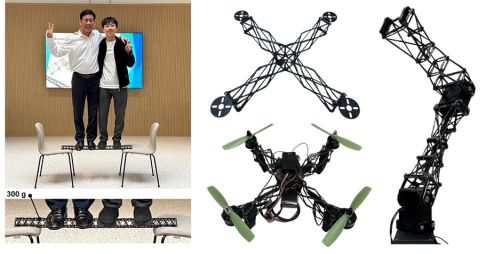
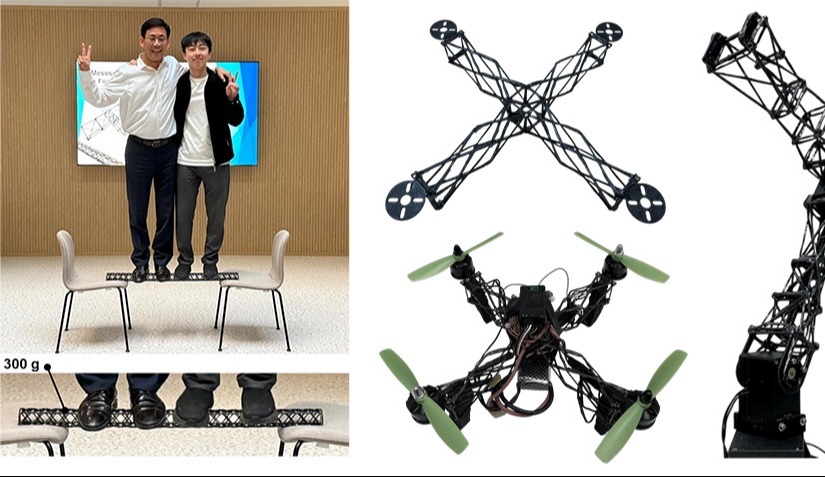
Prof. Sung-Hoon Ahn (left) and Dr. Jun Young Choi of SNU Department of Mechanical Engineering standing on a composite beam that supports a total load of approximately 150 kg. The prototype structures of drone and robotic arm are developed by the research team. (Source: Seoul National University)
Using a method called 3D node winding, the team created mesoscale carbon fiber lattices that achieve aluminum-level performance on a strength-to-weight basis while weighing as little as 1/100 the weight of aluminum.
Challenges in layer-by-layer structure
Today’s carbon fiber composites already offer high strength at low weight, but they are typically manufactured by stacking thin layers or assembling multiple components. These processes limit design freedom and introduce weak interfaces where layers or parts meet.
Even newer approaches, such as 3D-printed composites, rely on layer-by-layer fabrication. This creates internal boundaries that disrupt load transfer, forcing a trade-off between structural complexity and mechanical reliability.
Building structure from single continuous fiber
To overcome these limitations, the research team turned to a fundamentally different fabrication strategy. Instead of assembling or stacking materials, the structure is defined by placing a single continuous carbon fiber directly in three-dimensional space, a unifying concept that “binds them all together in perfect unity”.
The process begins with a temporary scaffold that defines nodal geometry. A long carbon fiber is then wound across these nodes, forming a spatial lattice network. Once the geometry is established, the structure is consolidated through resin impregnation, producing a solid composite.
Because the fiber remains continuous throughout the structure, forces are transmitted without interruption, avoiding the stress concentrations and failure points commonly associated with joints and interfaces.
High strength at ultralow weight
The resulting structures exhibit compressive strengths of approximately 10 to 30 megapascals, comparable to construction-grade materials such as concrete in compression.
While this remains below the absolute strength of high-grade metals, the structures achieve exceptional performance when normalized by weight, reaching aluminum-level efficiency at dramatically reduced mass.
At equal weight, the lattices can be up to ten times stronger than conventional lattice structures. This improvement arises from continuous load paths, which enable more efficient force distribution and reduce inactive material within the structure.
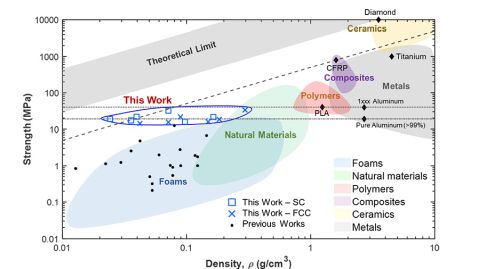
Strength–density performance comparison of the developed 3D carbon fiber composite lattice structure. (Source: Seoul National University)
Demonstrated in drone frame
To validate the approach in a real-world system, the researchers applied the structure to a drone frame with:
reduced structural weight by approximately 79% compared to conventional designs, and
a 33% increase in flight time under the same operating conditions.
These results confirm that structural weight reduction translates directly into improved system-level performance, particularly in applications where mass is a primary constraint.
Developing towards scalable, design-driven structures
Beyond material performance, the work reframes how load-bearing systems can be designed and manufactured.
Previously, such continuous three-dimensional fiber architectures were difficult to scale using conventional manufacturing methods. However, this approach aligns naturally with robotic, AI-driven fabrication systems, where complex fiber trajectories can be generated and executed directly from digital designs.
As these systems advance, they are expected to enable scalable production of architected composites that would be impractical to fabricate by hand.
The implications extend across multiple industries where weight and efficiency are critical, such as aerospace and mobility systems, robotics, and construction. More broadly, the method supports a transition from component-based engineering to integrated structural systems defined by geometry, continuity, and automated fabrication.