













Coffee capsules made from NatureWorks’ PLA score highest sustainability marks in new study

A new, independent study conducted by Netherlands-based Wageningen Food & Biobased Research, a part of Wageningen University & Research (WUR), assessed the environmental impact and circularity of single-use coffee capsules, in which sample from NatureWorks’ Ingeo PLA biopolymer outperforms other materials in terms of sustainability performance.

A study was conducted to evaluate the sustainability of coffee capsules made from different materials.
The study meticulously assessed materials and disposal methods emphasizing their global warming potential over a period of 100 years in carbon dioxide equivalents as well as their Material Circularity Indicator (MCI), which integrates critical factors such as recycling rates, recycled content, recycling process yield, biobased content, reusability and average product lifespan.
Samples from the study include coffee capsules made from compostable biobased materials, aluminum and conventional plastics to go through multiple end-of-life scenarios, including industrial composting, recycling, incineration and landfill.
The data shows the greenhouse gas emission from different disposal methods of coffee capsules made of compostable plastics, aluminum and conventional plastic.
Produced by NatureWorks’ partner and food packaging producer, Flo SpA, the thermoformed Ingeo-based capsule is made from annually renewable, plant-based resources which had an MCI of 100%, implying full circularity of the material.

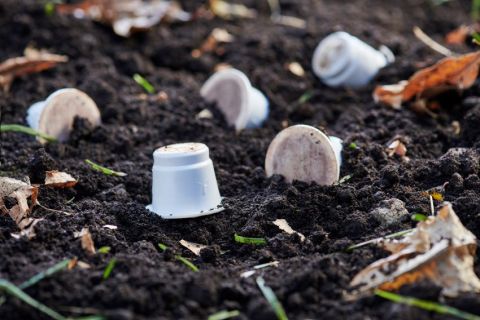
The compostable coffee capsules enable discarding of the capsule and wet coffee grounds into a single-waste stream.
From this, both the capsule material and coffee grounds undergo organic recycling, diverting both the packaging and spent coffee grounds away from landfills or incinerators to industrial composting where they are processed into a valuable soil amendment that can improve soils through carbon sequestration and water retention.
“The conclusion of this study is significant because it represents the entire life cycle of the capsule and the coffee inside - from carbon footprint to its circularity potential,” said Flavio Di Marcotullio, Strategic Marketing Manager, Single Serve Beverages at NatureWorks.
NatureWorks has partnered with Flo SpA since 2018 to develop Ingeo PLA-based compostable coffee capsules, including rigorous testing for quality and compostability, ensuring the most sustainable option while delivering a positive end-user brewing experience.