

















European plastic recycling industry growth challenged by shrinking market: Report

Plastics Recyclers Europe published a report on the European plastic recycling industry in 2022. Latest figures show that the total European installed plastics recycling capacity stands at 12.5 million tons in 2022. Due to heavy market disruption, the growth rate reduced from 17% to 10%, year-on-year.
Challenges posed on European plastic recycling industry
Although commitment on circularity remains strong, the recycling sector faced unprecedented challenges. The first one is the halt of activities during the COVID-19 pandemic outbreak, followed by the energy crisis in 2022.
In 2023, the significantly low demand for recyclates is observed in the sector. This is resulted from low prices for virgin plastics due to reduced industrial production in the EU and cheap imports of recycled plastic from outside the EU.
Overview of the industry
The report looks at 850 different recycling sites across Europe, the majority of which are small, with an average capacity of 15,000 tons. The plastic recycling sector counts with EUR 10.4 billion in turnover.
It is also noted that plastic recycling activities in 2022 resulted in the reduction of over 10 million tons of CO2 emissions, equivalent to removing from circulation of all Belgian passenger cars for a year.

Overview of the European plastic recycling industry in 2022. (Source: Plastics Recyclers Europe)
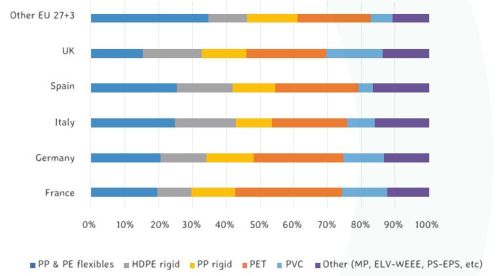
On polymer grades, flexible polyolefins, PET and rigid polyolefins remain to be with the highest capacities, representing more than 80% of the total.
The geographic dispersion of recycling activities in Europe, Germany, Italy, Spain, the UK and France represent 60% of the total. In Spain, Italy, Poland and Belgium, PE and PP flexibles hold the largest relative share of installed recycling capacity, while in France, nearly one-third of the total capacity is on PET.
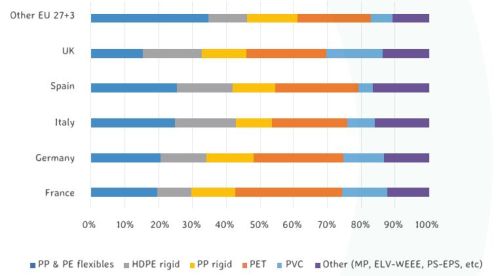
Installed recycling input capacity per polymer and per country. (Source: Plastics Recyclers Europe)
In addition, Belgium, the Netherlands, Poland and Romania owned the fastest growth in capacities compared to the previous year.
Urging for enforcement of legislative measures
New legislative developments will be key in driving the success of plastic’s circularity. This includes the proposals for the Packaging and Packaging Waste Regulation and the End-of-Life Vehicles Directive, which introduce new targets to improve the waste management of plastics in Europe.
These measures must be further paired with enforcement mechanisms and the practices across Member States.