














CHINAPLAS 2024: Gneuss’ new range of OMNI machines for closed-loop recycling

Typical applications for Gneuss’ OMNI recycling machines include the processing of PET scrap into high-quality end products such as thermoformed sheet (suitable for food contact), staple fiber, POY, FDY, BCF and strapping. In addition, a wide range of raw materials such as PS, PP, PE, PLA can be recycled.
The OMNI series is also used in the decontamination of post-consumer waste for production of direct food contact products such as HDPE bottle caps and coffee caps, as well as for odor reduction and degassing of PA, SAN or other polymers.
In addition to its compact design, the OMNI series scores highly in terms of flexibility. The fully automatic control of vacuum, extruder, dosing, degassing time, and filter change ensures a consistently high quality of the end products.
The compact design also results in very low energy consumption as energy used in the extrusion process is designed to be used in the next process step. This not only has a noticeable effect on electricity and gas consumption, but also significantly reduces the CO2 footprint of the recycling process.
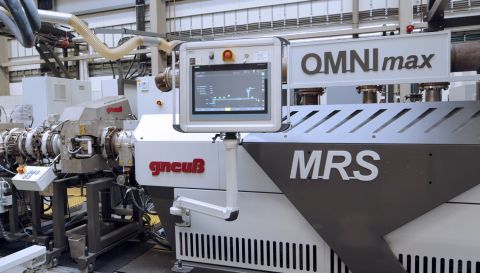
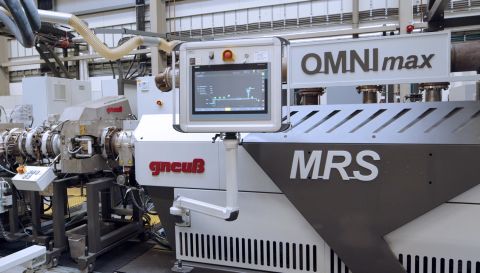
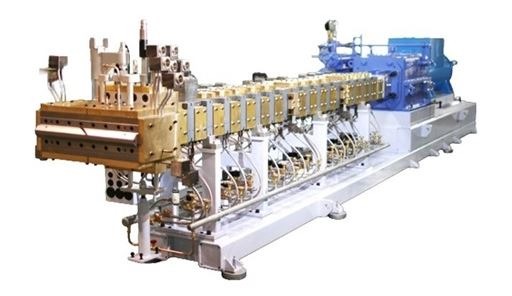
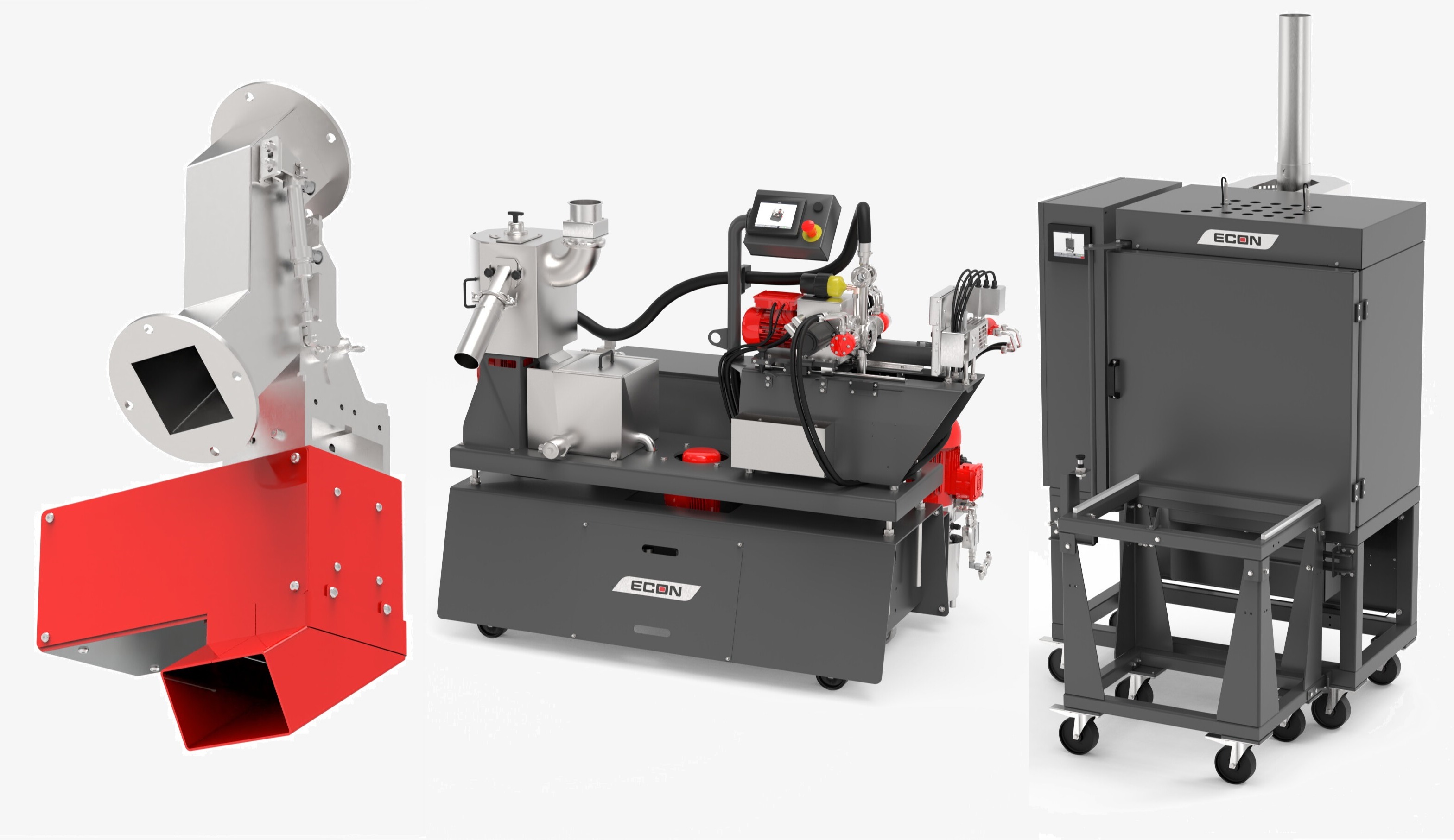
Gneuss OMNImax recycling machine with MRS extruder and RSFgenius filtration system.
MRS extruder
The MRS extruder is based on conventional single screw technology but is equipped with a multiple screw section for devolatilization. It enables very efficient and gentle decontamination of the polymer melt, whilst achieving the requirements for direct food contact standards.
The extruder allows the processing of rPET directly into high-quality end products without pre-drying by using a simple and rugged vacuum system. The satellite screws rotate in the opposite direction to the main screw, which disproportionately increases the surface exchange of the polymer melt.
A large opening for venting, exposing the full length of the satellite screws, is completely under vacuum. This provides excellent and unrestricted access to the polymer melt, the surface of which is constantly replaced at an extremely high rate by the action of the satellite screws in the multiple screw section. The surface area and the surface area exchange rate available for devolatilization are far greater than in other extrusion systems.
Vacuum system
Gneuss has developed its own vacuum systems for the extraction of volatile impurities, some of which have patented separation systems. Due to the large melt surface in the MRS extruder, the suction capacity is considerably higher than in conventional systems, so that large quantities of volatile impurities can be extracted from the polymer and separated from the vacuum flow by means of automated separator systems.
The vacuum system on display at CHINAPLAS 2024 is a water ring pump system designed for vacuums of 25-40 mbar and offers high automation and process control with low maintenance, even in recycling applications. In addition to a water ring pump vacuum system, Gneuss also offers deep vacuum systems with appropriate separators.
Gneuss Filtration Technology
Gneuss’ top model, the RSFgenius, operates with an integrated back-flushing system offering self-cleaning for very demanding applications. Screens can be automatically re-used up to 400 times and filtration finenesses below 10 microns/1200 mesh are available.
There will be an RSFgenius 150 on display at CHINAPLAS, with an active screen area of 450 cm2/70 square inches, for 1000 kg/h (2.200 lbs) of R-PET with a filtration fineness of 75 microns (200 mesh).
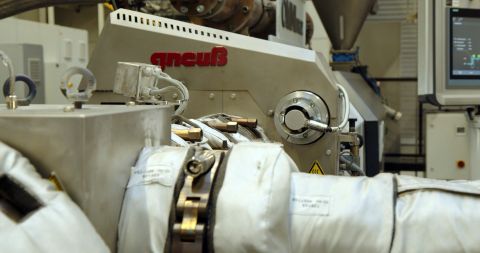
Patented rotary filtration system RSFgenius.
Online viscometer VIS
OMNI recycling systems as well as any other extrusion line can be equipped with the innovative and compact VIS online viscosity measurement system.
Using a high-precision, rigid gear pump, a small partial flow of polymer melt is diverted from the main melt channel and forced through a precisely manufactured slotted capillary.
The data measured there can be used to improve quality assurance. When processing PET on an OMNI recycling line the viscometer allows precise control of the end product’s viscosity.