























Global EV charging infrastructure supply falls behind demand: Reports

According to the latest figures revealed on World EV day, key markets in the electric vehicle (EV) transition are falling behind their stated goals for public charging infrastructure – in which the US, Europe and the UK are more than six times behind the number of plugs needed to meet growing EV demand by 2030.
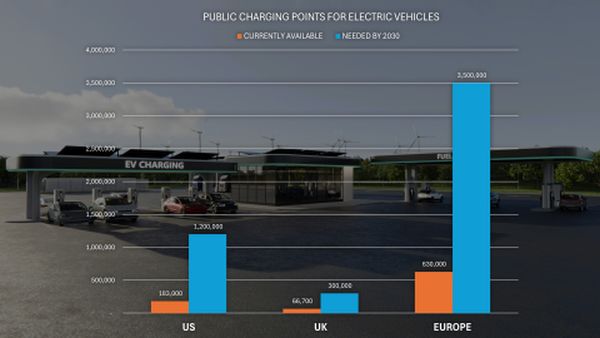
Data on the current and expected EV public charging points. (Source: influence Emobility)
The US
As the world’s second-largest EV market, the US has under 200,000 publicly available charging ports as of Q2 2024, based on the Joint Office of Energy and Transportation from the US government.
Large gap between the supply and demand of public chargers remains as the US aims to install 500,000 public chargers by 2030.
Europe
In Europe, a total of over 630,000 public charging infrastructure is installed in Europe.
The European Commission estimated that 3,500,000 charging devices have to be installed by 2030. However, ACEA (European Automobile Manufacturers’ Association) estimated even further that 8,800,000 charging points will be needed by 2030.
The UK
At the beginning of April 2024, there are 59,670 electric vehicle charging devices across the UK, according to the National Infrastructure Commission in the UK.
Although this data represents a 49% increase in the total number of charging infrastructure since April 2023, the government expects 300,000 charging points by 2030, a near 350% increase in supply.
Challenges to build effective EV charging
Accelerating the installation rate of EV charging infrastructure is essential to support the growing demand of EV and carbon neutral goal. However, the industry has to overcome challenges to provide effective service, and build reliable and profitable EV charging.
Konect, Gilbarco Veeder-Root’s end-to-end e-mobility ecosystem business, conducted a survey with multiple charge point operators.
71% of respondents express that they find recording charge-point downtime at their sites challenging while 57% identifies the biggest challenge to improve uptime is the limited support from service partners.