















TotalEnergies Corbion releases Life Cycle Assessment for recycled Luminy PLA

TotalEnergies Corbion has published the Life Cycle Assessment (LCA) for its recycled Luminy PLA, titled Life Cycle Assessment of PLA through Advanced Recycling – Utilizing Waste Streams as Feedstock for a Biobased Polyester.
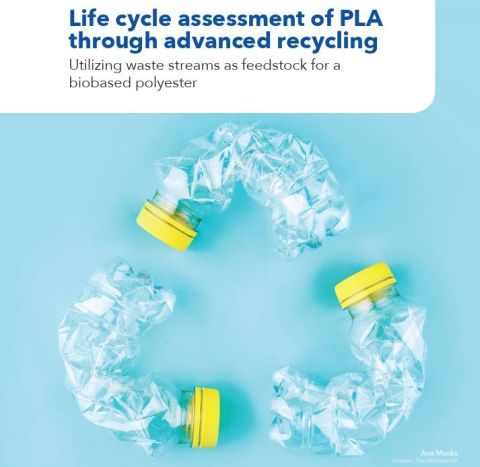
TotalEnergies Corbion has published the Life Cycle Assessment for its recycled Luminy PLA.
In this report, seven impact categories were considered, including GWP, water consumption, and land use.
Luminy recycled PLA, integrating 20% and 30% recycled content, significantly mitigates impacts across these categories compared to virgin PLA, illustrating the environmental benefits of this pioneering recycling methodology over traditional virgin production.
The study concludes that the advanced recycling of PLA as a production process has a lower impact compared to its production from virgin feedstock. Specifically, the Global Warming Potential (GWP) of Luminy 30% rPLA, considering its biogenic carbon content, is 0.19 kgCO2/kg of PLA, whereas virgin Luminy PLA emits 0.51 kgCO2/kg of PLA.
Importance of temporary carbon storage
The assessment highlights the importance of considering the temporary carbon storage in products which is key for biobased materials. By analyzing the carbon cycle for both biobased and fossil-based products, the report emphasizes the role of biogenic carbon content in PLA.
Recycling PLA allows a longer storage of this biogenic carbon which is originally from the atmosphere. Notably, when factoring in biogenic carbon content, the GWP of 30% recycled PLA is reduced by 300 kgCO2/tPLA compared to virgin PLA, marking a significant step towards achieving global climate targets.
Sustainability commitment aligned with UN Global Compact initiative
Concurrent with the LCA results, TotalEnergies Corbion’s recent announcement of its alignment with the United Nations Global Compact initiative reaffirms its commitment to sustainability.
This collaboration further reinforces the company’s adherence to universal sustainability principles, actively supporting the UN’s Sustainable Development Goals through responsible production practices and collaborative initiatives across its value chain.