










Search History
Clear History
{{item.search_key}}
Hot Searches
Change
{{item.name}}
{{item.english_name}}
Subscribe eNews
Once A Week Once Every Two Weeks
{{sum}}
Login Register

Applications

R-Cycle unveils AI-based PPWR Compliance Compass at Interpack 2026

BASF expands compostable ecovio portfolio for flexible barrier packaging

Analysis for EU policy on bio-based plastic packaging under PPWR

Products

BASF expands HALS and NOR HALS capacities

Clariant launches new propane dehydrogenation catalyst

ENGEL to show integrated solutions for efficiency and precision at Interplas 2026

Activities

  • 350,000+ visitors! CHINAPLAS 2026 shatters every record in the book

  • CHINAPLAS 2026: 86,504 visitors explore innovations on Day 3

  • Must-attend events: Application in Focus and Additives Seminar

Pictorial

News Videos

Top 10 Technology Trends awards presented at CHINAPLAS 2026

MAAG x SIKORA: Smart pelletizing + precise inspection - More stable, carbon-reduced

CAI Machine: New visual inspection technology debut! More efficient, greener, colorful printing

Conference Videos

Interview: Thailand’s perspective on cross-border circular cooperation

Interview: On Indonesian recycling industry and rising geopolitical tensions

Interview: Vietnam’s progress in circular economy

Corporate/Product Videos

For Rubber & Plastic Extrusion Equipment, trust Hebei Zhongsen! Custom Extruders, Traction Machines & Vulcanizing Lines

Is Your Mold Supplier Really Giving You Peace of Mind?

Kurtz GmbH & Co.

Home > News > Injection

WITTMANN vertical machine supports efficient automation for complex metal-plastic assemblies

Source:Adsale Plastics Network Date :2026-03-06 Editor :RC
Copyright: This article was originally written/edited by Adsale Plastics Network (AdsaleCPRJ.com), republishing and excerpting are not allowed without permission. For any copyright infringement, we will pursue legal liability in accordance with the law.

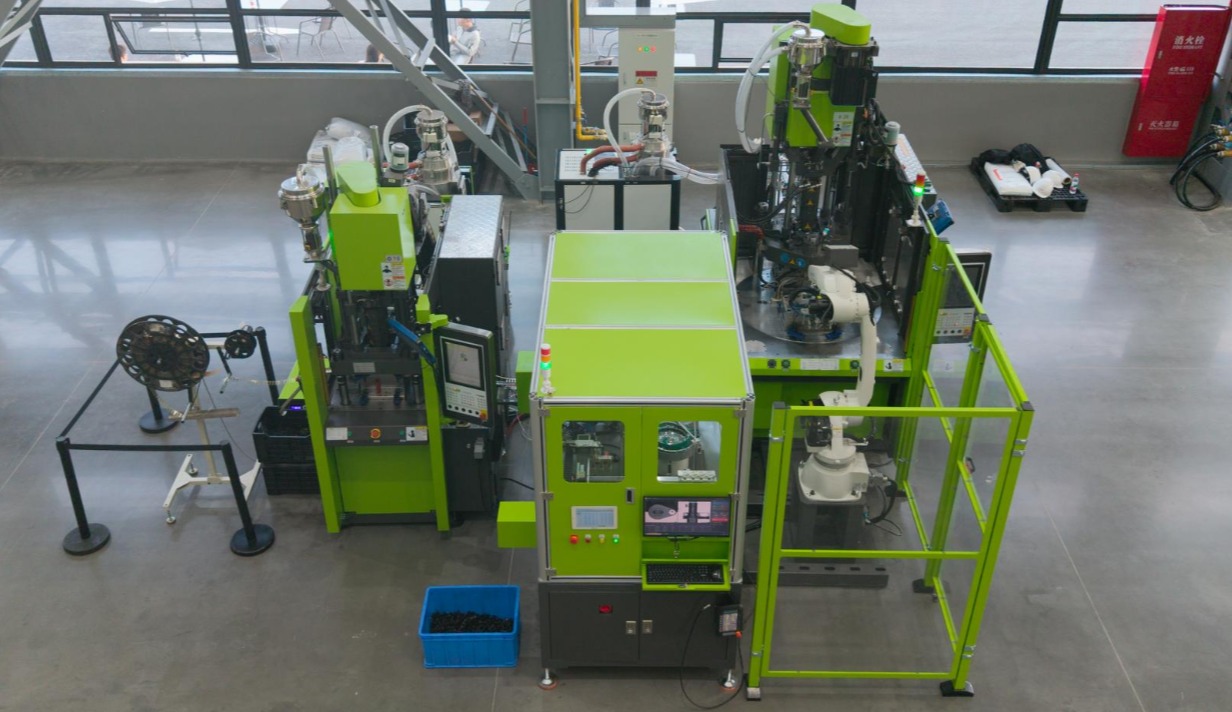
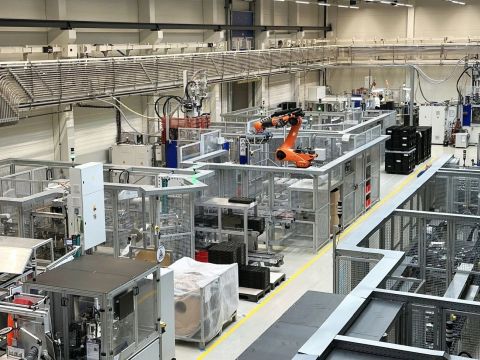
WITTMANN’s technology supports Swoboda CZ in Jihlava, Czech Republic in complex metal-plastic assemblies, which requires high degree of automation. With roughly 200 square meters of floor space, it is one of the largest and most complex production cells at this location. Millions of switchbox housing components are manufactured with this equipment every year.

WITTMANN x Swoboda_automated production cell.jpg

The automated production cell is equipped with WITTMANN’s vertical injection molding machine, two-station rotary table, temperature controllers, and six-axis robot.


The large WITTMANN vertical injection molding machine with 270 tons clamping force stands at the center of the production cell, equipped with a two-station rotary table, plus temperature controllers also supplied by WITTMANN.


Efficient automation, consistent high quality, simplified maintenance


Bohuněk explained the convenience in many ways brought by the WITTMANN vertical injection molding machine.


Firstly, intuitive user interface of the WITTMANN machine control system enables even production staff with little experience to achieve a consistently high standard of parts quality, and to re-start the process efficiently after a standstill.


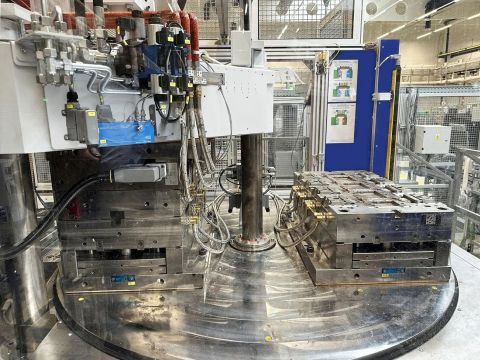
Secondly, a structural specialty of the vertical machines from WITTMANN include in the delivery as standard for all models with a two-station rotary table. This concerns the supply of the temperature control media. The connections are placed above, so that a central rotary distributor can be dispensed with. This ensures exceptionally easy accessibility to the molds, which simplifies both automation and manual work, such as maintenance servicing.

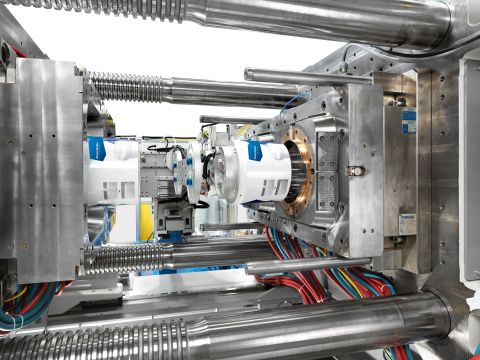
WITTMANN x Swoboda_two-station rotary table.jpg

The two-station rotary table.


Sophisticated transfer system


The mold bottom halves are positioned on the rotary table to produce the switchbox housing components. The large six-axis robot removes the finished parts from the cavities and simultaneously refills them with new inserts.


“The challenge this part presents to us is the large number and diversity of the insert parts, which the automation system must handle safely,” said Václav Dostal, Managing Director of Swoboda.


Another robot assists the large six-axis robot. It is responsible for pre-positioning the insert parts in frames. The parts to be over-molded include several signal pins, power pins and sockets. Some inserts are presented to the robot in trays. Some of the pins are punched and bent in-line via reel-to-reel systems.


The impressive feature though is the transfer system inside the production cell. Via a rail system, the frames are transported to the clamping unit, where the multi-axis robot takes over the complete insert sets and places the pins and sockets into the mold cavities. They are then over-molded with white, fiberglass-reinforced plastic material.


The freshly injection-molded components are transported away from the clamping unit by the transfer system. They are passed to camera inspection and DMC marking, deposited in trays and then leave the production cell. All empty frames and transport carriages are returned automatically to their starting points at the end of the cycle.


Setting benchmarks for other locations worldwide


The entire automation has been developed and built on site.


Automation solutions from Jihlava are also in operation at other Swoboda locations around the world. The new production process for making switchbox housing components is exemplary.


The complete automation of all process steps and the excellent repeatability of the WITTMANN injection molding machine have successfully increased the efficiency and made it possible to reduce the unit costs. Moreover, they ensure high process stability and consistency of quality standards.
 Like 丨  {{details_info.likes_count}}

The content you're trying to view is for members only. If you are currently a member, Please login to access this content.   Login

Source:Adsale Plastics Network Date :2026-03-06 Editor :RC
Copyright: This article was originally written/edited by Adsale Plastics Network (AdsaleCPRJ.com), republishing and excerpting are not allowed without permission. For any copyright infringement, we will pursue legal liability in accordance with the law.

WITTMANN’s technology supports Swoboda CZ in Jihlava, Czech Republic in complex metal-plastic assemblies, which requires high degree of automation. With roughly 200 square meters of floor space, it is one of the largest and most complex production cells at this location. Millions of switchbox housing components are manufactured with this equipment every year.


WITTMANN x Swoboda_automated production cell.jpg

The automated production cell is equipped with WITTMANN’s vertical injection molding machine, two-station rotary table, temperature controllers, and six-axis robot.


The large WITTMANN vertical injection molding machine with 270 tons clamping force stands at the center of the production cell, equipped with a two-station rotary table, plus temperature controllers also supplied by WITTMANN.


Efficient automation, consistent high quality, simplified maintenance


Bohuněk explained the convenience in many ways brought by the WITTMANN vertical injection molding machine.


Firstly, intuitive user interface of the WITTMANN machine control system enables even production staff with little experience to achieve a consistently high standard of parts quality, and to re-start the process efficiently after a standstill.


Secondly, a structural specialty of the vertical machines from WITTMANN include in the delivery as standard for all models with a two-station rotary table. This concerns the supply of the temperature control media. The connections are placed above, so that a central rotary distributor can be dispensed with. This ensures exceptionally easy accessibility to the molds, which simplifies both automation and manual work, such as maintenance servicing.


WITTMANN x Swoboda_two-station rotary table.jpg

The two-station rotary table.


Sophisticated transfer system


The mold bottom halves are positioned on the rotary table to produce the switchbox housing components. The large six-axis robot removes the finished parts from the cavities and simultaneously refills them with new inserts.


“The challenge this part presents to us is the large number and diversity of the insert parts, which the automation system must handle safely,” said Václav Dostal, Managing Director of Swoboda.


Another robot assists the large six-axis robot. It is responsible for pre-positioning the insert parts in frames. The parts to be over-molded include several signal pins, power pins and sockets. Some inserts are presented to the robot in trays. Some of the pins are punched and bent in-line via reel-to-reel systems.


The impressive feature though is the transfer system inside the production cell. Via a rail system, the frames are transported to the clamping unit, where the multi-axis robot takes over the complete insert sets and places the pins and sockets into the mold cavities. They are then over-molded with white, fiberglass-reinforced plastic material.


The freshly injection-molded components are transported away from the clamping unit by the transfer system. They are passed to camera inspection and DMC marking, deposited in trays and then leave the production cell. All empty frames and transport carriages are returned automatically to their starting points at the end of the cycle.


Setting benchmarks for other locations worldwide


The entire automation has been developed and built on site.


Automation solutions from Jihlava are also in operation at other Swoboda locations around the world. The new production process for making switchbox housing components is exemplary.


The complete automation of all process steps and the excellent repeatability of the WITTMANN injection molding machine have successfully increased the efficiency and made it possible to reduce the unit costs. Moreover, they ensure high process stability and consistency of quality standards.


全文内容需要订阅后才能阅读哦~
立即订阅

Recommended Articles

Injection
ENGEL to show integrated solutions for efficiency and precision at Interplas 2026
 2026-05-06
Injection
Haitian wraps up CHINAPLAS with full-ecosystem strength
 2026-05-04
Injection
ENGEL starts global roll-out of WINTEC e-win outside Asia
 2026-04-28
Injection
Chen Hsong’s new multi-material solution sets new benchmark for green manufacturing
 2026-04-23
Injection
Husky’s future-ready technologies take center stage
 2026-04-23
Injection
BOY machines demonstrates injection molding of high-precision medical components
 2026-04-23

You May Be Interested In

Change

  • People
  • Company
loading... No Content
{{[item.truename,item.truename_english][lang]}} {{[item.company_name,item.company_name_english][lang]}} {{[item.job_name,item.name_english][lang]}}
{{[item.company_name,item.company_name_english][lang]}} Company Name    {{[item.display_name,item.display_name_english][lang]}}  

Polyurethane Investment Medical Carbon neutral Reduce cost and increase efficiency CHINAPLAS Financial reports rPET INEOS Styrolution Evonik Borouge Polystyrene (PS) mono-material Sustainability Circular economy BASF SABIC Multi-component injection molding machine All-electric injection molding machine Thermoforming machine

WITTMANN vertical machine supports efficient automation for complex metal-plastic assemblies

识别右侧二维码,进入阅读全文
下载
x 关闭
订阅
亲爱的用户,请填写一下信息
I have read and agree to the 《Terms of Use》 and 《Privacy Policy》
立即订阅
Top
Feedback
Chat
News
Market News
Applications
Products
Video
In Pictures
Specials
Activities
eBook
Front Line
Plastics Applications
Chemicals and Raw Material
Processing Technologies
Products
Injection
Extrusion
Auxiliary
Blow Molding
Mold
Hot Runner
Screw
Applications
Packaging
Automotive
Medical
Recycling
E&E
LED
Construction
Others
Events
Conference
Webinar
CHINAPLAS
CPS+ eMarketplace
Official Publications
CPS eNews
Media Kit
Social Media
Facebook
Linkedin