











New materials powering the sustainable future of mobility

Electric vehicles (EVs) are charging into the mainstream, fueled by improved charging infrastructure, consumer confidence, government incentives, affordability, and environmental benefits such as zero tailpipe emissions. Behind this trend are manufacturers who are developing new battery materials that are not only flame retardant, but also safer, lighter and more sustainable.
Likewise, automotive parts are turning to eco-friendly materials, especially under regulations such as the End-of-Life Vehicles (ELV) Directives of the EU that ramps up mandatory targets for the use of recycled plastics in new vehicles. These new materials not only reduce environmental impact, but also enhance performance, durability, safety and comfort of the vehicle.
Innovative flame retardant materials for EV batteries
Different technologies have been developed to reach the goal of flame retardance for EV batteries. Below are some of the latest innovations and the benefits they offer.
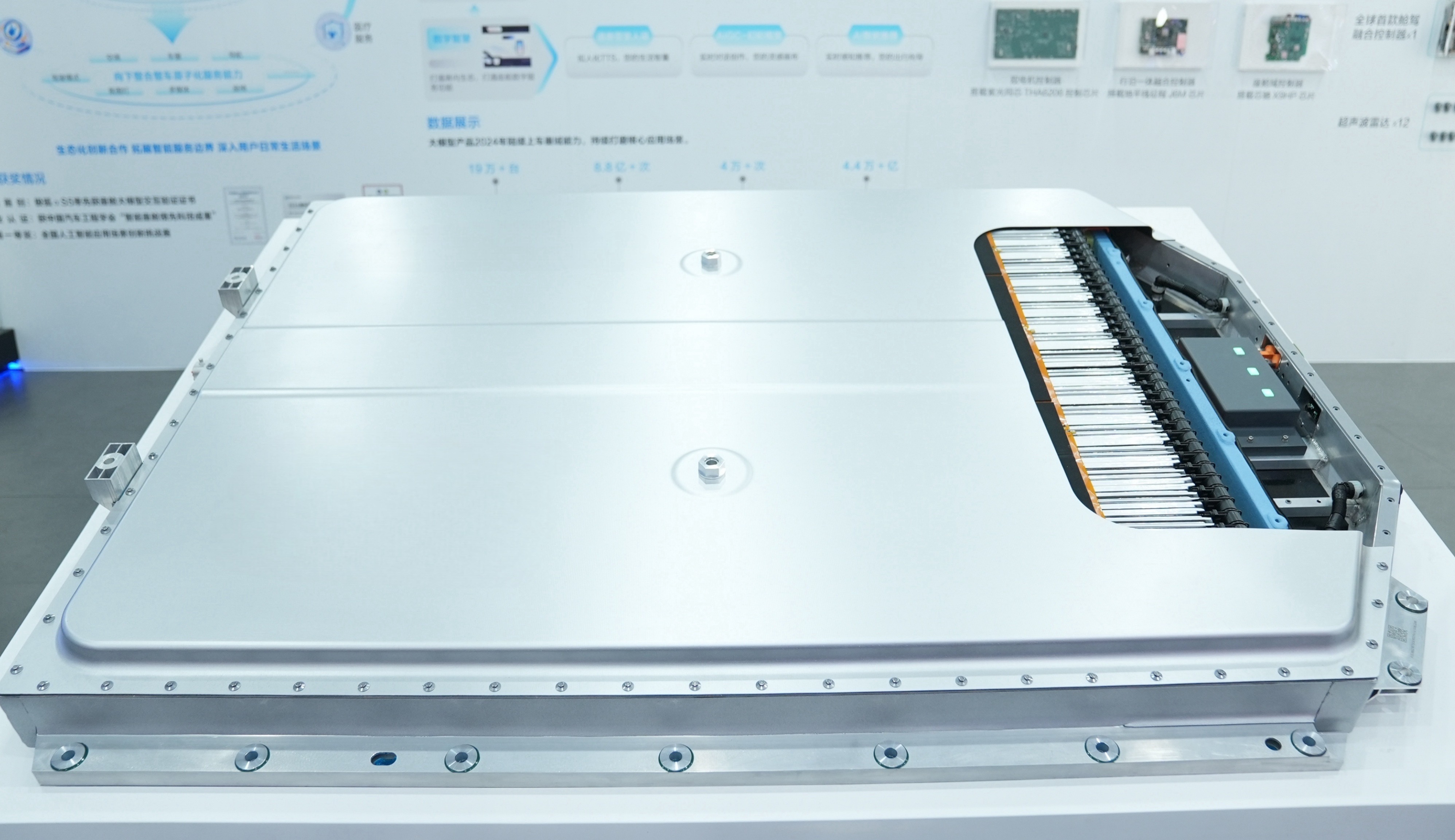
A next-generation solid-state battery pack is co-developed by Welion New Energy Technology and BASF. Without the hazards of flammable liquid electrolytes, the solid-state design delivers exceptional thermal stability. Tackling key challenges in charging speed and driving range, it accelerates the mainstream adoption of solid-state batteries and brings consumers safer, smarter and more reliable EVs. It also contributes to vehicle weight reduction, thermal management and enhanced safety performance.
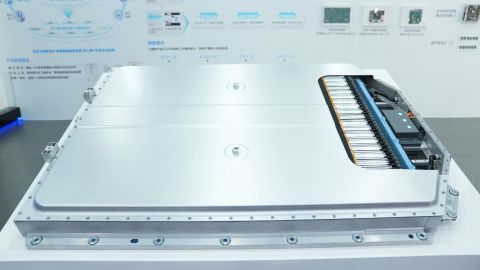
The next-generation solid-state battery pack co-developed by Welion New Energy Technology and BASF.
Meanwhile, ELASTOSIL R 531/60, a new silicone rubber that insulates busbars in high-voltage batteries of EVs, has been developed by Wacker. It is flame-resistant and reliably prevents leakage currents and energy losses. The insulation remains intact, even at operating temperatures of up to 205°C. It can withstand temperature fluctuations and is extremely flexible, even at temperatures down to 40°C, protecting the battery from vehicle body vibrations and impacts.
A next-generation flame-retardant encapsulation polyurethane foam technology – Baysafe BEF flame-retardant encapsulation foam series developed by Covestro – addresses the critical battery safety challenge in EVs by minimizing thermal propagation between battery cells. This lightweight foam is also applicable to batteries in e-bikes and portable battery generators.
Suitable for critical EV components such as connectors and busbars, Amodel PPA HFFR-4133 Orange (OR), developed by Syensqo, is a high-performance flame retardant PPA, distinguished by its stable and vibrant orange color. As orange-colored connectors has become a crucial safety standard by offering immediate visual identification of live high-voltage components, this innovation not only enhances safety but also offers clients a pre-colored orange resin, eliminating the need for in-press coloring and streamlining the manufacturing process.
Featuring non-brominated/non-chlorinated flame retardance that can help enhance the safety and functionality of critical components, such as electric vehicle control units, the LNP THERMOCOMP WFC061I compound is a new specialty material and a 2025 Edison Award winner developed by SABIC. Apart from protecting sensitive internal electronic parts from fire/smoke, impact, moisture and other threats, it can replace metal in EVCU covers to reduce weight significantly and expand design freedom.
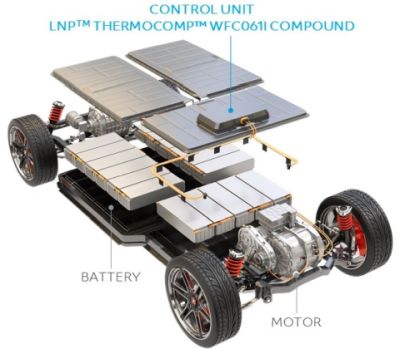
LNP THERMOCOMP WFC061I compound can replace metal in EVCUs covers.
A new intumescent polyurethane coating system, POLYRESYST EV5005, has been developed by Huntsman to provide passive fire protection to metal and composite substrates used in EVs without compromising design flexibility. It can be spray applied without any thickness constraints to help meet the fire standards needed. The material is fast curing and has high mechanical strength with hydrolytic stability and abrasion resistance, delivering a tough yet flexible layer that can help improve the structural integrity of core components in the event of impact or a thermal event.
Finally, flame retardant polymer materials, such as PC/ABS, PP, PA and PBT, produced by Shanghai PRET are widely used in power battery applications. These materials meet UL94 V0 level for flame retardance and electrical property standards with long-term physical durability. They also improve the energy density and extend the service life of power batteries, in line with environmental sustainability and lightweight designs of EVs.
Advanced recycled plastics for automotive applications
Technological breakthroughs have been made in recycled plastics for automotive interiors and exteriors. Here are some of the innovative solutions.
Eco-friendly car storage trays, made by certified TPE materials with over 70% recycled raw material content, have been developed by KRAIBURG TPE. They are industry-standard compliant for controlled emissions (VDA 278 VOC), fogging (DIN 75201-B), and odor levels (VDA 270 B-3), suitable for automotive interiors, ensuring good air quality and product safety. Apart from offering a soft and non-slip surface, they are also structurally stable and durable.
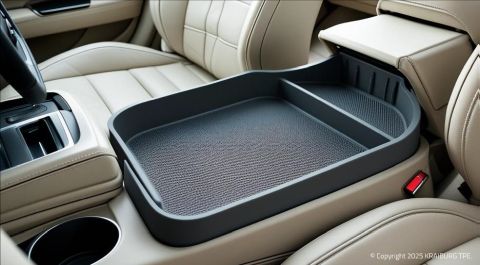
KRAIBURG TPE offers TPE materials with recycled content for automotive storage trays.
Bumper brackets made from certified post-consumer recycled (PCR) materials are now available the Borealis and Borouge. In particular, Borcycle MD2550SY and Borcycle GD3600SY—two high-performance grades from the Borcycle M portfolio of advanced mechanically recycled solutions—have been selected by a leading global automotive manufacturer for the bumper brackets of their new premium SUV. Both grades feature high levels of PCR content (50% and 65%, respectively) and meet stringent standards for consistency and purity, offering excellent processability, performance and quality.
Door visors are now available in recycled acrylic resin for the first time. Acrylic resin recovered from ELVs has been difficult to recycle into products due to its unstable quality and unsuitability for reuse until now, thanks to a unique recycling technology developed by Mitsubishi Chemical which prevents foreign matter from being included in the recovered acrylic resin, and that secures quality equivalent to virgin acrylic resin.
Interior pillars with airbags, decorative door panels and other high-demand applications in premium car interiors can contain more sustainable and recycled materials as a result of a partnership between Simoldes Plastics and ELIX Polymers. Among them is ELIX’s E-LOOP PC/ABS 5120MR, containing 30% post-consumer recycled material from water bottles, provides performance equivalent to premium materials, yet with a reduced carbon footprint up to 40%.
The industry’s first closed-loop recycling of polyurethane seat foam in automotive production is developed jointly by Dow, Jaguar Land Rover and Adient. The recycled foam used in the new seats is estimated to half CO2e emissions impact, avoiding over 44kg of CO2e per seat, the equivalent of charging almost 3,000 smartphones. Through chemical and advanced recycling processes, this breakthrough depolymerization closed-loop recycling solution meets the requirements and maintains the comfort and quality of the luxury automobile brand.
Sustainable automotive carpets will be available using SkyPET CR, a recycled PET material developed by SK Chemicals. Utilizing the company’s chemical recycling technology, which recycles waste plastics at molecular level, SkyPET can be recycled even after use. It can maintain high quality close to new products based on petroleum raw materials even after repeated recycling, making it a material of choice for establishing a complete circular system.