












Toray develops industry-first PPS recycling technology

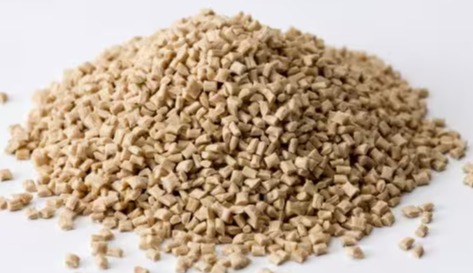
Toray has developed what it believes is the industry’s first solvent-based recycling technology to recover polyphenylene sulfide (PPS) from waste materials.
Recovering usable PPS from end-of-life products has been difficult because contaminants are hard to remove. Virtually no solvents can dissolve PPS because of its high chemical resistance.
The Japanese material manufacturer overcame this challenge by leveraging decades of PPS manufacturing technology to selectively dissolve and crystallize PPS from waste materials and remove glass fibers and other impurities. The resulting recycled material maintains the same molecular weight and melting point as virgin PPS.
According to Toray, this technology selectively dissolves and separates PPS from the materials while retaining its polymer form instead of breaking it down into a monomer, therefore, the process removes impurities more efficiently than conventional chemical recycling processes.
A preliminary Toray study suggests that recycled PPS made with this technology may reduce cradle-to-gate greenhouse gas emissions compared with the company’s PPS made from virgin materials. Toray is currently verifying these potential reductions through ongoing demonstration testing.
Toray aims to launch commercial supply around 2030, following its current scale-up demonstration. It will work with partners in the automotive, recycling, and other industries to establish a resource circulation system spanning the collection of PPS-containing waste materials through the reuse of recycled PPS.
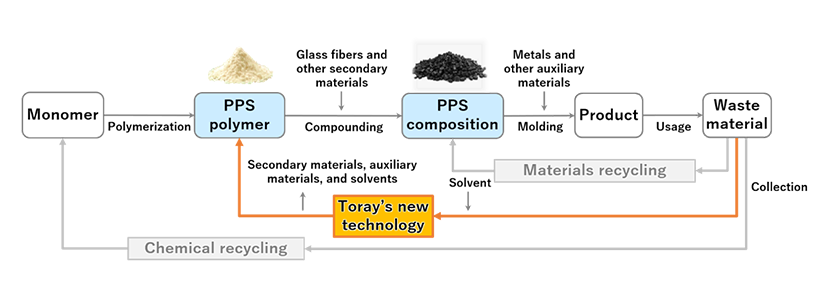
Future PPS circular flow concept. (Source: Toray)
About PPS
PPS is a super-engineering plastic with excellent heat and chemical resistance. Demand for it is growing, particularly for automotive parts and electrical and electronic components. Meanwhile, stricter resource circulation regulations, particularly in Europe, are increasing the importance of post-consumer recycling the automotive and other industries.