


















Sustainability Challenges in PVC Processing: A Screw and Barrel Perspective

Few materials are as foundational to modern manufacturing as polyvinyl chloride (PVC). From window and door profiles to pipes, fittings, and conduit, PVC supports global construction and infrastructure. Beyond the construction environment, it plays a critical role in medical and healthcare applications, where durability, hygiene, and consistency are non-negotiable. Because PVC is used widely, the industry now faces heightened scrutiny under today’s sustainability spotlight.
As sustainability pressures intensify, equipment design is no longer just about throughput and quality. Energy reduction mandates, carbon reporting requirements, and broader regional environmental and sustainability expectations are reshaping how processors evaluate their operations. Extrusion lines, particularly twin screw systems used for PVC compounding and profile extrusion, are closely examined not only for what they produce, but for how efficiently, reliably, and responsibly they operate over their full lifecycle.
This is where the conversation must shift. In PVC processing, screws and barrels are not merely consumable components, they are powerful assets for improving sustainability performance. If the PVC industry is serious about reducing energy consumption, extending equipment life, and embracing circularity, it must accelerate the transition toward durable screws, and recyclable and rebuildable barrels.
Wear: the hidden sustainability challenge in PVC processing
PVC is a notoriously demanding material from a wear perspective. Its formulations often contain fillers, stabilizers, and additives that make processing both corrosive and abrasive. Over time, this combination takes a heavy toll on screws and barrels. Wear manifests not only as dimensional loss and reduced output, but also as higher energy consumption as machines work harder to maintain performance.
Historically, the industry has addressed this challenge reactively, replace worn components and move on. But replacement-heavy strategies are increasingly incompatible with sustainability goals. Every discarded screw or barrel represents wasted material, embodied energy, and unnecessary carbon emissions.
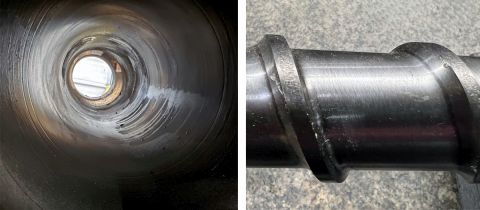
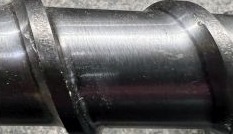
Photographs of wear observed during inspection. Left: barrel inlay wear. Right: screw outside diameter (OD) wear. (Source: Xaloy®)
Rethinking screw and barrel design for sustainability
To meet modern sustainability expectations, polymer processing components; screws, barrels, check valves, nozzles, endcaps, must be redesigned with wear mitigation, service life extension, and end-of-life recovery in mind.
Specialty coatings and advanced materials play a critical role in minimizing wear. Optimized surface treatments can significantly slow corrosion and abrasion, preserving clearances and reducing friction. At the same time, new screw and barrel designs, such as improved screw flight geometries and refurbish-able and relineable barrels, can limit localized stress and extend operational life.
However, not all components are equally easy to make sustainable. Screws, by their nature, are particularly vulnerable. Rebuilding screws is difficult because even a small crack can propagate into a catastrophic failure. A cracked screw can break, damage the barrel, and if left undetected, cascade into costly gearbox failure. From both a safety and sustainability standpoint, this risk makes “run-to-failure” strategies untenable.
For twin screws, gaps between the flights often increase during screw rebuilds. Larger gaps allow more material slip which generates excess heat, increases energy consumption, and accelerates wear on both the extruder and downstream components undermining sustainability gains across the entire process.
Material selection then becomes critical. Traditional parallel twin screws manufactured from 4140 steel with nitriding and chrome plating at the discharge end are increasingly hard to justify. Chrome plating introduces environmental and regulatory challenges, and the overall wear life remains limited. Transitioning to advanced materials such as Nitralloy offers a more sustainable alternative. Nitralloy provides a harder surface finish, superior polish, and improved wear resistance eliminating the need for chrome plating altogether while extending service life and reducing environmental impact.
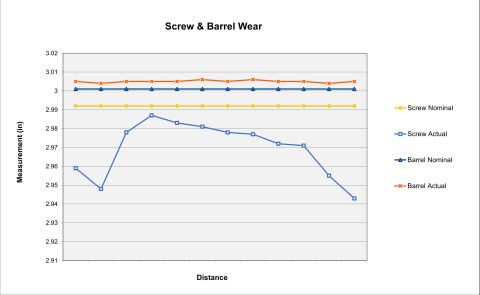
Comparative analysis of nominal versus actual screw and barrel measurements. (Source: Xaloy®)
Circularity through refurbishment, not disposal
While screws present rebuilding challenges barrels offer one of the clearest and most impactful paths to circularity in PVC processing. Unlike screws, barrels can often be restored multiple times without compromising performance provided they are designed with refurbishment in mind.
For conical twin barrels refurbishment is now a sustainable solution. Worn barrels can be precisely machined and restored to original specifications using bimetallic treatments. This approach preserves the existing barrel housing, minimizes raw material consumption, and significantly reduces the energy and emissions associated with manufacturing a new barrel.
Parallel twin barrels lend themselves particularly well to relining. Rather than scrapping the entire barrel assembly, a new wear resistant liner can be installed inside the existing barrel body. Relining restores tight clearances, improves processing efficiency, and extends barrel life often at a fraction of the environmental and financial cost of replacement.
Both refurbishment strategies dramatically reduce waste, prevent large steel components from entering the scrap stream prematurely and lower the overall carbon footprint of extrusion operations. Just as importantly refurbished and relined barrels help maintain optimal processing conditions which in turn reduces energy consumption and improves PVC processing performance.
From a sustainability perspective, refurbishing and relining barrels represents low-hanging fruit and an immediate actionable step that aligns operational efficiency with environmental responsibility.
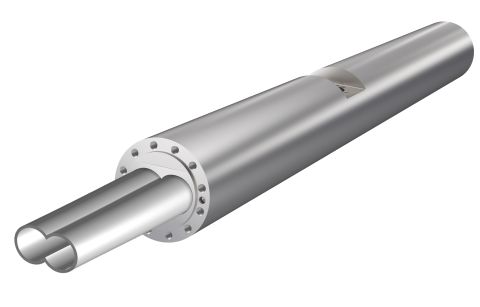
Illustration of a new twin-barrel liner being guided into the barrel assembly as part of the relining process. (Source: Xaloy®)
The path forward
PVC will remain a cornerstone of global manufacturing for decades to come. The question is whether the industry’s processing equipment, particularly twin screw extrusion systems, will evolve fast enough to meet rising sustainability expectations.
Customized, wear-optimized, and rebuild-able screw and barrel solutions offer a tangible path forward. By extending service life, reducing energy consumption, eliminating environmentally problematic coatings, and embracing refurbishment where possible, the PVC industry can materially improve its sustainability profile without compromising performance.
PVC processing must catch up, not because sustainability is a trend, but because it is now a core measure of operational excellence.
About the Author
Cheryl Sayer is Xaloy’s Chief Technology Officer and VP of Engineering, leading global engineering strategy, innovation, and product development.