














Threading the needle: A conversation on Nigeria's future in textile recycling

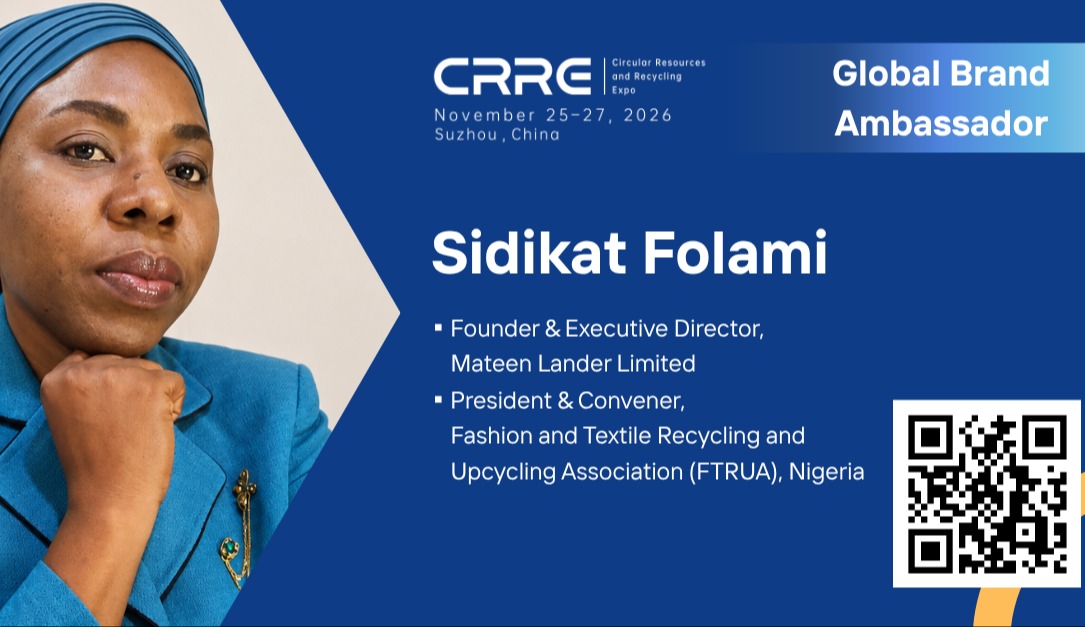
The Circular Resources and Recycling Expo (CRRE) recently spoke with Sidikat Folami, President of the Fashion and Textile Recycling & Upcycling Alliance (FTRUA) and Founder of Mateen Lander, a company that develops practical systems for textile recovery in Nigeria. The discussion provides a comprehensive look at Nigeria's emerging textile circularity market, highlighting both its current fragmentation and its immense untapped potential.
Folami outlines the major business opportunities across the value chain, from commercial collection to industrial applications in construction and manufacturing. She emphasizes that turning waste into reliable raw materials requires practical, locally adaptable technologies and consistent quality standards.
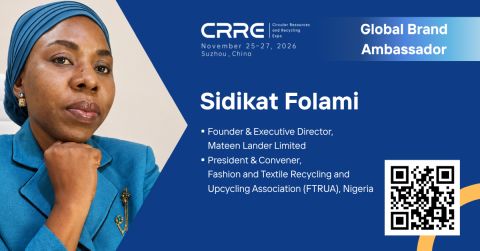
Sidikat Folami, President of the FTRUA and Founder of Mateen Lander, also serves as the Global Brand Ambassador of CRRE.
Current landscape and market potential
How would you assess the current state of Nigeria’s textile circularity market?
Folami: Nigeria's textile circularity market is still emerging and remains fragmented. While recovery, reuse, and recycling activities occur, the systems connecting textile waste generators, collectors, processors, and industrial users are still developing.
For instance, tailors' offcuts are largely underutilized, and organized large-scale collection remains limited. Factory textile waste is managed differently by individual manufacturers; some have internal arrangements for recovery and reuse, while others sell selected materials or use existing disposal channels.
Regarding used clothing, wearable items are passed on, donated, or sold through the second-hand market. Other garments are converted into cleaning rags or discarded once they are no longer useful. Damaged home textiles, such as bedsheets, curtains, and upholstery, are often stored before being disposed of with general waste.
Ultimately, where suitable recovery routes do not exist, some of these materials find their way to landfills.
What is needed to turn textile waste into a reliable source of industrial raw materials?
Folami: First, it is required to understand the material specifications and requirements of the intended end user. Textile waste is not uniform; it contains different fiber compositions, blended fabrics, and materials with distinct processing requirements. Therefore, the sector needs proper material identification, sorting, and preparation tailored to specific applications. What is unsuitable for one recycling process may still be useful for another.
Second, there must be consistency in supply. Industrial users require agreed specifications, reliable quantities, predictable quality, and dependable delivery. Achieving this requires appropriate processing equipment, material testing capabilities, quality control, and stronger relationships between suppliers and industrial buyers.
The ultimate objective must be moving from simply collecting available waste to supplying materials that meet specific industrial requirements.
Where do you see the biggest untapped business opportunities?
Folami: The biggest opportunity lies in material recovery and the development of a supply chain that connects textile waste generators with industrial users. Opportunities exist across the entire value chain, including commercial collection, aggregation, sorting, material identification, fiber recovery, processing, and manufacturing with recovered materials.
A particularly underserved area is the connection between textile waste generators and businesses that can utilize recovered materials. While potential users and industrial applications exist, there is a clear need for organized suppliers who can consistently deliver the right quality and quantity.
Additionally, there are business opportunities in technology development, textile waste data and traceability, Extended Producer Responsibility (EPR) compliance, and specialized waste management services.
Which industries could create the strongest demand for recycled textile materials in Nigeria?
Folami: Considerable opportunities exist in construction and building materials, automotive component manufacturing, furniture and upholstery, mattress manufacturing, and non-woven material production.
‧ Construction: Potential applications include insulation, acoustic materials, and other products incorporating recovered textile fibers, subject to testing and specifications.
‧ Automotive: The industry presents opportunities in selected interior components, insulation, and sound-related applications.
‧ Furniture and Mattresses: Manufacturers can explore recovered fibers for padding, fillings, upholstery, and related products.
‧ Textile and Apparel: Opportunities lie in fiber-to-fiber recycling and developing recycled fibers for sustainable textile and fashion production.
However, these markets are not equally developed in Nigeria. Some applications are more accessible, while others require stronger processing capabilities, product development, and market validation.
Priorities, barriers, and collaboration
What technologies and equipment are most urgently needed to develop the country's textile recycling capacity?
Folami: Nigeria should prioritize practical, adaptable technologies that support the entire recovery process rather than focusing solely on large recycling plants. The sector urgently needs better equipment and supporting infrastructure for:
‧ Material collection, handling, and storage.
‧ Sorting and fiber identification.
‧ Material preparation and mechanical fiber recovery.
‧ Testing and quality control.
Reliable energy and suitable warehousing are also critical components of the system.
Mechanical recycling should be prioritized in the near term while building the technical knowledge and infrastructure required for advanced recycling technologies.
Mechanical recycling allows Nigeria to begin processing suitable waste, develop local technical capacity, create employment, and understand available materials and markets.
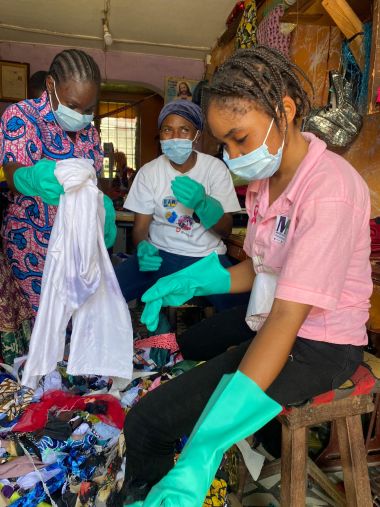
Nigeria’s textile recycling sector urgently needs better equipment and supporting infrastructure. (Source: Mateen Lander)
What are the main barriers preventing textile recycling businesses from scaling up?
Folami: Market development is a major challenge, as there is still a limited understanding of the commercial value of textile waste. Many assume immediate money can be made once waste is collected, without considering the costs of collection, handling, sorting, transportation, and processing. Six connected barriers include:
‧ Market development and awareness: Limited understanding of commercial applications and insufficient connections between suppliers and industrial users.
‧ Fragmentation: Waste is generated across numerous households, tailoring businesses, and manufacturing operations, making organized collection and aggregation challenging.
‧ Access to technology: Suitable equipment and processing infrastructure remain difficult to access and finance.
‧ Technical knowledge and skills: A shortage of specialized skills in textile identification, material recovery, processing, and industrial applications.
‧ Access to finance: Financial institutions and investors are unfamiliar with this emerging sector, leaving businesses to struggle with demonstrating commercial viability and managing perceived risks.
‧ Data and material specifications: A lack of baseline information, material classification, testing, and agreed specifications needed to support buyer confidence.
How can different stakeholders accelerate Nigeria's circular textile economy?
Folami: Industry associations have a very important role because they bring businesses and practitioners together under a common platform.
Organizations like the FTRUA can help coordinate industry participation, connect members to opportunities, encourage collaboration, identify shared needs, and represent the sector collectively in engagements with government, investors, and development partners.
Government should prioritize effective EPR implementation, incentives for recycling businesses, and policies that create markets for recovered materials. Public procurement can also encourage the use of recycled materials where they meet the required standards. Additionally, government investment is needed in infrastructure, research and development, and standards and certification.
International development partners should help facilitate access to technical knowledge, markets, finance, and collaborative opportunities. Alongside them, technology providers should make appropriate technologies more accessible and affordable through practical partnerships, training, and local capacity development.
Finally, investors need to understand the realities of an emerging industry and provide the capital and commercial support required to establish viable businesses. Ultimately, stakeholders must move beyond working in isolation to achieve coordinated action, shared learning, and practical partnerships.
What is your five-year goal, and what opportunities will CRRE 2026 bring?
Folami: By 2031, the goal is a more industrialized textile circularity sector with multiple income streams, employment opportunities, stronger industrial participation, and a clearer understanding of waste resources. Furthermore, Nigerian practitioners must have a seat at the table when local and international decisions affecting the industry are made.
CRRE 2026 provides an important platform to accelerate this development.
My message to international investors, manufacturers, and technology providers is that Nigeria possesses a large population, significant textile consumption, considerable material resources, a growing base of local practitioners, and substantial market potential. Nigeria welcomes partners to invest and build this industry together by combining technology with local talent and sustainable local operations.
About CRRE
CRRE is positioned as a national-level platform, with deep integration across the whole chain and broad international collaboration. It adopts a “summit forum + physical exhibition” dual-engine model. It is committed to building the first five-in-one super hub for resource-circulation in the Asia-Pacific region, covering: recycling – reprocessing – high-value applications – green finance – international rules.
Preregistration:
https://reg.crre-expo.com/CRRE/visitor-registration/eng?Regsource=RAZ23777