











Covestro and Fraunhofer UMSICHT turn ELV waste into basic chemicals

Covestro, the Fraunhofer Institute for Environmental, Safety and Energy Technology UMSICHT, and Carbon Minds GmbH have launched the CARBEX research project to recycle end-of-life vehicle waste into basic chemicals.
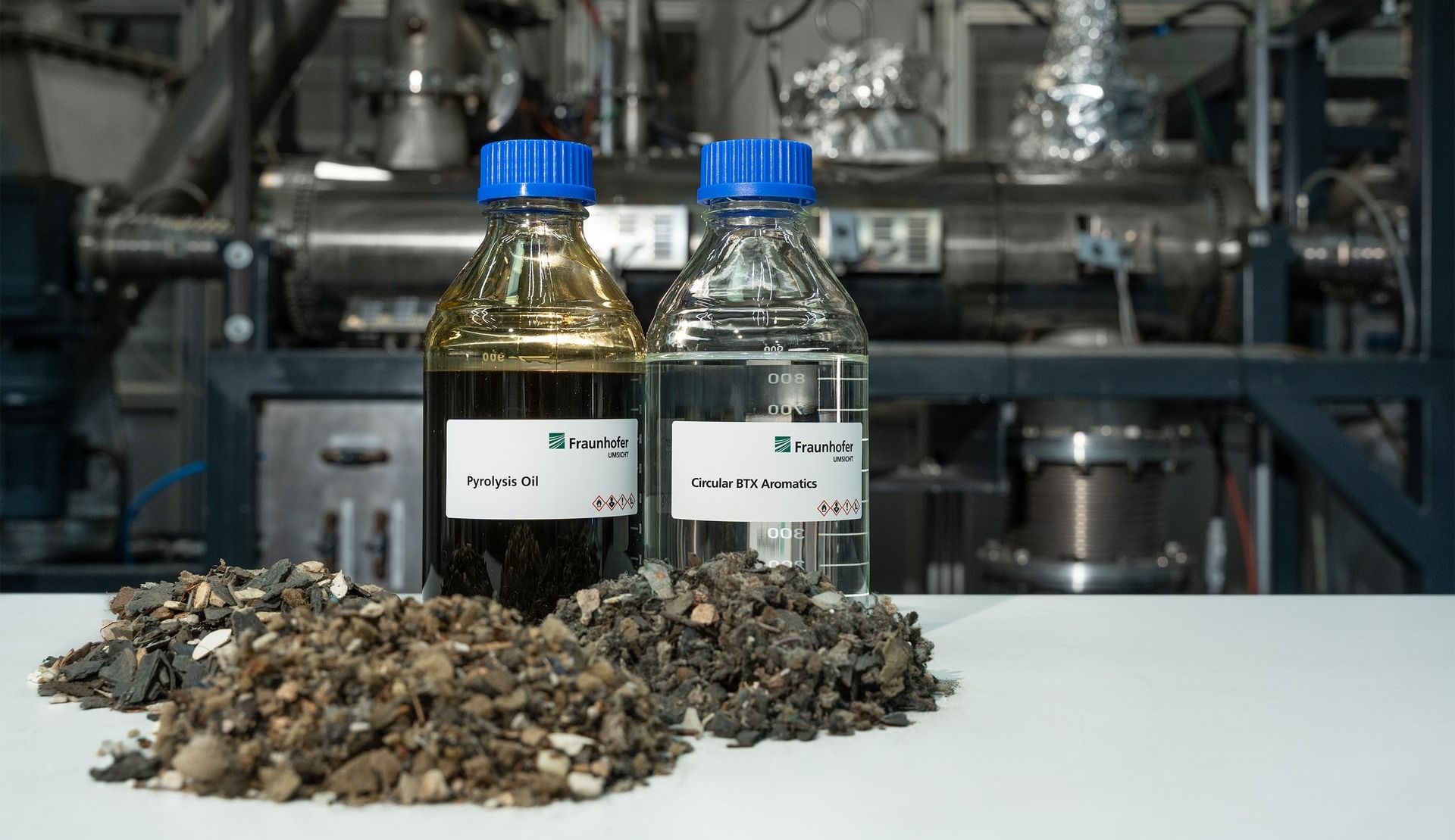
The joint project aims to validate a recycling process for recovering the aromatics benzene, toluene, ethylbenzene and xylenes (BTEX) from automotive shredder residue (ASR) – a waste stream from automotive recycling that is still largely incinerated today.
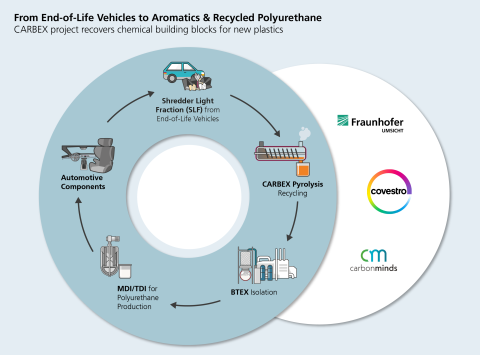
CARBEX project recovers chemical building blocks for new plastics.
Closed-loop automotive recycling
BTEX aromatics are essential building blocks for the chemical industry. Covestro uses benzene as a feedstock to produce MDI (methylene diphenyl diisocyanate) and toluene to produce TDI (toluene diisocyanate). MDI is used, for example, to make insulation foams for buildings and refrigerators, as well as structural and acoustic components for vehicles. TDI is used to produce flexible foams for mattresses, upholstered furniture and car seats.
At the end of a vehicle’s life, components like these, which contain significant amounts of polyurethane, can end up back in automotive shredder residue. This means CARBEX could help close the loop in automotive recycling.
Patented Pyromat technology: Pyrolysis coke becomes a catalyst
CARBEX is based on Fraunhofer UMSICHT’s patented Pyromat technology. It combines pyrolysis with a subsequent autocatalytic reforming process, in which the pyrolysis coke generated during the process itself is used as both a catalyst and an adsorbent.
At temperatures of around 500°C, components of the coke such as calcium carbonate, titanium dioxide and copper promote the formation of aromatic compounds. At the same time, they bind halogens such as chlorine and bromine, preventing them from entering the pyrolysis oil. This eliminates the need for an expensive external catalyst, which would quickly lose its effectiveness due to contaminants in real-world waste streams.
In preliminary laboratory-scale tests using automotive shredder residue (ASR), Fraunhofer UMSICHT achieved a BTEX content of 62% by weight in the pyrolysis oil – around 60% higher than in conventional pyrolysis oils – and reduced the halogen content by up to 99%.
According to the institute’s calculations, process-related emissions from the Pyromat process amount to around 1.1 metric tons of CO₂e per metric ton of BTEX, almost 40% lower than the 1.6 to 1.8 metric tons associated with steam cracking.
“The Pyromat technology uses pyrolysis coke as both a catalyst and an adsorbent. This makes the process robust and cost-effective, especially when dealing with highly contaminated waste streams,” explained Dr. Thomas Fehn, Project Manager at Fraunhofer UMSICHT’s Sulzbach-Rosenberg branch.
As part of the project, the team is taking this approach from the laboratory to continuous pilot-scale operation at a throughput of 10 kilograms per hour.
From waste to isocyanates
CARBEX covers the entire value chain, from BTEX production to its use in industrial applications.
Fraunhofer UMSICHT is adapting its existing pyrolysis plant, converting a fixed-bed reactor into a moving-bed reactor and identifying stable operating conditions. The aim is to produce at least 50 kilograms of BTEX-rich pyrolysis oil with halogen levels below 30 ppm – the threshold for further processing in large-scale industrial plants.
Covestro is developing a model-based separation process to recover the individual aromatics benzene and toluene from the pyrolysis oil through distillation. It will then validate their suitability for use in MDI and TDI production and carry out a techno-economic assessment.
As an independent partner, Carbon Minds GmbH is responsible for the ISO-compliant cradle-to-gate life cycle assessment (LCA) of the new value chain.