





















Sekisui Alveo’s polyolefin foam now carries Class B flammability rating

The Alveolit TA FR 3505 polyolefin foam of Sekisui Alveo, European manufacturer of polyolefin foams, now carries a Class B flammability rating. It is the company’s first foam to achieve this rating. The new exceptional fire-resistance classification opens up wider applications for the foam.
Class B flammability rating designates a high level of fire safety, indicating that the material will not lead to a flashover situation.
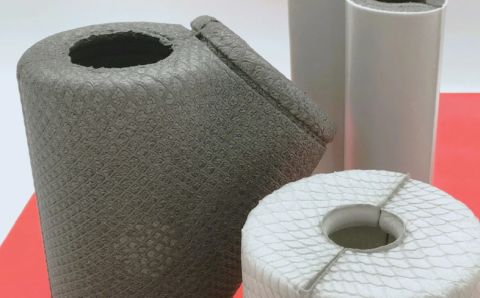
Alveolit TA FR 3505 is a physically crosslinked closed-cell polyolefin foam and was formerly rated Class E. It was designed especially for use in industrial and construction applications, including pipe insulation, pipe wrapping, and flat roof applications.
Fabian Leuthard, Application Development Manager at Sekisui Alveo, says: “This is our first foam to achieve the Class B flammability rating in accordance with EN 13501-1. We look forward to seeing it used in new applications that the new rating makes possible.”
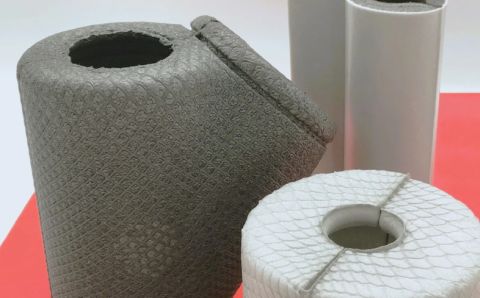
Alveolit TA FR 3505 is a physically crosslinked closed-cell polyolefin foam designed especially for industrial and construction applications.
Latest test methods
The testing of Alveolit TA FR 3505 was conducted in 2022 according to the European standards EN 11925-2:2020 and EN 13823: 2020 in an independent accredited testing laboratory specialized in flammability testing of materials.
The test method used is known as “single burning item” and evaluates the potential contribution of a building product (excluding flooring) to the development of a fire in a fire situation simulating a single burning item in a room corner near that product.
The test is used to determine fire growth rate, flame spread, and heat release. Additional classifications are smoke production and flaming droplets/particles.
The sample tested was anthracite colored Alveolit TA FR 3505, 5 mm thick, with a density of 29 kg/m3, glued to a galvanized steel sheet 1 mm thick. The foam is offered in a range of thicknesses, which are available on request. Thicknesses from 3 mm to 10 mm can be certified according to standard EN13501-1:2019 on demand.