




















Transparent polycarbonates refine sensor roof module for autonomous driving

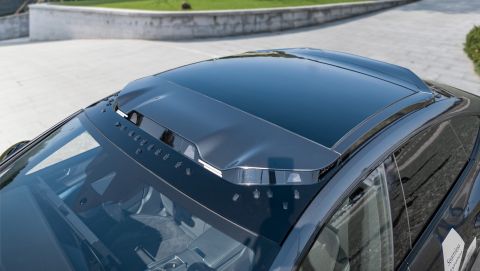
Webastro, an automotive supplier, recently unveiled a prototype of a fully integrated sensor roof module for autonomous driving, which uses materials from Covestro.
High functionality and aesthetic design with Covestro’s materials
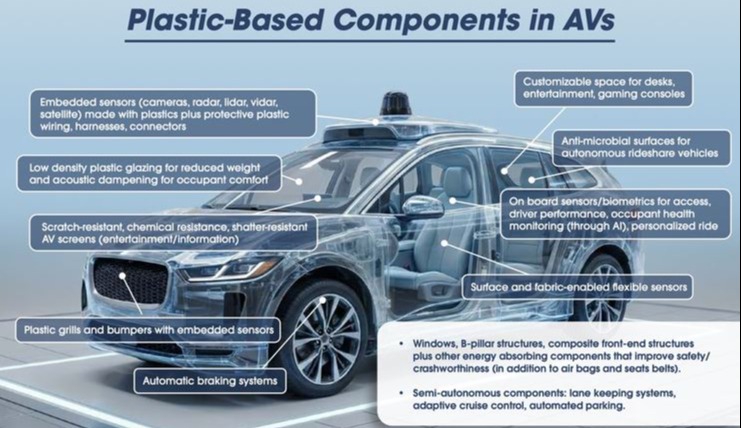
Covestro’s transparent polycarbonate (PC) Makrolon AG and black PC-ABS Bayblend T95 MF are used in the sensor roof module. The complete sensor technology is hidden under a seamless roof module made of Makrolon AG.
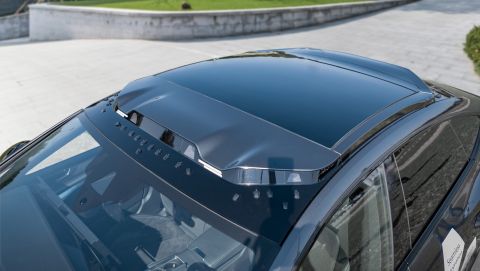
Polycarbonate plastics enable lightweight, aesthetic and durable component construction.
Makrolon AG was developed for use in glass-like exterior components and is highly permeable to various sensor signals. Meanwhile, it meets high mechanical requirements.
Additionally, it offers design freedom for embedding all relevant electronic components while at the same time providing an attractive exterior design for the component. The lightweight plastics also ensure a low center of gravity for the vehicle, and thus better road holding.
High heat resistance of polycarbonate also ensures the roof module retains its shape even at high outside temperatures and in strong sunlight, and does not impair the sensors’ function. On the other hand, cleaning and de-icing systems ensure flawless operation in winter.
Cooperation with Chinese automaker
At the International Symposium for Automotive Lighting (ISAL) to be held from 25-27, September, in Darmstadt, Germany, Covestro will showcase a roof module equipped with LiDAR sensors from Chinese automaker Human Horizons.
The Chinese automaker equips its new HiPhi Z model with LiDAR sensors protected by Covestro’s PC-PET Makroblend UT235 M. The cover glass made of special polycarbonate Makrolon AX ST allows optical signals from these sensors to pass through, which ensures maximum efficiency.