



















Colloids debuts graphene-based masterbatches for enhancing thermal conductivity

While more countries are introducing policies to support the development of a green economy, more companies are taking the initiative to explore new paths in sustainable development, reducing resource consumption and environmental pollution through technological innovation and industrial upgrading.
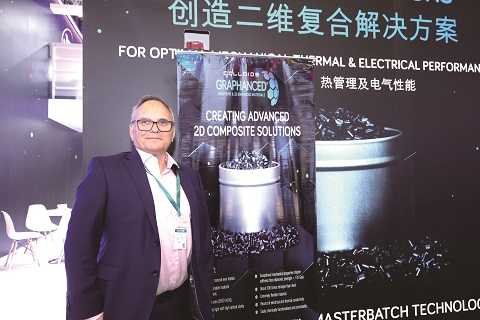
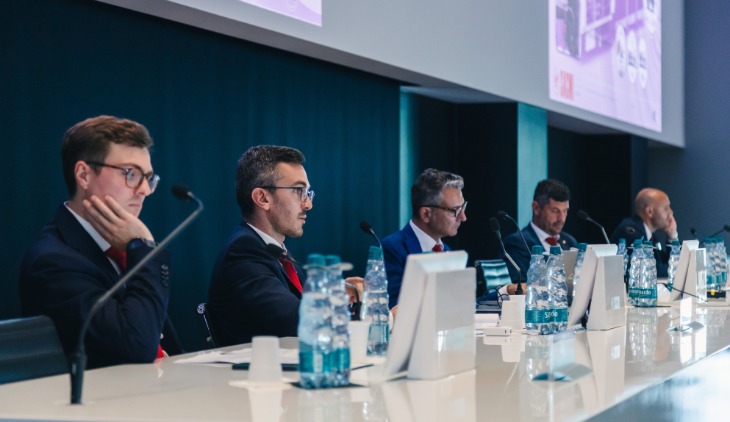
"In the context of the global economy, the plastics industry is working hard to meet market demands and promote the development of the applications industry, to which Colloids is committed to revolutionizing," says Dr. Derek Hepburn, Technical Director of Colloids Group.
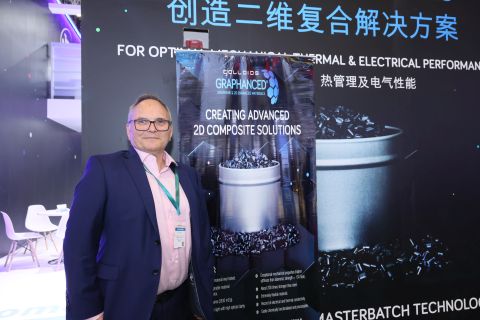
Dr. Derek Hepburn, Technical Director of Colloids Group.
As a leader in masterbatch R&D and production, Colloids showcases a series of graphene-based masterbatches for thermoplastic and thermoplastic/elastomeric polymers - GRAPHANCED. Notably, CHINAPLAS 2024 marks the debut of the practical application of GRAPHANCED in the field of thermal conductivity.
The base resins of the GRAPHANCED series include (but not limited to) PA6, PA66, PBT, PET, PC, polyolefin, PS, SAN, EMA, TPEs, and TPU. The development of GRAPHANCED products is in progress and is compatible with high-end polymers (such as PEEK, PPS).
An innovative technological breakthrough, GRAPHANCED series masterbatch products integrate high-quality graphene nanoplatelets and two-dimensional materials into thermoplastic polymers to form fundamental changes in material properties. By adding just 0.1 wt.% of specific graphene nanosheets, the mechanical properties are significantly improved.

Colloids presents GRAPHANCED graphene masterbatch series at CHINAPLAS.
Dr. Hepburn explains that taking PA6 as an example, after adding GRAPHANCED, its tensile modulus increased by 40%, tensile strength increased by 20%, and yield tensile strength also increased by 32%. Similarly, in PBT materials, at the same addition amount, tensile modulus increased by 20%, tensile strength increased by 15%, and yield tensile strength increased by 6%. Moreover, when the graphene nanoplatelet content further increases, thermal conductivity also shows significant improvement.
Colloids launched this range of products by working closely with leading institutions and manufacturers to deliver exceptional material performance and sustainability. This technological breakthrough enables customized solutions for a variety of thermoplastic polymers.
At a theoretical level, through careful design and implementation of specific modified material synthesis processes, key properties such as mechanical strength and thermal stability of plastics can be precisely controlled to meet specific requirements in different application scenarios.
"These products are not just technological demonstrations, but solutions that bring practical advantages to various industries," Dr. Hepburn stresses. For instance, in the automotive industry, these solutions help achieve lightweighting and improve efficiency, thus boosting the mileage of electric vehicles. In addition, these products also play an important role in areas such as infrastructure, construction and agriculture by minimizing the loss of resources and combating climate change.
Looking forward to the next two to three years, Dr. Hepburn believes that sustainability will remain as the key driving force for the development of the plastics industry. In addition to the advancement of sustainability initiatives and technological breakthroughs, market demand, regulatory changes and consumer preferences will also have a profound impact on the development of the industry and the company.
"Sustainability is not only the cornerstone of our business model, but also the core principle of all our actions. We fully understand that in the global economy, the success of a company depends largely on its responsibility to the environment and commitment to sustainable development,§ says Dr. Hepburn.
Therefore, Colloids always adhere to this principle in product development and are committed to providing maximum value while ensuring minimal impact on the environment, he remarks.
Booth: 8.2F27