











Search History
Clear History
{{item.search_key}}
Hot Searches
Change
{{item.name}}
{{item.english_name}}
Subscribe eNews
Once A Week Once Every Two Weeks
{{sum}}
Login Register

Applications

KRAIBURG TPE THERMOLAST H improves wrist orthoses design

ExxonMobil develops high-performance vacuum skin packaging formulations

Tetra Pak launches industry-first 1-litre aseptic carton with paper-based barrier

Products

Covestro and EMPTECH partner to advance high-security identity document solutions

SABIC launches first laser-weldable thermoplastics for photovoltaic applications

Chengdu Liuliu Plastic Machinery Shines at CHINAPLAS 2026 with Patent Dust-free Resin Tile Cutter

Activities

  • 350,000+ visitors! CHINAPLAS 2026 shatters every record in the book

  • CHINAPLAS 2026: 86,504 visitors explore innovations on Day 3

  • Must-attend events: Application in Focus and Additives Seminar

Pictorial

News Videos

Top 10 Technology Trends awards presented at CHINAPLAS 2026

MAAG x SIKORA: Smart pelletizing + precise inspection - More stable, carbon-reduced

CAI Machine: New visual inspection technology debut! More efficient, greener, colorful printing

Conference Videos

Driving systemic change: Unilever’s evolution in the circular economy

Interview with Director Global Sustainability Advocacy at Unilever

Interview: Thailand’s perspective on cross-border circular cooperation

Corporate/Product Videos

For Rubber & Plastic Extrusion Equipment, trust Hebei Zhongsen! Custom Extruders, Traction Machines & Vulcanizing Lines

Is Your Mold Supplier Really Giving You Peace of Mind?

Kurtz GmbH & Co.

Home > News > Others

Material breakthroughs in low-altitude economy only seen in CHINAPLAS

Source:Adsale Plastics Network Date :2026-05-19 Editor :RC
Copyright: This article was originally written/edited by Adsale Plastics Network (AdsaleCPRJ.com), republishing and excerpting are not allowed without permission. For any copyright infringement, we will pursue legal liability in accordance with the law.

Flying as daily transportation, drones for food delivery, eVTOL flying across city skyline… These scenes that used to only appear in sci-fi movies are coming into reality. In 2026, low-altitude economy begins to develop into scalable applications.


As drone logistics, low-altitude cultural tourism, and urban air mobility have rapidly implemented, the value of low-altitude economy market in China has exceeded RMB 1.5 trillion, with 160,000 related companies.


However, when eVTOL, drone, flying car move from “viable” to “commercial available”, market competition gets more intense – vehicles have to be both lightweight and strong, ensuring safety and durable in complicated environment. Material has become a key in the commercialization of low-altitude economy.


At CHINAPLAS 2026, Evonik, Covestro, Rianlon, Sinopec, Datong Yulong, Kingfa Science, LFT (Xiamen) and other companies have presented their material innovations for low-altitude economy.


Safety as first priority


Low-altitude flying vehicles have to operate in complicated environment, including high temperature and humidity, strong UV light, and strong wind turbulence. Therefore, the vehicle materials have to meet stringent requirement on weather stability, durability, impact resistance, flame retardant, heat insulation and more.


For critical areas around battery pack, the standards for temperature, insulation and flame retardant are even higher. In extreme cases such as thermal runaway, the vehicle has to remain structurally intact.


In material selection, common structural parts are made of common engineering plastics such as PA, PC, POM, PPO and TPE, which meet basic flame-retardant, strength and stability requirements. While advanced engineering plastics that can withstand temperature higher than 150°C, including PPS, PEEK, and PI, are used in high-heat area, battery pack, and core protection parts, offering outstanding heat resistance, flame retardancy, and aging resistance for long and stable operation under extreme conditions.


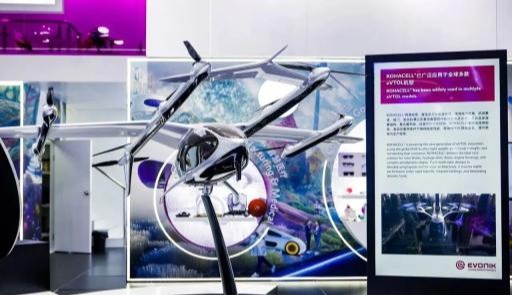
Evonik’s ROHACELL PMI foam is light but provides impressive mechanical strength. It can be applied in critical structural parts in eVTOL, ensuring the vehicles lightweight but overall stability. In face of the challenge of thermal runaway during operation, Evonik’s VESTAMID PA12 supports stable operation of battery and power system in extreme conditions.
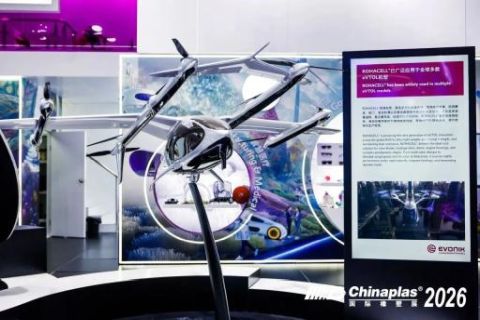

CHINAPLAS 2026_Low-altitude economy_01.jpg


Evonik’s solutions for eVTOLs.


Covestro’s transparent PC has low density, high transparency, and high impact resistance. With ultra-thin structural design, the material can be used in windshields, resulting 50% lighter compared to traditional glass windshields. Its encapsulation polyurethane foam technology is also used for thermal runaway protection for batteries, as well as coating system for protection and optimization in lightweight of the whole flying vehicle.
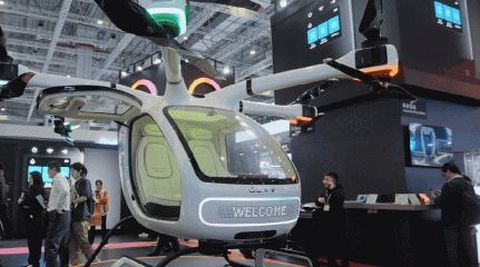
 

CHINAPLAS 2026_Low-altitude economy_02.jpg


Covestro’s solutions for eVTOLs.


Rianlon presented U-pack B8119 which enhances long-term heat aging resistance under 150°C high temperature. The company’s U-pack UV-703 also offers UV durability, color protection and gloss protection for interior and exterior. It does not impact coating adhesiveness, and is odor-less, meeting interior & exterior VOC/FOG emissions requirements. These significantly enhance material stability and durability in complicated operation environments.


SINOPEC’s high strength and flexible self-reinforced PP sheets for low-altitude flying vehicles. It features integrated structure, high rigidity, outstanding impact resistance comparable to glass fiber with density only <0.9g/cm³, which is 40% lighter than glass fiber, 67% lighter than aluminum alloy. The material is also low VOC and can also be fully recycled after use.


Carbon fiber-reinforced PA composite material has high rigidity and impact resistance, as well as outstanding fatigue and creep resistance. The material can be used in propeller blade and machine arm parts.
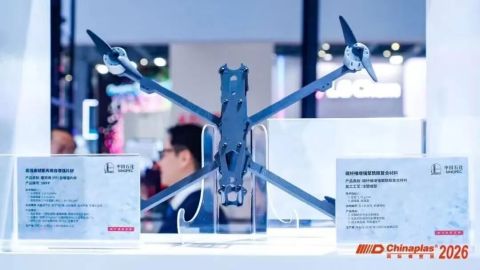

CHINAPLAS 2026_Low-altitude economy_03.jpg


SINOPEC’s solutions for drones.


Lightweighting: Reducing weight for longer endurance


For flying vehicles like eVTOLs, drones, lighter weight means longer endurance, more carrying capacity, lower energy consumption and operation cost. Therefore, lightweight materials are ideal for vehicle body.


Under this context, Datong Yulong, Kingfa Science, LFT (Xiamen), and Orinko showcased their lightweighting materials for low-altitude flying applications.


Datong Yulong’s long carbon fiber-reinforced thermoplastic (LCFT) targets for drone and flying vehicle structural parts. It ensures rigidity and 10-30% lighter weight, making material breakthrough in rigidity, lightweight, and flexibility.


Kingfa Science’s KingPan is a composite panel combining thermoset polymer and carbon fiber. It features high rigidity and low density, with rigidity 4 times higher than aluminum but only half of its density. The material can be used in drone parts, meeting performance requirement while reducing weight at the same time, significantly improving endurance of drones.
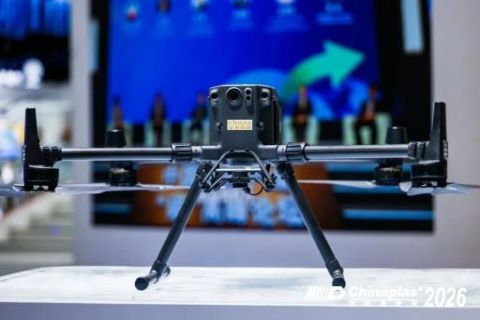

CHINAPLAS 2026_Low-altitude economy_04.jpg


Kingfa’s solutions for drones.


LFT (Xiamen) showed its long carbon fiber-reinforced thermoplastics, which features lightweight, ultra-high rigidity, flame retardant, and weather resistance. It helps achieve weight reduction and cost reduction in vehicle body and drone propeller.


From new energy to low-altitude economy: Multiple applications of long fiber composite materials


Orinko’s carbon fiber product series features lightweight, high tensile strength, and corrosion resistance, which support weight reduction in drones, reducing energy consumption and enhancing endurance and operation stability. It also solves the previous industry challenge of heavy weight and corrosion in metals.
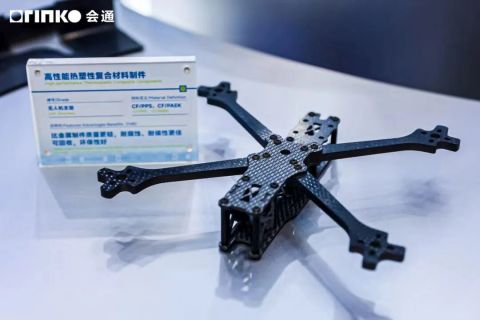

CHINAPLAS 2026_Low-altitude economy_05.jpg


Orinko’s solutions for drones.


WOTE Advanced Materials and Genius Advanced Material offer high-performance engineering plastic as alternative to metal structural parts for eVTOL and commercial aerospace applications.
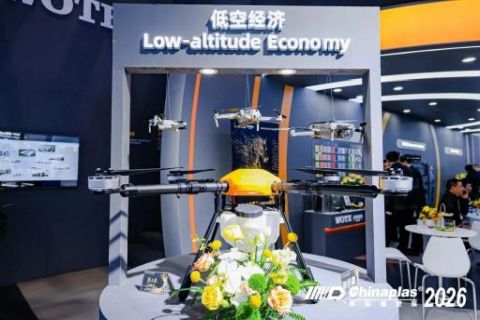

CHINAPLAS 2026_Low-altitude economy_06.jpg


WOTE’s solutions for low-altitude economy.


Cost reduction: Innovative process for mass production


From prototype to mass production of low-altitude flying vehicle, automated manufacturing solutions are also essential. Automation not only enhance efficiency in mass production, it also reduces production cost and accelerates industrialization of flying vehicles.


Haitian International’s injection molding and automation solutions for drone propeller have standardized manufacturing procedures for this core parts:

  • Drone propellers and clamps molding and assembly in one flow

  • Precision control within ±0.05mm

  • Production efficiency enhanced by more than 30%

  • Significantly reduces human assembling process


KraussMaffei’s FiberForm process is a fully automated combination of thermoforming and thermoplastic overmolding. Compared to conventional metal part manufacturing, this process shortens flying vehicle part production time to only 2 minutes. This enhances production efficiency and reduce cost while maintaining same structural rigidity and flying safety.


Conclusion


In the development of low-altitude economy, challenges and opportunities occur at the same time.


In one path, applications continue to expand, product portfolios are getting more mature, overall industry is accelerating to scale up; in another path, material and manufacturing systems continuously make breakthroughs in safety, lightweighting, weather resistance and mass production.


For plastics and rubber industries, these are not simply an extension to an application, but also a chance to upgrade high-performance materials and manufacturing ability.


 Like 丨  {{details_info.likes_count}}
Low-altitude economy
thermoplastic elastomer (TPE)
eVTOL
CHINAPLAS
Carbon fiber
Polycarbonate (PC)
Polyamide (PA)
 JIANGSU YICAN SPECIAL PLASTICS CO., LTD.      
 NANTONG FUYUAN CARBON FIBER RECYCLING CO., LTD      
 Rongsheng Petrochemical Co., Ltd.      
 FUJIAN HUASU INNOVATIVE PLASTICS MATERIALS CO., LTD.      
 SHANGHAI HUAZHENG COMPOSITES CO.;LTD      
 Inner Mongolia Dadi Yuntian Chemical Co..Ltd      
 JIANGSU LISIDE NEW MATERIAL CO., LTD      
 Zhejiang Future Petrochemical Co.,ltd      
 ANHUI HAO YUAN CHEMICAL GROUP CO., LTD.      

The content you're trying to view is for members only. If you are currently a member, Please login to access this content.   Login

Source:Adsale Plastics Network Date :2026-05-19 Editor :RC
Copyright: This article was originally written/edited by Adsale Plastics Network (AdsaleCPRJ.com), republishing and excerpting are not allowed without permission. For any copyright infringement, we will pursue legal liability in accordance with the law.

Flying as daily transportation, drones for food delivery, eVTOL flying across city skyline… These scenes that used to only appear in sci-fi movies are coming into reality. In 2026, low-altitude economy begins to develop into scalable applications.


As drone logistics, low-altitude cultural tourism, and urban air mobility have rapidly implemented, the value of low-altitude economy market in China has exceeded RMB 1.5 trillion, with 160,000 related companies.


However, when eVTOL, drone, flying car move from “viable” to “commercial available”, market competition gets more intense – vehicles have to be both lightweight and strong, ensuring safety and durable in complicated environment. Material has become a key in the commercialization of low-altitude economy.


At CHINAPLAS 2026, Evonik, Covestro, Rianlon, Sinopec, Datong Yulong, Kingfa Science, LFT (Xiamen) and other companies have presented their material innovations for low-altitude economy.


Safety as first priority


Low-altitude flying vehicles have to operate in complicated environment, including high temperature and humidity, strong UV light, and strong wind turbulence. Therefore, the vehicle materials have to meet stringent requirement on weather stability, durability, impact resistance, flame retardant, heat insulation and more.


For critical areas around battery pack, the standards for temperature, insulation and flame retardant are even higher. In extreme cases such as thermal runaway, the vehicle has to remain structurally intact.


In material selection, common structural parts are made of common engineering plastics such as PA, PC, POM, PPO and TPE, which meet basic flame-retardant, strength and stability requirements. While advanced engineering plastics that can withstand temperature higher than 150°C, including PPS, PEEK, and PI, are used in high-heat area, battery pack, and core protection parts, offering outstanding heat resistance, flame retardancy, and aging resistance for long and stable operation under extreme conditions.


Evonik’s ROHACELL PMI foam is light but provides impressive mechanical strength. It can be applied in critical structural parts in eVTOL, ensuring the vehicles lightweight but overall stability. In face of the challenge of thermal runaway during operation, Evonik’s VESTAMID PA12 supports stable operation of battery and power system in extreme conditions.


CHINAPLAS 2026_Low-altitude economy_01.jpg


Evonik’s solutions for eVTOLs.


Covestro’s transparent PC has low density, high transparency, and high impact resistance. With ultra-thin structural design, the material can be used in windshields, resulting 50% lighter compared to traditional glass windshields. Its encapsulation polyurethane foam technology is also used for thermal runaway protection for batteries, as well as coating system for protection and optimization in lightweight of the whole flying vehicle.


CHINAPLAS 2026_Low-altitude economy_02.jpg


Covestro’s solutions for eVTOLs.


Rianlon presented U-pack B8119 which enhances long-term heat aging resistance under 150°C high temperature. The company’s U-pack UV-703 also offers UV durability, color protection and gloss protection for interior and exterior. It does not impact coating adhesiveness, and is odor-less, meeting interior & exterior VOC/FOG emissions requirements. These significantly enhance material stability and durability in complicated operation environments.


SINOPEC’s high strength and flexible self-reinforced PP sheets for low-altitude flying vehicles. It features integrated structure, high rigidity, outstanding impact resistance comparable to glass fiber with density only <0.9g/cm³, which is 40% lighter than glass fiber, 67% lighter than aluminum alloy. The material is also low VOC and can also be fully recycled after use.


Carbon fiber-reinforced PA composite material has high rigidity and impact resistance, as well as outstanding fatigue and creep resistance. The material can be used in propeller blade and machine arm parts.


CHINAPLAS 2026_Low-altitude economy_03.jpg


SINOPEC’s solutions for drones.


Lightweighting: Reducing weight for longer endurance


For flying vehicles like eVTOLs, drones, lighter weight means longer endurance, more carrying capacity, lower energy consumption and operation cost. Therefore, lightweight materials are ideal for vehicle body.


Under this context, Datong Yulong, Kingfa Science, LFT (Xiamen), and Orinko showcased their lightweighting materials for low-altitude flying applications.


Datong Yulong’s long carbon fiber-reinforced thermoplastic (LCFT) targets for drone and flying vehicle structural parts. It ensures rigidity and 10-30% lighter weight, making material breakthrough in rigidity, lightweight, and flexibility.


Kingfa Science’s KingPan is a composite panel combining thermoset polymer and carbon fiber. It features high rigidity and low density, with rigidity 4 times higher than aluminum but only half of its density. The material can be used in drone parts, meeting performance requirement while reducing weight at the same time, significantly improving endurance of drones.


CHINAPLAS 2026_Low-altitude economy_04.jpg


Kingfa’s solutions for drones.


LFT (Xiamen) showed its long carbon fiber-reinforced thermoplastics, which features lightweight, ultra-high rigidity, flame retardant, and weather resistance. It helps achieve weight reduction and cost reduction in vehicle body and drone propeller.


From new energy to low-altitude economy: Multiple applications of long fiber composite materials


Orinko’s carbon fiber product series features lightweight, high tensile strength, and corrosion resistance, which support weight reduction in drones, reducing energy consumption and enhancing endurance and operation stability. It also solves the previous industry challenge of heavy weight and corrosion in metals.


CHINAPLAS 2026_Low-altitude economy_05.jpg


Orinko’s solutions for drones.


WOTE Advanced Materials and Genius Advanced Material offer high-performance engineering plastic as alternative to metal structural parts for eVTOL and commercial aerospace applications.


CHINAPLAS 2026_Low-altitude economy_06.jpg


WOTE’s solutions for low-altitude economy.


Cost reduction: Innovative process for mass production


From prototype to mass production of low-altitude flying vehicle, automated manufacturing solutions are also essential. Automation not only enhance efficiency in mass production, it also reduces production cost and accelerates industrialization of flying vehicles.


Haitian International’s injection molding and automation solutions for drone propeller have standardized manufacturing procedures for this core parts:

  • Drone propellers and clamps molding and assembly in one flow

  • Precision control within ±0.05mm

  • Production efficiency enhanced by more than 30%

  • Significantly reduces human assembling process


KraussMaffei’s FiberForm process is a fully automated combination of thermoforming and thermoplastic overmolding. Compared to conventional metal part manufacturing, this process shortens flying vehicle part production time to only 2 minutes. This enhances production efficiency and reduce cost while maintaining same structural rigidity and flying safety.


Conclusion


In the development of low-altitude economy, challenges and opportunities occur at the same time.


In one path, applications continue to expand, product portfolios are getting more mature, overall industry is accelerating to scale up; in another path, material and manufacturing systems continuously make breakthroughs in safety, lightweighting, weather resistance and mass production.


For plastics and rubber industries, these are not simply an extension to an application, but also a chance to upgrade high-performance materials and manufacturing ability.

全文内容需要订阅后才能阅读哦~
立即订阅

Recommended Articles

Others
Material breakthroughs in low-altitude economy only seen in CHINAPLAS
 2026-05-19
Others
KRAIBURG TPE’s sustainable series for sustainable robotic applications
 2026-05-13
Others
Washable, biobased kitchen towel commercialized
 2026-05-13
Others
Covestro recycled PC for suitcase
 2026-04-28
Others
TPE solutions for stronger exercise bands
 2026-03-27
Others
Market report: New Energy Market Expands as Plastics Solidify Foundations
 2026-02-13

You May Be Interested In

Change

  • People
  • Company
loading... No Content

{{[item.truename,item.truename_english][lang]}} {{[item.company_name,item.company_name_english][lang]}} {{[item.job_name,item.name_english][lang]}}
{{[item.company_name,item.company_name_english][lang]}} Company Name    {{[item.display_name,item.display_name_english][lang]}}  

Polyurethane Investment Medical Carbon neutral Reduce cost and increase efficiency CHINAPLAS Financial reports rPET INEOS Styrolution Evonik Borouge Polystyrene (PS) mono-material Sustainability Circular economy BASF SABIC Multi-component injection molding machine All-electric injection molding machine Thermoforming machine

Material breakthroughs in low-altitude economy only seen in CHINAPLAS

识别右侧二维码,进入阅读全文
下载
x 关闭
订阅
亲爱的用户,请填写一下信息
I have read and agree to the 《Terms of Use》 and 《Privacy Policy》
立即订阅
Top
Feedback
Chat
News
Market News
Applications
Products
Video
In Pictures
Specials
Activities
eBook
Front Line
Plastics Applications
Chemicals and Raw Material
Processing Technologies
Products
Injection
Extrusion
Auxiliary
Blow Molding
Mold
Hot Runner
Screw
Applications
Packaging
Automotive
Medical
Recycling
E&E
LED
Construction
Others
Events
Conference
Webinar
CHINAPLAS
CPS+ eMarketplace
Official Publications
CPS eNews
Media Kit
Social Media
Facebook
Linkedin