



















BMW expands use of 3D-printed, customized robot grippers

BMW Group has been using 3D printers from as early as 1991 to produce individual vehicle parts and components, initially for concept cars, prototypes and race cars, then later for production models. The Group now also manufactures many work aids and tools for its own production system in various 3D printing processes.
Over 100,000 printed parts were produced per year across all the BMW plants that form the global production network, from Spartanburg and the German plants to sites in Asia.
3D printing large robot grippers for CFRP roofs
For a number of years, the BMW Group’s Lightweight Construction and Technology Centre in Landshut has been using a particularly large 3D printed gripper element.
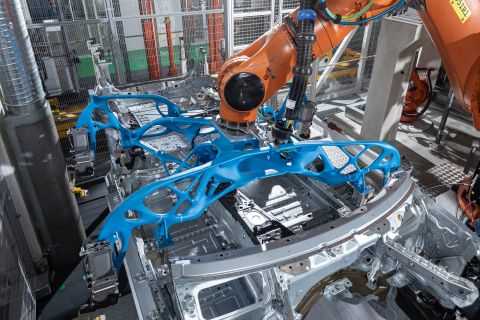
Weighing around 120 kilograms, the gripper for a robot can be manufactured in just 22 hours and is then used on a press in the production of all CFRP roofs for BMW M GmbH models. The press is first loaded with the CFRP raw material. The gripper is simply rotated 180 degrees to remove the finished roofs.
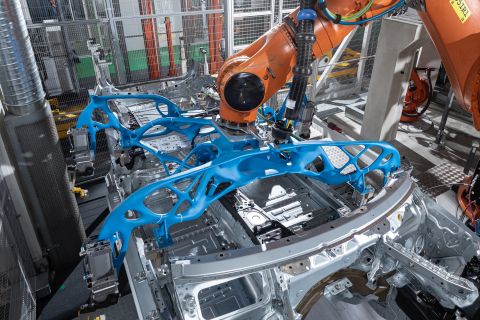
3D-printed large robot grippers are used for production of CFRP roofs at BMW.
Compared to conventional grippers, the version manufactured using 3D printing was roughly 20% lighter, which in turn extend the operating life of the robots and also reduced wear and tear on the system, as well as cutting maintenance intervals. The combined use for two steps also reduced the cycle time.
A unique feature of the robot gripper is the ideal combination of two different 3D printing processes. While the vacuum grippers and the clamps for the needle gripper to lift the CFRP raw material are made using selective laser sintering (SLS), the large roof shell and bearing structure are manufactured using large scale printing (LSP).
LSP can be used to produce large components economically and sustainably. The process uses injection molding granules and recycled plastics, while CFRP residual material can also be used and recycled. Compared to the use of primary raw materials, CO2 emissions when manufacturing the gripper are roughly 60% lower.
Further weight savings with bionic grippers
In the summer of 2023, a new, even lighter generation of gripper was introduced. To achieve this, the previous gripper concept was analyzed and optimized topologically – the birth of the bionic robot gripper. This combines the roof shell from the LSP printer with SLS vacuums and a bionically optimized bearing structure.
For this, a mold with printed cores is used in the sand casting. This mold is then cast with the intricate aluminium structure. The new gripper is a further 25% lighter than its predecessor, meaning the entire process of manufacturing a CFRP roof of the BMW M3 can be performed with just one robot, rather than three as was previously the case.
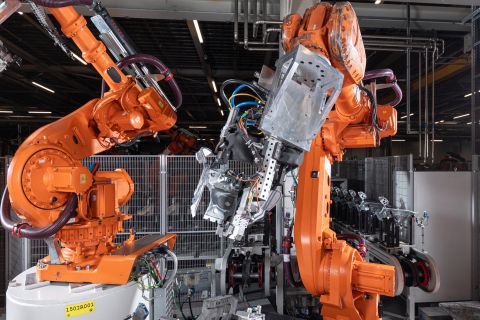
BMW equips established grippers with 3D-printed attachments and are already replacing complete gripper systems with weight-optimized bearing structures.
The BMW Group also employs grippers produced using the 3D printing process in chassis construction. As of recently, the first examples of a bionic robot gripper have been used. This gripper can hold and move the entire floor assembly of a BMW i4, reducing the weight of the complete gripper by 30% (50 kg).