
















Search History
Clear History
{{item.search_key}}
Hot Searches
Change
{{item.name}}
{{item.english_name}}
Subscribe eNews
Once A Week Once Every Two Weeks
{{sum}}
Login Register

Applications

Study warns PCR packaging growth falls behind PPWR 2030 targets

Borouge supports mono-material instant noodle bowl in Korea

KRAIBURG TPE’s sustainable series for sustainable robotic applications

Products

Chen Hsong establishes support hub in Indonesia

Fakuma 2026: Sumitomo (SHI) Demag to shine with all-electric solutions

BASF launches ReducedPCF Elastollan TPU portfolio

Activities

  • 350,000+ visitors! CHINAPLAS 2026 shatters every record in the book

  • CHINAPLAS 2026: 86,504 visitors explore innovations on Day 3

  • Must-attend events: Application in Focus and Additives Seminar

Pictorial

News Videos

Top 10 Technology Trends awards presented at CHINAPLAS 2026

MAAG x SIKORA: Smart pelletizing + precise inspection - More stable, carbon-reduced

CAI Machine: New visual inspection technology debut! More efficient, greener, colorful printing

Conference Videos

Driving systemic change: Unilever’s evolution in the circular economy

Interview with Director Global Sustainability Advocacy at Unilever

Interview: Thailand’s perspective on cross-border circular cooperation

Corporate/Product Videos

For Rubber & Plastic Extrusion Equipment, trust Hebei Zhongsen! Custom Extruders, Traction Machines & Vulcanizing Lines

Is Your Mold Supplier Really Giving You Peace of Mind?

Kurtz GmbH & Co.

Home > News > Medical

Polyimide-based nanoporous membrane used for developing reusable N95 masks

Source:Adsale Plastics Network Date :2020-06-16 Editor :VC

Surgical grade N95 mask’s filtration efficiency for sub-300 nanometers (nm) particles is around 85%. As the COVID-19 virus shows a diameter of around 65–125 nm, there is a need for developing more efficient masks.


A research team at Saudi Arabia's King Abdullah University of Science and Technology (KAUST) developed a flexible, replaceable nanoporous membrane to achieve a reusable N95 mask with enhanced filtration efficiency.

membrane_N95_web.jpg

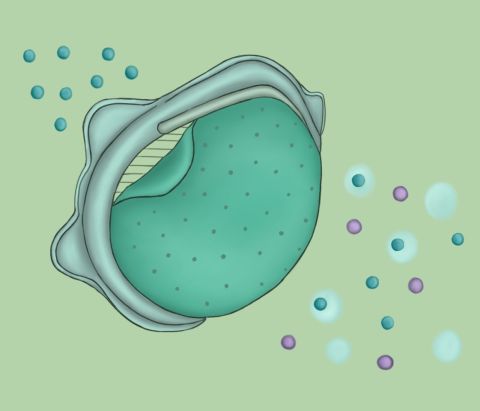
The nanoporous membrane is made to filter out COVID-19 virus (purple), allowing only clean air (blue) through. (Photo: ACS Nano)

N95_1_web.jpg

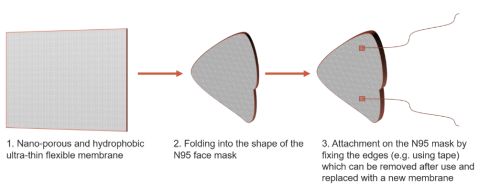
Schematic showing the use of the nanoporous membrane fabricated on an 8-in wafer on a reusable N95 mask after folding it. The membrane can be replaced after every use. (Photo: ACS Nano)


The membrane is polyimide-based. After a porous silicon template was placed over that membrane, a process called reactive ion etching was used to create an array of tiny pores within it.


The size of the pores ranged from 5 to 55 nm which is considerably smaller than COVID-19 virus. To allow for sufficient breathability, those pores were placed no farther than 330 nm apart from one another.


Polyimide has been widely used in aerospace and microelectronics applications and, more recently, in flexible electronics due to its excellent mechanical strength, thermal stability, and chemical properties over a wide range of temperatures (-20°C to 400°C).


N95_2_web.jpg

Polyimide thin layer coated on a 4-in silicon wafer and cured (left). Polyimide-based nanoporous membrane being released from the wafer (right).


Besides, the membrane is intrinsically hydrophobic (water-repelling), which contributes to antifouling and self-cleaning as a result of droplets rolling and sliding on the inclined mask area.


The membrane is simply applied to the surface of the m N95 ask before each use, then just peeled off and disposed of afterwards.


The research paper was recently published in the journal ACS Nano by American Chemical Society (ACS).

 Like 丨  {{details_info.likes_count}}
Face mask

The content you're trying to view is for members only. If you are currently a member, Please login to access this content.   Login

Source:Adsale Plastics Network Date :2020-06-16 Editor :VC

Surgical grade N95 mask’s filtration efficiency for sub-300 nanometers (nm) particles is around 85%. As the COVID-19 virus shows a diameter of around 65–125 nm, there is a need for developing more efficient masks.


A research team at Saudi Arabia's King Abdullah University of Science and Technology (KAUST) developed a flexible, replaceable nanoporous membrane to achieve a reusable N95 mask with enhanced filtration efficiency.


membrane_N95_web.jpg

The nanoporous membrane is made to filter out COVID-19 virus (purple), allowing only clean air (blue) through. (Photo: ACS Nano)


N95_1_web.jpg

Schematic showing the use of the nanoporous membrane fabricated on an 8-in wafer on a reusable N95 mask after folding it. The membrane can be replaced after every use. (Photo: ACS Nano)


The membrane is polyimide-based. After a porous silicon template was placed over that membrane, a process called reactive ion etching was used to create an array of tiny pores within it.


The size of the pores ranged from 5 to 55 nm which is considerably smaller than COVID-19 virus. To allow for sufficient breathability, those pores were placed no farther than 330 nm apart from one another.


Polyimide has been widely used in aerospace and microelectronics applications and, more recently, in flexible electronics due to its excellent mechanical strength, thermal stability, and chemical properties over a wide range of temperatures (-20°C to 400°C).


N95_2_web.jpg

Polyimide thin layer coated on a 4-in silicon wafer and cured (left). Polyimide-based nanoporous membrane being released from the wafer (right).


Besides, the membrane is intrinsically hydrophobic (water-repelling), which contributes to antifouling and self-cleaning as a result of droplets rolling and sliding on the inclined mask area.


The membrane is simply applied to the surface of the m N95 ask before each use, then just peeled off and disposed of afterwards.


The research paper was recently published in the journal ACS Nano by American Chemical Society (ACS).

全文内容需要订阅后才能阅读哦~
立即订阅

Recommended Articles

Medical
Medical Plastics Conference hails local innovation and global standards
 2026-04-22
Medical
CHINAPLAS 2026: An array of cutting-edge solutions for medical device production
 2026-04-21
Medical
Report: Innovative Plastics Technologies Propel Medical Device Advancement
 2026-03-24
Medical
Dr. Boy machines to demonstrate high-precision medical components at CHINAPLAS 2026
 2026-03-09
Medical
Syensqo joins MedTech Innovator to support next generation medical device innovation
 2026-02-24
Medical
Syntegon launches AIM9 high-speed inspection platform for pharmaceutical sector
 2026-02-23

You May Be Interested In

Change

  • People
  • Company
loading... No Content
{{[item.truename,item.truename_english][lang]}} {{[item.company_name,item.company_name_english][lang]}} {{[item.job_name,item.name_english][lang]}}
{{[item.company_name,item.company_name_english][lang]}} Company Name    {{[item.display_name,item.display_name_english][lang]}}  

Polyurethane Investment Medical Carbon neutral Reduce cost and increase efficiency CHINAPLAS Financial reports rPET INEOS Styrolution Evonik Borouge Polystyrene (PS) mono-material Sustainability Circular economy BASF SABIC Multi-component injection molding machine All-electric injection molding machine Thermoforming machine

Polyimide-based nanoporous membrane used for developing reusable N95 masks

识别右侧二维码,进入阅读全文
下载
x 关闭
订阅
亲爱的用户,请填写一下信息
I have read and agree to the 《Terms of Use》 and 《Privacy Policy》
立即订阅
Top
Feedback
Chat
News
Market News
Applications
Products
Video
In Pictures
Specials
Activities
eBook
Front Line
Plastics Applications
Chemicals and Raw Material
Processing Technologies
Products
Injection
Extrusion
Auxiliary
Blow Molding
Mold
Hot Runner
Screw
Applications
Packaging
Automotive
Medical
Recycling
E&E
LED
Construction
Others
Events
Conference
Webinar
CHINAPLAS
CPS+ eMarketplace
Official Publications
CPS eNews
Media Kit
Social Media
Facebook
Linkedin