











World-first global supply chain for renewable plastics used in Sony’s products

Audio-visual equipment involves a wide variety of plastics, resulting in a complex supply chain that makes it difficult to visualize and manage the entire flow from raw materials. Additionally, plastic components that require high performance in terms of flame resistance and optical properties cannot be fully replaced with plastics produced through material recycling, hindering the use of virgin fossil-based plastics in such products.
To address these challenges, a global supply chain, involving 14 companies across five countries and regions, is established for the production of renewable plastics that can be used in Sony's high-performance audio-visual products.
This world’s first global supply chain includes Sony, Mitsubishi, ADEKA, CHIMEI, ENEOS, Formosa Chemicals & Fibre, Hanwha Impact, Idemitsu Kosan, Mitsui Chemicals, Neste, Qingdao Haier New Material Development, SK Geo Centric, Toray Industries, and Toray Advanced Materials Korea.
The various plastic materials manufactured through this supply chain are slated for use in Sony's products that will be launched worldwide.
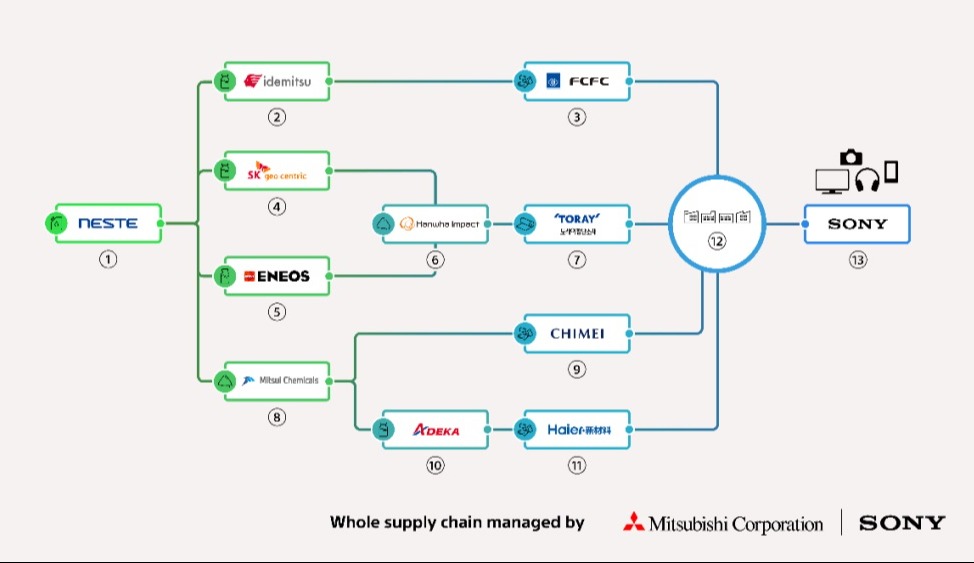
Overview of the entire supply chain
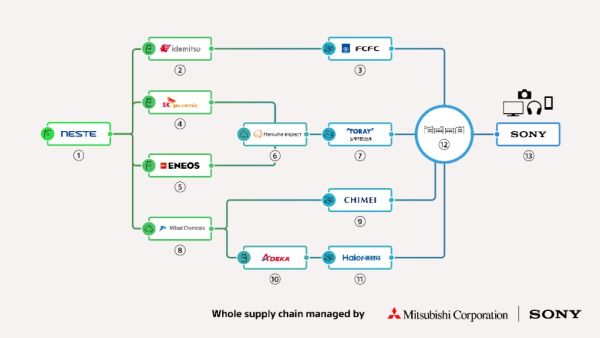
Production of renewable naphtha — Neste
Production of renewable styrene monomer — Idemitsu Kosan
Production of renewable polystyrene resin — Formosa Chemicals & Fibre
Production of renewable para-xylene — SK Geo Centric
Production of renewable para-xylene — ENEOS
Production of renewable terephthalic acid — Hanwha Impact
Production of renewable PET resin — Toray Advanced Materials Korea
Production of renewable bisphenol-A — Mitsui Chemicals
Production of renewable polycarbonate (PC) resin — CHIMEI
Production of renewable flame retardants — ADEKA
Production of renewable PC/ABS resin — Qingdao Haier New Material Development
Molding manufacturers
Design and manufacturing of finished products — Sony
A big step to transition to renewable plastics and emission reduction
The supply chain enables the production of multiple types of renewable plastics from biomass resources with a mass balance approach. This allows Sony to proactively source raw materials for its products with the quality and properties equivalent to virgin fossil-based plastics.
Defining the supply chain helps the companies track and document GHG (Greenhouse Gas) emissions data over the supply chain in a verifiable way, allowing participating companies to leverage the data to advance efforts to reduce their carbon footprint going forward.
This initiative involving wide-ranging partners is also part of the “Creating NEW from reNEWable materials” project, jointly launched by Sony, which aims to achieve zero usage of virgin fossil-based plastics through the introduction of renewable plastics, and Mitsubishi.
Sony, Mitsubishi, and the supply chain partners will continue to actively promote the introduction of renewable plastics for high-performance products such as audio-visual products.
Watch more: Sony’s “Creating NEW from reNEWable materials” project introduction