














Dramatic slowdown in Europe’s transition to a circular plastics system

Plastics Europe published its biennial report “The Circular Economy for Plastics: A European Analysis”, presenting the latest (year 2024) data and insights into Europe’s circular plastics transition, including trends in circular plastics production, conversion, consumption, and trade, as well as data on waste management.
The report’s key finding is that the pace of Europe’s transition has slowed dramatically amid increased global competition.
Europe’s annual growth in circular production has declined sharply from 13.6% in 2022 to only 1.2% in 2024, resulting in 8.7 Mt in circular output (or 15.8% of total production). By contrast, annual growth in global circular plastics production has accelerated from 5% to 7.7%.
Completing the picture, European converter demand for circular plastics is also losing momentum, falling from 16.2% annual growth in 2022 to 4% in 2024.
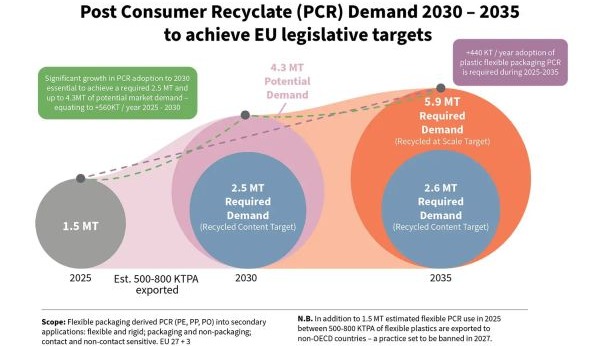
Similar research findings: Global post-consumer recycled packaging falls behind PPWR 2030 targets
Europe is exporting waste but importing recycled materials
New data on trade also highlights the significant dependence of Europe’s plastics transition on external value chains: 19% of converter demand for circular plastics was met through imports, and 12.4% of Europe’s collected waste is recycled in other regions.
Europe’s dependence on imports is even greater for fossil-based plastics, with 25% of converter demand being met from abroad.
“As a result of high energy and feedstock prices, emissions costs and a lack of fair trade, Europe’s plastics manufacturers are in survival mode. Our value chain cannot make the necessary investments in circularity,” said Rob Ingram, President of Plastics Europe and CEO of Ineos Olefins & Polymers Europe.
Gulf crisis exposed: European circular plastics economy is non-negotiable
Europe still maintains the largest share of circular plastics (15.8%) in relation to its total production mix. However, its ongoing leadership has been driven primarily by a sharp decline in fossil-based plastics production, which fell by 8.3% to 43.3 Mt between 2022 and 2024.
“The Gulf crisis has reinforced how exposed Europe is to fossil-resource shocks, and that a strong European circular plastics economy is not a nice-to-have; it’s non-negotiable. It’s time to reclaim ownership of our circular economy, starting with keeping and using strategic resources in Europe,” Virginia Janssens, Managing Director of Plastics Europe, urged.
While recycling rates have improved to 29.6%, over 70% of Europe’s collected plastic waste – a valuable circular feedstock that could reduce Europe’s dependence on fossil resources – continued to be sent to incineration (16.0 Mt, 48.9%) and landfill (7.0 Mt, 21.5%) in 2024.
Problem? Lack of market signals, scale and speed
Despite the European Commission recognising the strategic importance of the plastics manufacturing sector in the Industrial Accelerator Act, current EU policy frameworks lack the market signals, scale and speed required to reverse current trends.
Urgent action is needed at EU and national levels to restore industry’s competitiveness and unlock investment in circular plastics at scale.
This must address Europe’s energy and emissions cost crisis, ensure fair trade and a level playing field, and foster strong market demand for circular plastics through ambitious market pull measures, unlocking the economic power of a harmonized single market.
“We must create the business case for circular plastics in Europe, by making it economically attractive to keep and recycle our plastic waste,” Janssens added.
She concluded: “Europe is home to many of the world’s most innovative and forward-thinking plastics manufacturers and has been a frontrunner in the transition to a circular plastic system. With the right support, we can create a thriving circular plastics system that underpins the next generation of industry in Europe and ensures its economic resilience and security.”